
How to Move From Texting to a Phone Call Before a First Date
Want to talk before you meet? Use a practical checklist to decide whether to ask, suggest a brief call, choose a comfortable channel, and handle yes, later, no, or silence without pressure.

Quick Answer
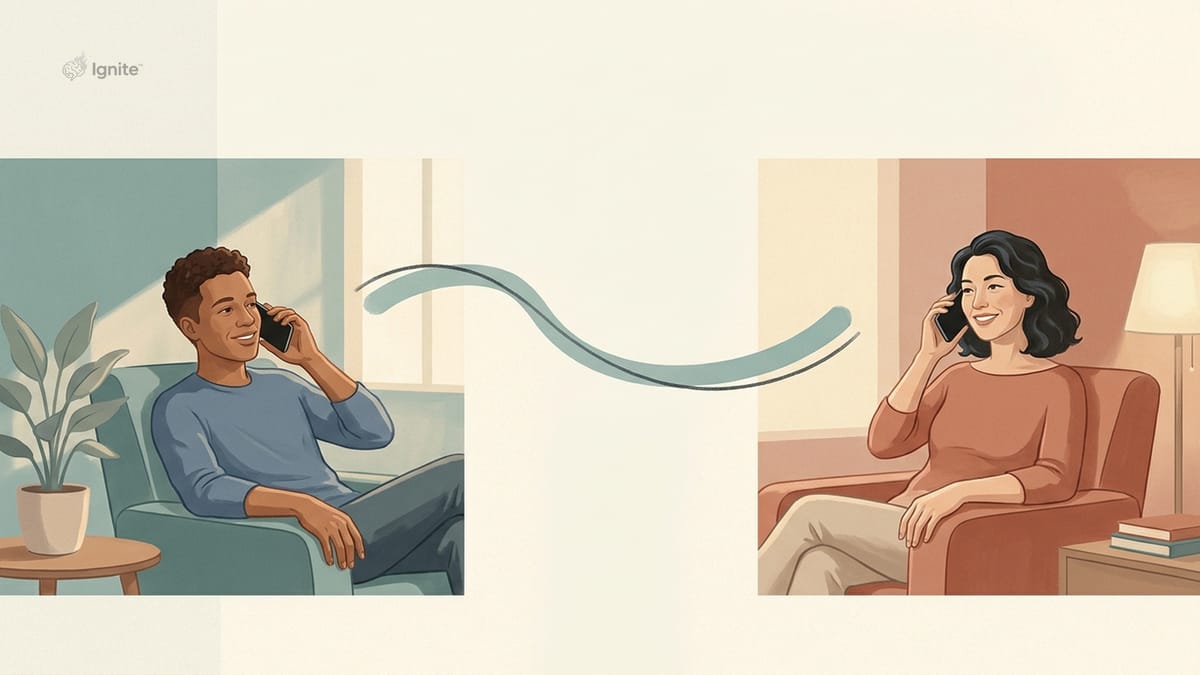
Ask with a friendly invitation tied to your conversation: “I’ve enjoyed chatting. Would you be up for a quick call tomorrow evening? Happy to keep texting if you prefer.” If they agree, choose a time and a channel you both feel comfortable using. A call is optional; it does not prove compatibility or replace first-date safety precautions.
The texts feel easy, but you are unsure how to ask for a phone call before a first date. You want to hear their voice, but you do not want to sound demanding or turn the chat into an interview.
You do not need a perfect line. You need to know what you are asking for, leave room for a real choice, and follow the answer. The HeartSpark™ communication framework puts that context—your goal, timing, tone, and boundaries—before wording.
Use this checklist before sending an invitation. Required means needed for the path you choose, not that everyone must call. Recommended items help but can be adapted. Conditional items apply only to the named situation. Optional items are personal preferences.
Decide what you want from a pre-date call
A call can be a chance to continue a conversation before meeting. It does not need to become a test that someone must pass.
Your goal might be simple: “I would enjoy talking live before we decide about coffee.” Or a date may already be planned, and you would like a brief chat first.
This checklist covers the invitation, the response, and a simple way to begin and end the call. It is not a background check or a way to predict chemistry. It cannot establish identity or guarantee safety.
The outcome is a clear next step: ask, wait, skip the call, or stop. If you both want to call, the outcome becomes an agreed time and channel. Deciding not to call can be just as complete.
Check whether a call fits both of you
This is for adults texting a potential first date, whether a meeting is still an idea or already arranged. Look at the current exchange, not just its best moment. Are both people adding something, asking questions, or returning to a shared topic?
There is no message count to complete before you may ask. Equally, a lively chat does not mean someone has agreed to talk by phone.
Text preferences, phone anxiety, disability, and language needs deserve room. You can offer another way to communicate without asking someone to explain a personal need.
Do not use this checklist to pursue someone who has declined contact. If you face pressure, threats, or troubling behavior, stop and use the platform’s block or report tools as appropriate. Seek qualified local support when needed, and emergency help for immediate danger.[1]
Set your boundaries before you ask
You do not need a paid tool or a HeartSpark™ account. Start with these basics:
- Required: Decide whether you actually want a call, rather than feeling that dating advice demands one.
- Required: Know what contact details you are comfortable sharing.
- Recommended: Have a realistic time window you could offer.
- Recommended: Pick one real topic from the chat to carry forward.
- Optional: Suggest a short length if that would make the invitation clearer.
- Conditional, if you both agree: Choose a working voice channel you can both use comfortably.
A call does not have to mean exchanging phone numbers. If your dating app offers calling, check that the feature is available and review what it shares. Do not assume every app offers it or hides the same details. Solace’s dating safety guidance supports going at your own pace and using a pre-meeting call if it helps you feel more comfortable.[2]
Do not call while the time or channel is unresolved. A privacy concern or a stated no also blocks that step. It does not automatically end a text conversation you both still want.
Choose whether to ask
These checks are for your own decision, not a score for the other person.
- [ ] Required: Name your preference. You can explain why you would like a call without claiming it will reveal their feelings.
- [ ] Recommended: Identify one shared topic. You have a real detail to return to, rather than a list of screening questions.
- [ ] Required: Check for an expressed boundary. If they have declined a call or asked to slow down, you do not send another call request.
If a call is your preference but not a condition of meeting, say so. If you only feel comfortable meeting after a call, you can state that boundary too:
“I’m more comfortable having a short call before meeting. Would that work for you?”
They remain free to decline. You remain free not to meet. Neither person needs to persuade the other to abandon a boundary.
Send an invitation that leaves room for no
Use plain language that sounds like you. These are examples to adapt, not lines proven to produce a yes.
- [ ] Conditional, if inviting: Write one clear question. The message asks whether they want a call; it does not announce that you will call.
- [ ] Recommended, if inviting: Suggest a flexible time window. They can accept it or offer another time.
- [ ] Required, if inviting: Leave a genuine choice. A no or a preference to keep texting will not trigger an argument.
- [ ] Conditional, if asking: Send the invitation once. You have made the request without stacking more messages onto it.
A shared-topic version might be:
“I’d love to hear the rest of that concert story. Up for a quick call tomorrow evening? Texting here is fine too.”
If a date is already planned:
“Looking forward to Saturday. Would you like a short call before then, or shall we save the chat for coffee?”
You can suggest ten minutes if you both like a short starting point. That is an example, not an ideal length or a rule.
Only offer options you genuinely accept. “No pressure” does not make a request low pressure if you keep pushing afterward.
Handle their reply
If they say yes
An accepted idea still needs a plan.
- [ ] Conditional, if accepted: Agree on a time. Both people have confirmed when; include a time zone if needed.
- [ ] Conditional, if accepted: Agree on a channel. Both know where the call will happen and are comfortable using it.
- [ ] Conditional, if the service is unfamiliar: Inspect its disclosure settings. Check what number or profile details the other person can see before using it.
For example: “Great—would tomorrow at 7 p.m. Eastern work? Which way would you feel comfortable calling?”
Keep control of your personal information. RAINN advises against sharing a phone number or other private details before trust develops, and against pressure to move off a dating platform too soon.[1]
If no channel suits both of you, do not force one. Keep texting if you both want to, or leave the call aside.
If they say “later”
- [ ] Conditional, if they say later: Leave the call unbooked until a time is agreed. “Busy this week” is not an appointment.
If they suggest another time, confirm it if it works. Without an alternative, “No problem—let me know if you’d like to find a time” leaves the choice open. It does not create a deadline or a reminder schedule.
If they decline or prefer text
- [ ] Conditional, if they decline: Acknowledge the preference. Your reply does not argue or demand an explanation.
“Sure, happy to keep chatting here” works if that is true for you. If a call matters to your own comfort, acknowledge the mismatch without asking them to prove anything.
If there is no answer
- [ ] Conditional, if there is no answer: Keep the call unconfirmed. You do not place a surprise call or treat silence as agreement.
You do not know the reason for the silence. You do know that a call has not been arranged. Do not keep rewriting the same request to overcome an answer you have not received.
If you both agree, keep the call simple
The aim is to talk, not conduct an assessment.
- [ ] Optional, after agreement: Choose an easy opening topic. You have something from the existing chat to ask about.
- [ ] Conditional, when the call starts: Check that now still works. If it does not, end the call or agree on another time.
- [ ] Conditional, near the agreed end: Offer to wrap up. You do not assume the other person wants to continue.
- [ ] Conditional, if meeting remains of interest: Confirm the date separately. Both people agree to the meeting rather than treating the call as a commitment.
“Hey, is now still a good time?” is enough to begin. Then return to that concert story or another shared topic. You do not need questions designed to expose flaws or demand personal disclosure.
To finish: “I’ve enjoyed talking. I said I’d keep this short, so shall we wrap up?” You can both choose to continue, but neither owes extra time.
Use the labels without turning dating into a scorecard
The order matters in a few places: check boundaries before asking, get agreement before calling, and confirm a meeting separately.
Your availability, privacy settings, and opening topic can be considered independently. An exact call length and a prepared topic can be skipped. Agreement and comfort with the chosen channel cannot.
A preference for text may lead to a different path, not a failed check. If a practical detail is missing, clarify it only when the call is welcome. If willingness is missing, better logistics will not fix that.
Know whether you have a decision, an invitation, or a booking
Use these simple completion checks:
| Stage | What “done” means |
|---|---|
| Your choice | You have chosen to ask, wait, skip, or stop. |
| Your invitation | You have asked clearly and left room for a real answer. |
| Their response | Your next action matches what they actually said—or leaves an unanswered request open. |
| A booked call | Both people have agreed on a time and channel. |
| Call follow-through | You checked that the timing still worked and respected the choice to end. |
Each person owns their participation. Either can change their mind. There is no outside signoff, required screenshot, recording, or transcript to collect.
If the plan is incomplete, name the missing detail: “We haven’t picked a time yet.” Leave it unbooked until that changes. You do not need to assign the other person a deadline.
Catch assumptions before they become pressure
These are possible oversights to check, not claims about what most daters do. One risk is treating several separate choices as a single yes.
| Assumption to catch | What to check instead |
|---|---|
| “They gave me their number, so I can call now.” | Did they agree to a call at this time? If not, ask first. |
| “They said later, so we have a plan.” | Has a time actually been agreed? If not, leave it open. |
| “Seven means the same time for both of us.” | If you are in different zones, confirm which one you mean. |
| “This service keeps my number private.” | Inspect its current disclosure settings before using it. |
| “The call went well, so meeting must be safe.” | Keep first-meeting precautions separate from how the call felt. |
RAINN notes that no action can guarantee safety. If you meet, choose a public, populated place, share your plans with someone you trust, and control your own transport. Harm is never the victim’s fault.[1]
Make one final check, then follow the actual answer
- [ ] Required: Match your next action to the actual response. Do not substitute a guess about their motives.
- [ ] Conditional, if a call is booked: Confirm the agreed time and channel. No unwanted disclosure or unresolved boundary is being overlooked.
- [ ] Conditional, if a call is declined or unconfirmed: Leave it unbooked. Do not treat a no or silence as permission.
- [ ] Conditional, if meeting is next: Make a separate plan. Keep first-date safety precautions in place.
You should be able to say: “I have chosen a next step that respects both of us. If we are calling, we have agreed when and how.”
If something required is missing, do not call yet. Resolve a welcome practical question, return to text, or stop. Recheck only when plans, preferences, or availability change—not to reinterpret the same silence.
If you both feel ready to meet, use this guide on when to ask someone out. A call does not commit either person to a date.
Key Takeaway
A useful invitation gives both people a choice. Success is a clear, respectful next step—not getting a phone call at any cost.
Continue Exploring
If the conversation feels warm but directionless, explore why dating-app conversations lose momentum. A call is one possible next step, not a repair for one-sided participation.
Frequently Asked Questions
How long should we text before I suggest a call?
Use the current conversation, not a fixed number of days or messages. If both people are participating and you would like to talk, you can ask. If a boundary has been expressed or you feel rushed, wait or stop.
Do I have to give out my phone number?
No. You can keep your number private. If a mutually suitable option exists, check its current settings before using it. If no option feels comfortable to both of you, you do not have to arrange a call.
Does declining a call mean they are not interested?
A declined call does not tell you why someone said no. You can respect the preference and decide what works for you without demanding an explanation. If you need a call before meeting and they do not want one, it is okay not to meet.