Attachment Styles in Dating: The Practical Guide (Not Pop Psychology)
Learn how attachment styles in dating influence communication, conflict, and relationship decisions—and how behavioral awareness improves outcomes.

Have you ever found yourself thinking:
- "Why do I always attract the same type of person?"
- "Why do I pull away when things get serious?"
- "Why do I become anxious when someone doesn't text back?"
- "Why does every relationship seem to follow the same script?"
Most people assume the answer is bad luck.
Others blame compatibility.
But often the explanation is behavioral.
Many dating decisions are influenced by attachment patterns that operate below conscious awareness.
Understanding those patterns can dramatically improve relationship outcomes.
What Are Attachment Styles?
Attachment styles are recurring behavioral patterns that influence how people:
- connect with others
- handle emotional closeness
- respond to conflict
- manage uncertainty in relationships
They are not personality types.
They are not permanent labels.
And they should not be used as excuses for unhealthy behavior.
Instead, think of attachment styles as behavioral tendencies that influence decision-making in relationships.
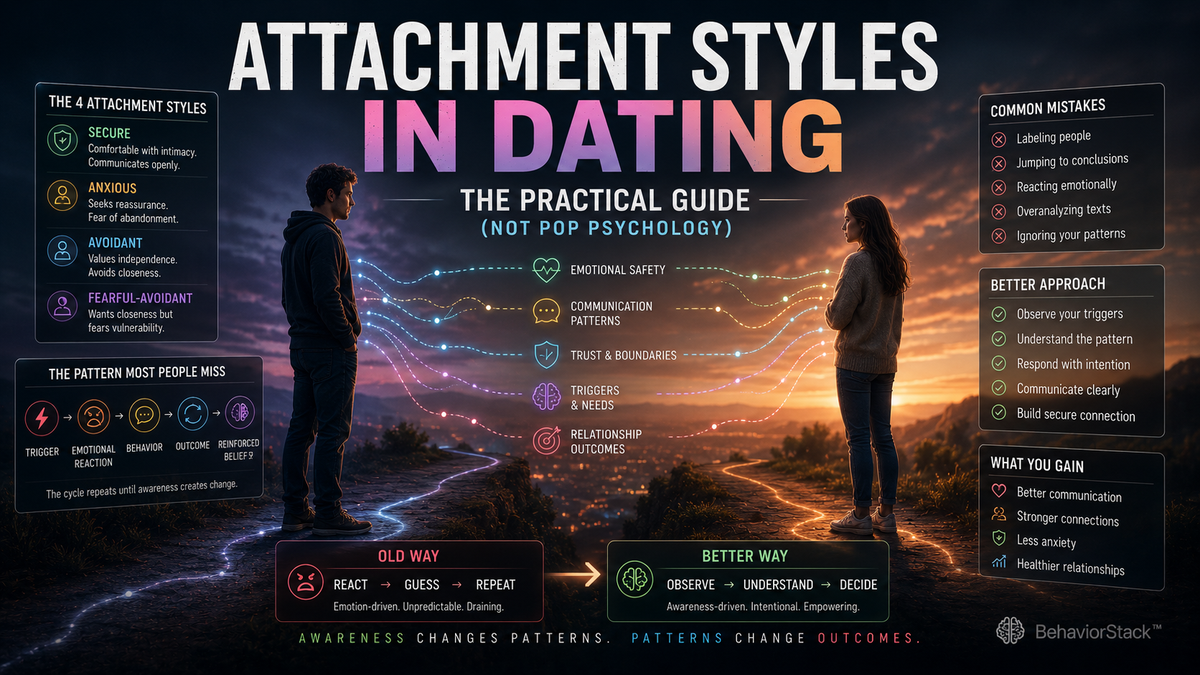
The four most commonly discussed attachment patterns are:
- Secure
- Anxious
- Avoidant
- Fearful-Avoidant
Most people display characteristics from more than one category depending on circumstances and relationship dynamics.
The Problem With Pop Psychology
Social media has turned attachment styles into labels.
People often hear things like:
- "He's avoidant."
- "She's anxious."
- "That's just my attachment style."
The problem is that labels rarely improve decisions.
Behavior does.
A healthier question is not:
"What attachment style am I?"
A more useful question is:
"What behaviors keep creating the same outcomes?"
That shift moves the focus from identity to awareness.
How Attachment Patterns Show Up In Real Life
Anxious Tendencies
People may:
- seek frequent reassurance
- overanalyze communication
- fear rejection
- assume the worst when uncertainty appears
Avoidant Tendencies
People may:
- withdraw during conflict
- value independence excessively
- struggle with vulnerability
- create emotional distance
Secure Tendencies
People are more likely to:
- communicate directly
- tolerate uncertainty
- set healthy boundaries
- resolve conflict constructively
Fearful-Avoidant Tendencies
People may alternate between:
- seeking closeness
- creating distance
This can create confusing relationship dynamics.
Why Attachment Styles Matter
Relationship success is often less about compatibility than people think.
It is frequently influenced by:
- communication patterns
- emotional regulation
- timing
- conflict management
- behavioral awareness
Without understanding these patterns, people often repeat the same mistakes.
This can lead to:
- repeated relationship cycles
- unnecessary conflict
- emotional exhaustion
- poor partner selection
The Pattern Most People Miss
Many dating outcomes follow a predictable cycle:
Trigger
↓
Emotional Reaction
↓
Behavior
↓
Outcome
↓
Reinforced Belief
For example:
A delayed text creates anxiety.
An anxious message is sent.
The other person pulls away.
The withdrawal confirms the original fear.
The cycle repeats.
Most people focus on the outcome.
Few people examine the pattern.
Old Way vs Better Way
Old Way
React → Assume → Repeat
Examples:
- Jumping to conclusions
- Overanalyzing messages
- Withdrawing without explanation
- Seeking constant reassurance
Better Way
Observe → Understand → Decide
Examples:
- Recognizing emotional triggers
- Evaluating evidence before reacting
- Communicating intentions clearly
- Responding thoughtfully instead of emotionally
A Practical Example
Instead Of:
Seeing a delayed text and immediately assuming:
"They are losing interest."
Then sending multiple follow-up messages.
You Can:
Recognize the emotional reaction.
Pause.
Evaluate context.
Communicate intentionally.
Results
- Less anxiety
- Better communication
- Stronger trust
- Healthier relationship dynamics
How To Improve Attachment Awareness
Instead of focusing on labels, focus on:
Awareness
What situations consistently trigger emotional reactions?
Patterns
What behaviors repeatedly create poor outcomes?
Intent
Are your actions helping the relationship or protecting a fear?
This is where systems like BehaviorStack™ begin to matter.
This is where systems like BehaviorStack™ begin to matter. Behavioral awareness helps identify recurring patterns before they become recurring problems. HeartSpark™ applies this behavioral framework to dating, communication, and relationship decisions—helping people respond with greater awareness and intention.
Behavioral awareness helps identify recurring patterns before they become recurring problems.
Why This Gives You An Edge
Most people approach dating emotionally.
Very few approach it behaviorally.
Understanding attachment patterns allows you to:
- communicate more effectively
- recognize emotional triggers
- improve relationship decisions
- create healthier interactions
The goal is not to become a different person.
The goal is to become more aware of the patterns shaping your decisions.
Attachment styles are often misunderstood.
They are not labels that determine your future.
They are behavioral tendencies that influence how people think, react, and connect.
The people who develop awareness of those patterns gain a significant advantage in relationships.
Because healthier relationships rarely come from better labels.
They come from better decisions.
CONTINUE EXPLORING
👉 Learn more about:
What Is BehaviorStack™? The Framework Behind Smarter Decisions
👉 Read next:
How to Know What to Say: A Better Way to Start Conversations
👉 Explore:
How to De-Escalate a Text Argument in 5 Messages or Less
👉 Try: