BehaviorStack™ vs LLM: What’s the Real Difference?
BehaviorStack vs LLM explained: understand the difference between generating responses and making high-probability decisions.

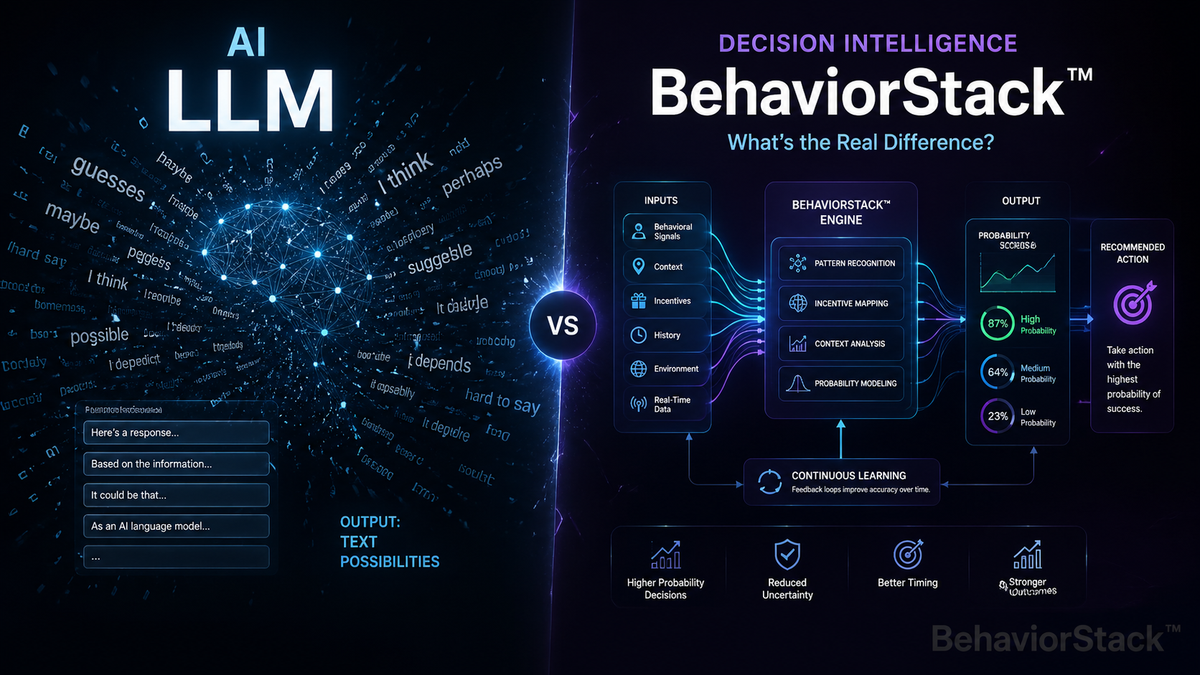
Artificial intelligence is evolving rapidly—but not all AI is designed for the same purpose.
Large Language Models (LLMs) have transformed how we generate content, answer questions, and interact with machines.
But there’s a critical gap:
They generate responses—
They don’t guide decisions.
That’s where BehaviorStack™ comes in.
What Is an LLM?
A Large Language Model (LLM) is an AI system trained on massive datasets of text to generate human-like responses.
It works by:
- Predicting the next word in a sequence
- Learning patterns in language
- Generating coherent, context-aware text
LLMs power:
- Chatbots
- Content generation tools
- Virtual assistants
They are extremely effective at communication—but not necessarily at decision-making.
What Is BehaviorStack™?
BehaviorStack™ is a behavior-driven decision intelligence framework designed to guide smarter actions.
It analyzes:
- Behavioral patterns
- Incentives and emotional drivers
- Context and timing
- Probability-weighted outcomes
…and turns them into structured, decision-ready insights.
👉 To understand the full framework, see:
What Is BehaviorStack™? The Framework Behind Smarter Decisions
Why This Difference Matters
Most AI tools today focus on generating outputs.
This leads to:
- Decisions based on surface-level responses
- Lack of real-world grounding
- Inconsistent results
In high-impact areas—like trading, communication, or timing—this gap becomes critical.
Key Differences: BehaviorStack™ vs LLM
| Dimension | LLM (Large Language Model) | BehaviorStack™ |
|---|---|---|
| Core Function | Generates text | Guides decisions |
| Input Type | Language patterns | Behavioral signals + context |
| Output | Words, responses | Probability-weighted actions |
| Intelligence Type | Linguistic | Behavioral + decision-based |
| Strength | Fluent communication | High-probability outcomes |
| Weakness | No behavioral grounding | Depends on signal quality |
Common Mistakes With AI
Most people:
- Assume AI “knows” what’s best
- Trust fluent responses as accurate
- Use AI outputs without validating outcomes
This results in decisions driven by confidence—not probability.
How to Improve AI-Driven Decisions
Instead of relying on generated responses, focus on:
- Behavioral signals
- Context awareness
- Outcome probability
This is where BehaviorStack™ becomes critical.
LLMs generate possibilities.
BehaviorStack™ identifies what is most likely to work.
How BehaviorStack™ Works
Step 1: Signal Collection
Behavioral and contextual signals are gathered.
Step 2: Pattern Recognition
Data is analyzed to identify meaningful behavioral patterns.
Step 3: Probability Modeling
Possible outcomes are ranked based on likelihood.
Step 4: Decision Output
Users receive structured insights designed to guide action.
Old Way vs. Better Way
Old Way
Prompt → Response → Guess
Better Way
Signal → Insight → Higher-Probability Decision
Real-World Applications
Instead of:
- Guessing when to enter a trade
- Overthinking what to say
- Acting on incomplete information
You can:
- Make market decisions based on behavioral signals
- Communicate with higher response probability
- Act with confidence backed by structured insight
Result:
- More consistent outcomes
- Reduced uncertainty
- Improved decision quality
Why This Creates an Advantage
Most AI—and most people—optimize for:
What sounds right
BehaviorStack™ optimizes for:
What is most likely to work
That shift is what separates response generation from decision intelligence.
How Ignite Platform™ Uses BehaviorStack™
BehaviorStack™ serves as the behavioral decision-intelligence layer within Ignite Platform™.
Ignite Platform™ combines the communication capabilities of large language models with BehaviorStack™ technology to structure behavioral signals, evaluate context, compare probable outcomes, and produce actionable guidance.
Within this architecture:
- LLMs interpret information and generate natural-language responses.
- BehaviorStack™ evaluates behavior, context, timing, and probability.
- Ignite Platform™ brings these capabilities together within practical decision applications.
BehaviorStack™ technology powers applications across the Ignite Platform™ ecosystem:
- HeartSpark™ → communication, dating, and relationship intelligence
- MarketSpark™ → behavior-informed market and trading decisions
Each application follows the same principle:
Better signals → Better insights → Better decisions
Related Topics and Next Steps
Continue exploring:
- Why Timing Matters in Decision-Making
- How to Read Market Behavior: The Hidden Signals Most Traders Miss
- The Future of Behavioral Decision Intelligence: Why BehaviorStack™ Matters
Explore the tools: