Dating Profile Photos vs Prompts: What Creates Better Conversations?
Photos decide whether someone stops; prompts decide what they can say. A stage-by-stage, research-grounded comparison of the two profile elements — and a simple way to tell which one is limiting your conversations.

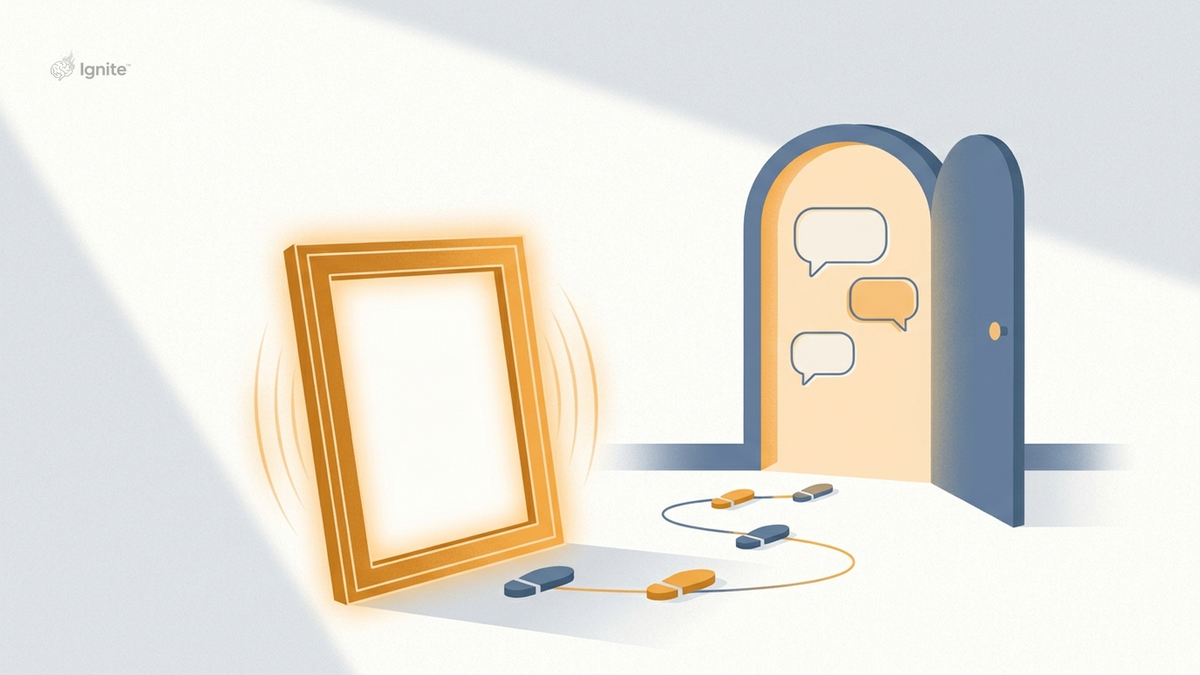
They do different jobs. Photos largely decide whether someone stops and engages with your profile; prompts and written answers largely decide what that person can say to you. Eye-tracking research finds people spend the most time reading profile text, yet photos carry the strongest impression. For better conversations, fix whichever stage is failing — usually the weaker prompt answers.
You know the pattern. The matches arrive — not a flood, but enough — and then the conversations open with “hey,” drift through three exchanges, and quietly die. So you blame the profile, as if it were one thing, and start another round of the same unresolved argument with yourself: do I need better photos, or better answers?
Every corner of the internet has a confident take. One thread says nobody reads prompts. Another insists prompts are the only thing standing between you and a meaningful connection. Most of the numbers quoted in these debates trace back to nothing.
Here is the more useful frame: photos and prompts are not competing versions of the same job. They do different jobs at different stages between a stranger noticing you and a real conversation happening. Once you see which job belongs to which element, the question changes from “which matters more?” to “which one is failing in my case?” — and that question has a practical answer.
The Real Question Behind “Photos vs Prompts”
On the surface this looks like a single decision: where should your next hour of profile effort go? Underneath it are two precise, genuinely comparable options.
Option A is your photo set — the lead photo plus the supporting shots behind it. Option B is your written profile — prompt answers on apps like Hinge or Bumble, or the bio text on swipe-first apps. Both are inputs you control, both sit on the same profile, and both influence the same outcome. That makes them comparable. What makes the comparison worth doing carefully is that they influence the outcome at completely different points.
The reader this is written for is not chasing a match count. The goal is better conversations — exchanges with some substance that have a chance of becoming a date. So we will judge photos and prompts against that goal, not against raw attention. One boundary up front: this comparison covers profile inputs only. What you do inside a conversation after the opener is a separate skill with its own failure modes, and paid app features are out of scope.
How We’ll Judge: The Four Stages a Profile Has to Survive
A profile is not judged once. It is judged in sequence, and each stage has its own standard:
- Stopping power. Does the element get the profile noticed at all? No attention, no conversation — this is the entry gate.
- Impression depth. Once someone is looking, what judgment forms? This determines whether attention converts into a like or match with actual intent behind it.
- Opener fuel. Does the element give a match something specific to say? Conversation quality is bounded by the material available to open with — “hey” is what happens when a profile supplies nothing.
- Fit filtering. Does the element attract the right people and quietly deter the wrong ones? Better conversations come from better-fit matches, not more matches.
Photos and prompts will be scored against all four stages using the same evidence standard: peer-reviewed research where it exists, documented platform mechanics where it doesn’t, and clearly labeled reasoning everywhere else.
Photos vs Prompts at a Glance: Who Does What
| Decision criterion | Profile photos | Prompt answers |
|---|---|---|
| Stopping power (getting noticed) | Decisive — the lead photo gates everything downstream | Invisible until the profile earns a look |
| First impression | Strongest single impact on the impression formed | Gets the most viewing time; deepens or erodes the impression |
| Opener fuel | Only when photos show context — activities, places, pets | The primary source of specific, commentable threads |
| Fit filtering | Weak — signals lifestyle, rarely values or intent | Strong — carries humor, values, and what you’re looking for |
| Effort to improve | Higher — new shots, better light, maybe a friend with a camera | Lower — a focused rewrite in one sitting |
| Shelf life | Months to years, until you visibly change | Until the answers stop sounding like you |
The clearest distinction: photos dominate the front of the pipeline — attention and first impression — while prompts dominate the back, where a match decides what to say and whether you seem like their kind of person. So the conditional takeaway writes itself: if engagement is scarce, photos are the gate to fix; if engagement exists but conversations are thin, prompts are the gate. Platform-reported engagement statistics circulate widely, but their methodology is rarely public, so no verdict here depends on them.
Photos vs Prompts, Stage by Stage
Which One Gets You Noticed?
Photos, and it is not close. On every major app, the lead photo is the first thing evaluated and often the only thing evaluated before a decision. Research on online dating profiles has long treated photo presence as a baseline requirement: in early large-scale profile studies, simply having a photo was a major predictor of how much contact a user received, especially for women (Fiore et al., 2008, citing Fiore & Donath, 2005). Nothing about swipe-based design has weakened that gate.
Prompts, by contrast, are structurally invisible at this stage. No one has ever swiped right on a sentence they hadn’t stopped to read. Even on Hinge, where individual prompts can receive likes and comments, that can only happen after the profile has already earned a look.
Stage verdict: Photos win decisively — for everyone, at this stage only. No prompt quality compensates for photos that get skipped.
Which One Shapes the First Impression?
This stage is more interesting, because attention and impact split apart. An eye-tracking study published in Communication Research found that people spend most of their profile-viewing time on the text — yet the photo has the strongest impact on the impression they form (van der Zanden et al., 2022). The two channels also operate largely independently: an attractive photo does not rescue sloppy text, and strong text does not fully offset a weak photo.
Read that again, because it is the finding most “photos vs prompts” arguments miss. Your photo buys you the benefit of the doubt; your prompts determine whether that benefit survives ten seconds of actual reading. As secondary coverage of this research area puts it, prompts and similar features are what let humor, values, and personality slow the evaluation down (Psychology Today, 2025).
Stage verdict: Photos lead the impression; prompts decide whether it holds up under scrutiny.
Which One Gives Them Something to Say?
Here the comparison flips entirely. A match who wants to message you needs raw material — something specific, addressable, and easy to respond to. Photos can supply this only incidentally: a trail you hike, a kitchen mid-recipe, a dog with opinions. A generic portrait, however flattering, gives a stranger nothing to grab.
Prompts exist for exactly this purpose. A specific answer — “I keep a list of small restaurants to try after long walks” — hands a match several natural openings at once, while a generic one (“I love travel, food, and laughing”) functions like no prompt at all. This is the same principle behind conversation-ready profile writing, and it is also the input tools like HeartSpark™ are built around: its Opening Line Generator starts from real profile details rather than inventing lines, which only works when the profile actually contains them.
Stage verdict: Prompts win decisively — for any reader whose matches exist but conversations are thin.
Which One Filters for the Right People?
Photos signal lifestyle, effort, and rough compatibility cues, but they carry almost nothing about values, intent, or how someone communicates. Broad-appeal photos can even work against you, pulling in attention you didn’t want.
Prompts are the filtering instrument. Stated plainly, they let compatible people recognize themselves — and let incompatible people move on before costing you a conversation. Humor, specificity, and a clear sense of what you’re looking for all do quiet filtering work that no photo can.
Stage verdict: Prompts — especially for readers whose inbound interest feels misaligned.
What Each Does Well — and What Each Can’t Do
Photos do well: they are evaluated instantly, they gate all downstream attention, and a strong lead photo backed by varied, contextual supporting shots raises both engagement and the odds that someone finds something to comment on.
Photos can’t: carry your values, your humor, or your intent. They supply opener material only by accident, and appearance-led attention is often precisely the attention that goes nowhere.
Prompts do well: they receive the most viewing attention, they supply the threads that good openers are built from, they filter for fit, and they are cheap to improve — a rewrite costs an evening, not a photoshoot.
Prompts can’t: rescue a photo set that gets skipped. On a swipe-first app, the best prompt ever written has a readership of zero until the photos earn it one.
One honest asymmetry before we continue: these are not interchangeable levers. Because attention is structurally photo-gated, weak photos cap everything downstream. The right conclusion is not “both matter equally” — it is that each is decisive at a different stage, which is why the next section is organized around your bottleneck rather than a universal winner.
Which One to Fix First: Three Common Scenarios
Scenario 1: Few likes or matches at all. Fix photos first. Attention is the failing gate, and prompts cannot be read by people who never stop. The exception: if your photos are already clear, current, and varied, the text may be suppressing the impression — audit your prompts second, not never.
Scenario 2: Matches happen, but nobody messages — or every opener is “hey.” Fix prompts first. Your profile is winning attention but supplying no opener fuel; your matches literally have nothing to grab. The exception: on swipe-first apps with no comment mechanics, the first message is your own job — pair the prompt rewrite with the habit of opening on something specific from their profile.
Scenario 3: Conversations start fine, then fizzle. Fix neither — this is usually a momentum problem, not a profile problem. Profile-supplied context naturally runs out after the first few exchanges, and what happens next has its own mechanics, covered in detail in why dating app conversations lose momentum. The exception: stronger, more specific prompts still raise the starting stock of shared context, so the profile work is never wasted.
A Simple Way to Decide Where Your Next Hour Goes
Before changing anything, answer three priority questions honestly:
- Which stage is actually failing — getting noticed, getting matched, getting messaged, or getting sustained conversation?
- Would a stranger know what to comment on within ten seconds of reading your prompts?
- Do your photos show a life someone could ask about — or just a face?
Then apply the decision rules: if engagement is scarce, fix photos. If matches exist but openers are dead, fix prompts. If conversations start and fade, keep the profile and work on momentum. And never judge one element while the other is clearly broken — that is how people rewrite their bio for the fourth time while a blurry lead photo quietly caps everything.
Two disqualifiers keep you honest: don’t rewrite prompts while your lead photo is unclear, outdated, or an ambiguous group shot; and don’t book a photo shoot to solve a “my chats are boring” problem.
Finally, verify before committing: read the finished profile as a stranger would — or hand it to a friend — and check whether at least one specific, low-pressure question falls out naturally. If a reader can’t find anything to ask about, neither can a match.
The Bottom Line on Photos vs Prompts
The defensible default: get your photos to a competent baseline first — clear, current, varied — because attention is structurally photo-gated and no downstream strength survives invisibility. After that baseline, prompts carry nearly all of the return on effort for conversation quality. They are what a match reads, what they respond to, and what filters the right people in.
But the honest answer stays conditional: attention-starved profiles need photos; conversation-starved profiles need prompts; momentum-starved conversations need neither. What the available research cannot tell you is equally important — it measures attention and impression, not outcomes, and no honest source can promise that any profile change will produce more replies, better dates, or a relationship. Anyone who does is selling something.
What a better profile can do is remove the avoidable friction: give the right person a reason to stop, an impression that survives a closer look, and something real to say to you. The rest is conversation.
Key Takeaway
Photos and prompts are not rivals. Photos open the door; prompts furnish the room. Before your next profile edit, diagnose which stage of your own pipeline is starving — then spend the hour there.
Continue Exploring
Ready to put this to work? Learn how to write a dating profile that creates better conversation starters — a step-by-step method for turning your real interests into specific threads a match can pick up. And if you’d like structured help drafting prompt answers or openers that sound like you, HeartSpark™ builds suggestions from your actual context rather than generic lines.
Frequently Asked Questions
Do people actually read prompts, or just look at photos?
Both — and that’s the point. Eye-tracking research shows viewers spend most of their profile-viewing time on the text, even though the photo has the strongest impact on the overall impression. People look at photos first and read next; a profile needs to survive both steps.
Should I comment on a photo or a prompt when I match with someone?
Comment on whichever is most specific. Prompt answers are usually the easier entry point because they already contain an opinion, a scene, or a preference you can ask about. A photo only works as an opener when it shows something concrete — a place, an activity, a pet — rather than a plain portrait.
Can better prompts make up for average photos?
Only partially. Attention is photo-gated, so prompts can’t rescue a profile that gets skipped. But once your photos are clear and current enough to earn a look, prompt quality is what determines whether that look becomes a real conversation — which is where most profiles actually fail.