Emotion vs Need: A Simple Decoder for Better Conversations
Learn how to separate emotions from underlying needs so you can improve communication and avoid unnecessary conflict.

Most Arguments Aren't About What People Are Saying
Imagine this conversation.
Person A:
"You never make time for me anymore."
Person B hears:
"I'm being attacked."
So they respond:
"That's not true. I was busy."
Suddenly, the conversation spirals.
Both people become frustrated.
Neither person feels heard.
The issue?
Most people react to emotions while completely missing the underlying need.
And that's where conversations begin to fail.
Why Smart People Still Struggle With Communication
People often assume communication problems come from:
- saying the wrong thing
- lacking effort
- lacking social skills
But communication is rarely an intelligence problem.
It's usually a translation problem.
Underneath almost every difficult conversation are invisible behavioral forces.
Things like:
- timing
- emotional states
- expectations
- unmet needs
- uncertainty
People express emotions.
But they are usually communicating needs.
Those are not the same thing.
The Hidden Decoder Most People Never Learn
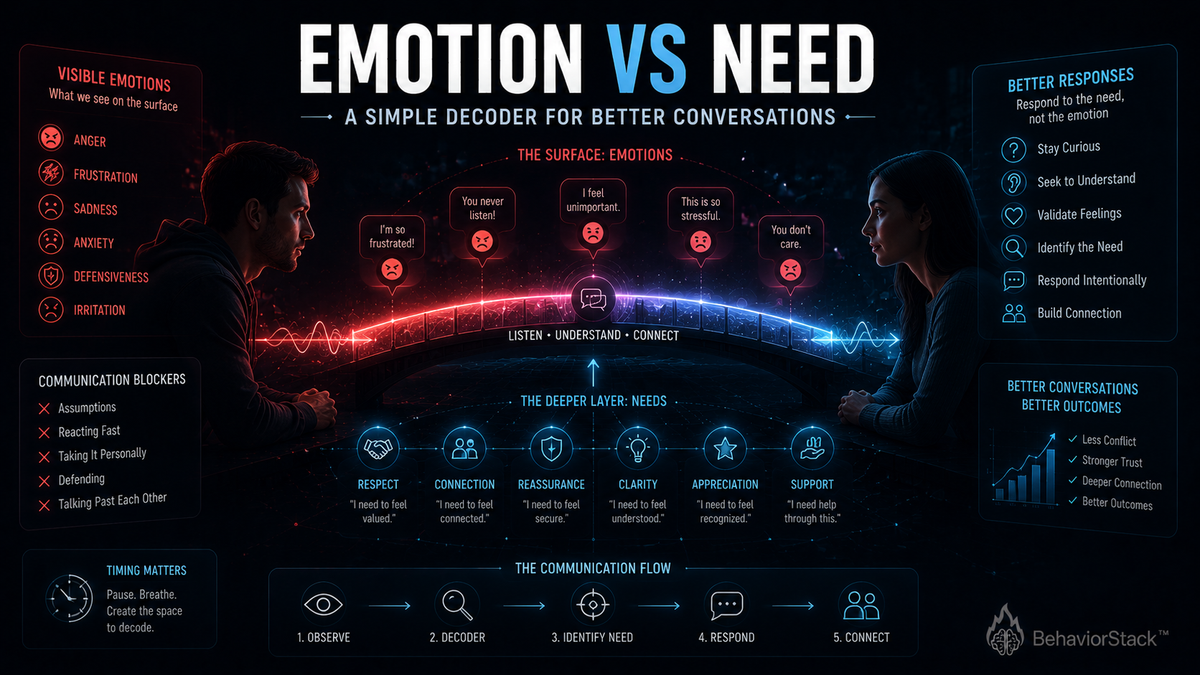
Think of communication as two separate layers.
Surface Layer: Emotion
This is what people show.
Examples:
- anger
- frustration
- sadness
- defensiveness
- irritation
Deeper Layer: Need
This is what people are actually asking for.
Examples:
- reassurance
- appreciation
- safety
- connection
- certainty
- respect
Emotion is often the wrapper.
Need is the message inside.
The Pattern Most Conversations Follow
Many conversations unintentionally follow this cycle:
Trigger
↓
Emotion
↓
Reaction
↓
Defensiveness
↓
Disconnection
↓
Repeat
The problem is that both people become trapped reacting to emotions.
Nobody stops to decode the need.
A Different Way To Think About Conversations
Instead of asking:
"How do I respond to their emotion?"
Ask:
"What need might exist underneath this emotion?"
Use this simple framework:
Step 1: Observe The Emotion
What are they expressing?
Examples:
- anger
- disappointment
- frustration
Step 2: Identify The Possible Need
What could they be needing?
Examples:
- attention
- clarity
- reassurance
- validation
Step 3: Respond To The Need
Address the underlying concern instead of defending yourself.
This often changes the entire direction of the conversation.
When the underlying need is relationship clarity, preparing for an exclusivity conversation can help you state the request without turning urgency into pressure. Verification required: test the destination after the new article’s final URL is live.
A Quick Decoder
| Emotion | Possible Need |
|---|---|
| Anger | Respect |
| Frustration | Progress |
| Sadness | Connection |
| Anxiety | Certainty |
| Defensiveness | Safety |
| Silence | Understanding |
The decoder isn't perfect.
But it's often far more effective than reacting emotionally.
How HeartSpark™ Fits Into The Process
HeartSpark™ isn't designed to tell people what to say.
It's designed to improve how decisions around communication are made.
Powered by BehaviorStack™, it acts as a decision-support system.
Understand Signals
Recognize the emotions driving the interaction.
Identify Patterns
Spot recurring communication loops.
Improve Timing
Determine when to engage and when to pause.
Make More Confident Decisions
Respond intentionally instead of reactively.
Because better conversations rarely happen by accident.
A Side-By-Side Example
Typical Approach
Person:
"You never listen to me anymore."
Response:
"That's not true."
Result:
- defensiveness
- escalation
- frustration
Behavior-Aware Approach
Person:
"You never listen to me anymore."
Response:
"It sounds like you're feeling disconnected lately. Is that what you're trying to tell me?"
Result:
- reduced tension
- increased clarity
- better communication
The Long-Term Advantage
Most people optimize for:
- being right
- responding quickly
- ending discomfort
The real advantage comes from:
- awareness
- timing
- consistency
- probability
Small improvements in communication compound over time.
Better conversations create:
- stronger relationships
- less conflict
- more trust
- better outcomes
Conclusion
Most conversations don't fail because people don't care.
They fail because people react to emotions instead of understanding needs.
The next time a difficult conversation begins, don't immediately solve the emotion.
Decode the need.
Because better communication often starts with a simple shift in perspective.
And over time, those small shifts create dramatically different outcomes.
CONTINUE EXPLORING
👉 Learn more about:
What Is BehaviorStack™? The Framework Behind Smarter Decisions
👉 Read next:
How to De-Escalate a Text Argument in 5 Messages or Less
👉 Explore:
How to Know What to Say: A Better Way to Start Conversations
👉 Try:
HeartSpark™ — Better Conversations. Higher-Probability Responses.