
How to Avoid Emotional Decisions in High-Stakes Situations
Emotional decisions often lead to poor timing and inconsistent outcomes—MarketSpark™ helps improve decision-making through behavioral awareness and probability analysis.

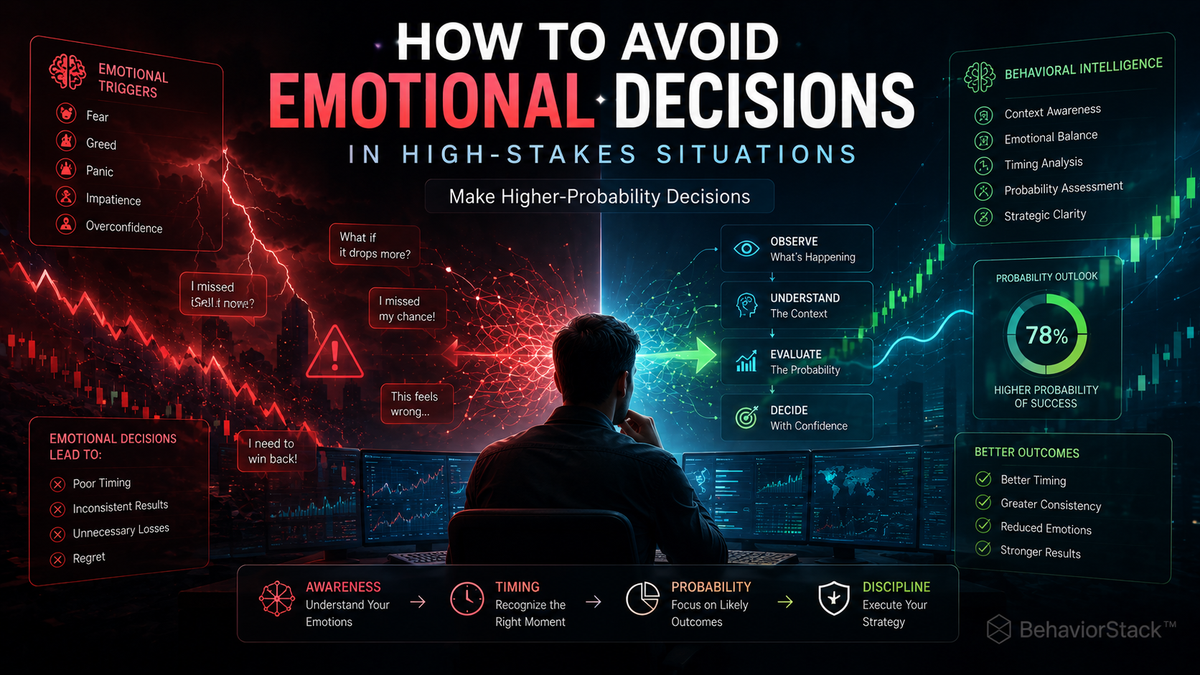
The Moment Most Decisions Go Wrong
High-stakes situations create pressure.
And pressure changes behavior.
Whether it involves:
- investing
- negotiation
- communication
- leadership
- financial decisions
- uncertainty
people often believe they are thinking logically…
when they are actually reacting emotionally.
The problem is not intelligence.
The problem is:
emotion under pressure.
Fear, urgency, hesitation, excitement, and uncertainty can distort decision-making faster than most people realize.
That’s why emotional decisions often lead to:
- poor timing
- overreactions
- inconsistent outcomes
- avoidable mistakes
Why Information Alone Doesn’t Solve The Problem
Most people assume better decisions come from:
- more data
- more charts
- more opinions
- more analysis
But in high-pressure environments, information overload can actually increase emotional reactions.
Traditional tools often provide:
- endless information
- generic alerts
- surface-level AI outputs
But they rarely evaluate:
- emotional state
- timing
- behavioral context
- reaction patterns
- probability of outcomes
As a result:
people still make reactive decisions even while surrounded by information.
Emotional Reactions Usually Follow Predictable Patterns
Most emotional decisions happen in cycles.
Fear-Based Reactions
People:
- hesitate too long
- avoid action
- focus on worst-case outcomes
Urgency-Based Reactions
People:
- chase momentum
- react impulsively
- mistake movement for certainty
Overconfidence Reactions
People:
- ignore risk
- stop evaluating context
- assume recent success guarantees future outcomes
These patterns appear repeatedly across:
- markets
- communication
- leadership
- negotiations
- decision-making environments
The behavior changes.
The emotional patterns often do not.
A Better Decision-Making Framework
Instead of:
Emotion → Reaction → Regret
A more effective process becomes:
Signal → Context → Probability → Decision
This changes how decisions are approached.
Instead of reacting emotionally, the focus becomes:
- awareness
- timing
- probability
- behavioral context
That shift is critical in high-stakes situations.
How MarketSpark™ Helps Reduce Emotional Decisions
Behavioral Timing Awareness
MarketSpark™ helps identify behavioral shifts and contextual timing signals before emotional momentum takes over.
Structured Decision Support
Instead of reacting impulsively to movement or uncertainty, users receive more structured behavioral insights designed to improve clarity.
Probability-Oriented Guidance
The platform focuses on:
- probability
- timing
- contextual awareness
- behavioral patterns
instead of simply generating information.
This helps users move from:
reactive thinking
to:
more intentional decision-making.
Powered by BehaviorStack™.
Real-World Example
Instead of:
- chasing movement emotionally
- reacting impulsively during uncertainty
Users can:
- evaluate behavioral conditions more objectively
- make decisions with greater structure and awareness
Result:
- improved timing
- reduced emotional reactions
- stronger long-term consistency
Why Behavioral Awareness Creates An Advantage
Most people rely on:
emotion + reaction.
Higher-quality decisions come from:
structure + probability + awareness.
The ability to recognize emotional patterns before reacting creates a significant strategic advantage over time.
Especially in environments where:
- pressure
- uncertainty
- timing
directly affect outcomes.
Conclusion
Emotional decisions are not usually caused by lack of intelligence.
They are caused by:
- pressure
- uncertainty
- timing
- emotional reactions
- behavioral blind spots
MarketSpark™ helps introduce:
- behavioral awareness
- probability-oriented thinking
- timing analysis
- structured decision support
into high-stakes environments.
Because better decisions rarely come from reacting faster.
They come from:
understanding behavior more clearly.
CONTINUE EXPLORING
👉 Learn more about:
What Is BehaviorStack™? The Framework Behind Smarter Decisions
👉 Read next:
Why Emotions Drive Most Decisions (Not Logic)
👉 Explore:
Why Timing Matters More Than Information in Decision-Making
👉 Try:
MarketSpark™