
Bayesian Updating for Real Life: Changing Your Mind Without Waffling
Bayesian updating is the practice of adjusting beliefs as new evidence emerges. Learn how probability-based thinking helps people and AI systems make better decisions without becoming reactive or indecisive.

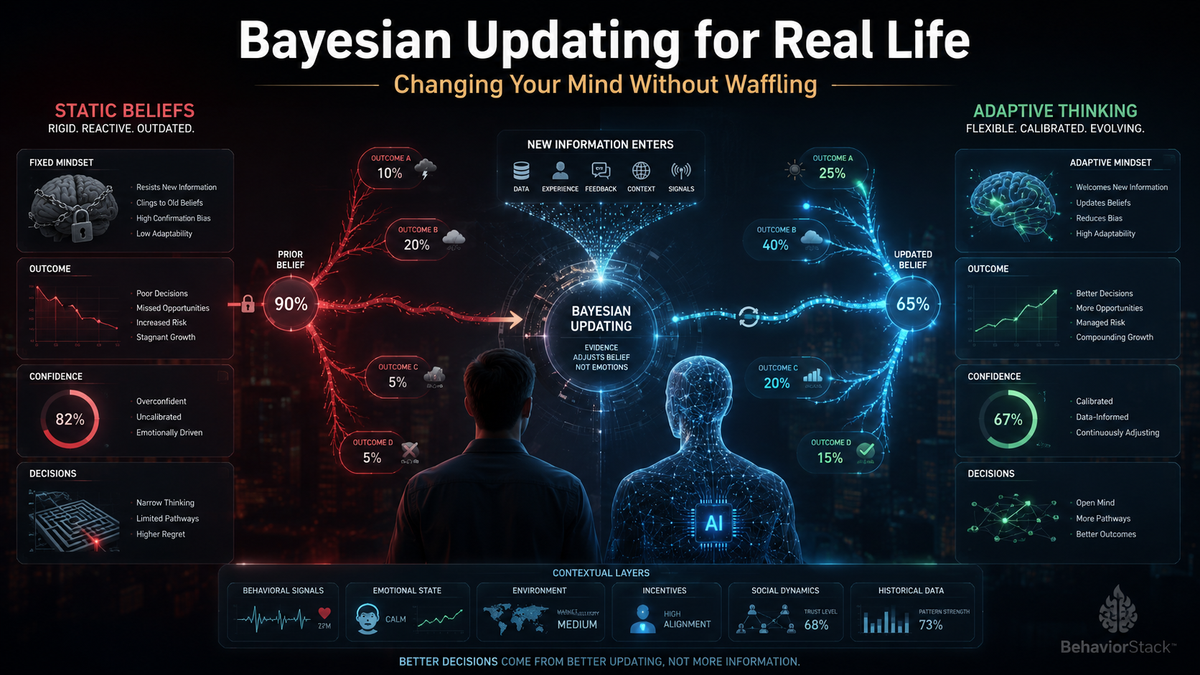
Most AI systems generate outputs.
Very few improve decisions.
Every day, people encounter new information that challenges their existing beliefs.
A marketing campaign underperforms.
A trade moves against expectations.
A negotiation takes an unexpected turn.
A relationship dynamic shifts.
A competitor launches a product no one anticipated.
The challenge isn't simply collecting more information.
The challenge is knowing how much that information should change your thinking.
Many people struggle with this balance.
Some refuse to change their minds even when evidence clearly points in a different direction.
Others overreact to every new data point, constantly changing direction and chasing the latest signal.
Neither approach produces consistently good outcomes.
Bayesian Updating, pronounced, BAY-zee-uhn (or BAY-zhuhn) offers an alternative.
Instead of treating beliefs as fixed truths, Bayesian thinking treats them as probabilities that can be adjusted as new evidence becomes available.
In a world defined by uncertainty, complexity, and information overload, the ability to update beliefs intelligently may be one of the most valuable decision-making skills available.
What Is Decision Intelligence?
Decision intelligence is the practice of improving decision quality through structured reasoning, probability analysis, contextual awareness, and behavioral understanding.
Traditional information systems focus on delivering answers.
Decision intelligence focuses on improving outcomes.
This distinction is critical.
Information alone does not guarantee good decisions.
People make decisions within complex environments shaped by:
- incentives
- emotions
- uncertainty
- timing
- cognitive biases
- social pressures
Decision intelligence attempts to account for these factors rather than ignoring them.
The goal is not simply to know more.
The goal is to make better decisions.
This requires understanding:
- probability instead of certainty
- context instead of isolated facts
- behavior instead of assumptions
- outcomes instead of outputs
As AI systems evolve, decision intelligence is becoming increasingly important because information is no longer scarce.
Judgment is.
Why Traditional AI Falls Short
Most AI systems focus on:
- prompts
- outputs
- automation
- surface-level responses
They are incredibly effective at generating content, summarizing information, answering questions, and automating repetitive tasks.
However, many struggle with the deeper elements that drive decision quality.
They often fail to understand:
- incentives
- emotion
- timing
- behavioral context
- probability
As a result, many AI systems generate information without improving outcomes.
For example:
An AI system may produce ten different negotiation responses.
But which response is most likely to succeed given the personalities involved?
An AI system may summarize a market opportunity.
But how does current sentiment affect the probability of success?
An AI system may recommend a strategy.
But how should confidence change if new evidence emerges tomorrow?
These questions move beyond information generation and into decision intelligence.
The Missing Layer: Behavior
This is where systems like BehaviorStack™ become important.
Behavior influences nearly every decision humans make.
People do not respond solely to information.
They respond to perception.
They respond to emotion.
They respond to incentives.
They respond to timing.
Behavior affects:
- communication
- timing
- perception
- confidence
- reactions
- risk assessment
Without behavioral context, even accurate information can produce poor outcomes.
Imagine receiving perfectly correct feedback from a manager.
If the timing is wrong, the feedback may be rejected.
If the emotional state of the recipient is ignored, the message may fail.
If incentives are misunderstood, resistance may increase.
The information may be accurate.
The outcome may still be poor.
Behavioral context often determines whether information becomes action.
How Behavioral Decision Intelligence Works
Behavioral decision intelligence combines structured reasoning with an understanding of how people actually make decisions.
Awareness
The first step is recognizing behavioral and emotional patterns.
Humans are influenced by:
- confirmation bias
- loss aversion
- overconfidence
- fear
- social pressure
Awareness helps decision-makers identify when emotions may be influencing judgment.
Understanding these patterns creates a foundation for more objective thinking.
Context
Information never exists in isolation.
Effective decision-making requires understanding:
- incentives
- relationships
- timing
- environmental conditions
- competing objectives
The same information can produce different outcomes depending on the surrounding context.
Decision intelligence evaluates information within the environment where decisions occur.
Probability
Probability is where Bayesian updating becomes especially valuable.
Instead of asking:
Is this true?
Decision intelligence asks:
How likely is this to be true?
And when new information appears:
How should that likelihood change?
Bayesian updating helps decision-makers avoid both stubborn certainty and constant overreaction.
It creates a framework for adapting intelligently.
Instead of replacing beliefs entirely, evidence adjusts confidence levels over time.
This leads to more accurate decision-making in uncertain environments.
Structure
Most poor decisions are reactive.
Behavioral decision intelligence introduces structure.
Rather than reacting emotionally to new information, decision-makers follow a process:
- Establish an initial belief.
- Gather evidence.
- Evaluate the quality of the evidence.
- Adjust confidence levels.
- Reassess possible outcomes.
This creates consistency while remaining adaptable.
Real-World Applications
Behavioral decision intelligence has applications across virtually every area of life and business.
Relationships
Understanding behavioral patterns helps people communicate more effectively.
Instead of reacting emotionally, individuals can adjust their expectations and strategies as new information becomes available.
Negotiation
Negotiators constantly update their understanding of incentives, motivations, and leverage.
Bayesian thinking improves flexibility without sacrificing conviction.
Leadership
Strong leaders adapt to changing circumstances while maintaining strategic direction.
They update beliefs based on evidence rather than ego.
Marketing
Consumer behavior changes continuously.
Effective marketers adjust messaging, targeting, and positioning based on emerging patterns rather than fixed assumptions.
Trading
Markets provide a constant stream of new information.
Successful traders rarely seek certainty.
Instead, they continuously update probabilities and manage risk accordingly.
Communication
Understanding emotional context improves the likelihood that messages will achieve desired outcomes.
Strategic Planning
Organizations that update assumptions intelligently tend to outperform organizations that rely on rigid forecasts.
Why This Changes The Future of AI
The future of AI is not simply better outputs.
It is better decisions.
Today's AI systems are rapidly becoming capable of generating information.
Tomorrow's systems will increasingly focus on:
- behavioral understanding
- probability analysis
- contextual reasoning
- outcome optimization
The next generation of AI will likely be evaluated less by what it can generate and more by how effectively it improves real-world outcomes.
This represents a significant shift.
The competitive advantage will move from information access to decision quality.
Organizations that understand this shift early may gain substantial advantages.
Why This Creates a Long-Term Advantage
People and organizations that understand:
- incentives
- psychology
- timing
- behavior
- probability
consistently make higher-quality decisions over time.
Bayesian updating provides a framework for learning without becoming reactive.
It encourages adaptation without indecision.
It allows confidence to evolve alongside evidence.
Most importantly, it helps decision-makers navigate uncertainty more effectively.
The future belongs to individuals and organizations capable of adjusting intelligently as conditions change.
Those who can continuously refine their understanding of reality often outperform those who cling to certainty.
Conclusion
The modern world produces more information than ever before.
Yet information alone does not create better decisions.
What matters is how beliefs evolve as new evidence emerges.
Bayesian updating provides a powerful framework for adapting without overreacting.
It encourages probability-based thinking instead of certainty-based thinking.
It helps decision-makers remain flexible without becoming inconsistent.
As AI continues to evolve, the systems that create the greatest value will not simply generate answers.
They will improve decisions.
This shift—from information generation to behavioral decision intelligence—represents one of the most important developments in the future of AI.
Frameworks like BehaviorStack™ are built around this principle:
Better outcomes come not from having more information, but from understanding behavior, context, probability, and decision-making itself.
The future of intelligence is not knowing more.
It is deciding better.
CONTINUE EXPLORING
👉 Learn more about: BehaviorStack™: The Framework Behind Smarter Decisions
👉 Read next: What Is Decision Intelligence? And Why AI Alone Isn't Enough
👉 Explore: BehaviorStack™ vs Standard AI Layers: The Missing Piece
👉 Discover: HeartSpark™ — Behavioral Intelligence for Better Conversations