What Is a Decision Intelligence System? And Why AI Alone Isn’t Enough
A decision intelligence system uses behavior, context, and probability to guide better decisions—going beyond traditional AI outputs.

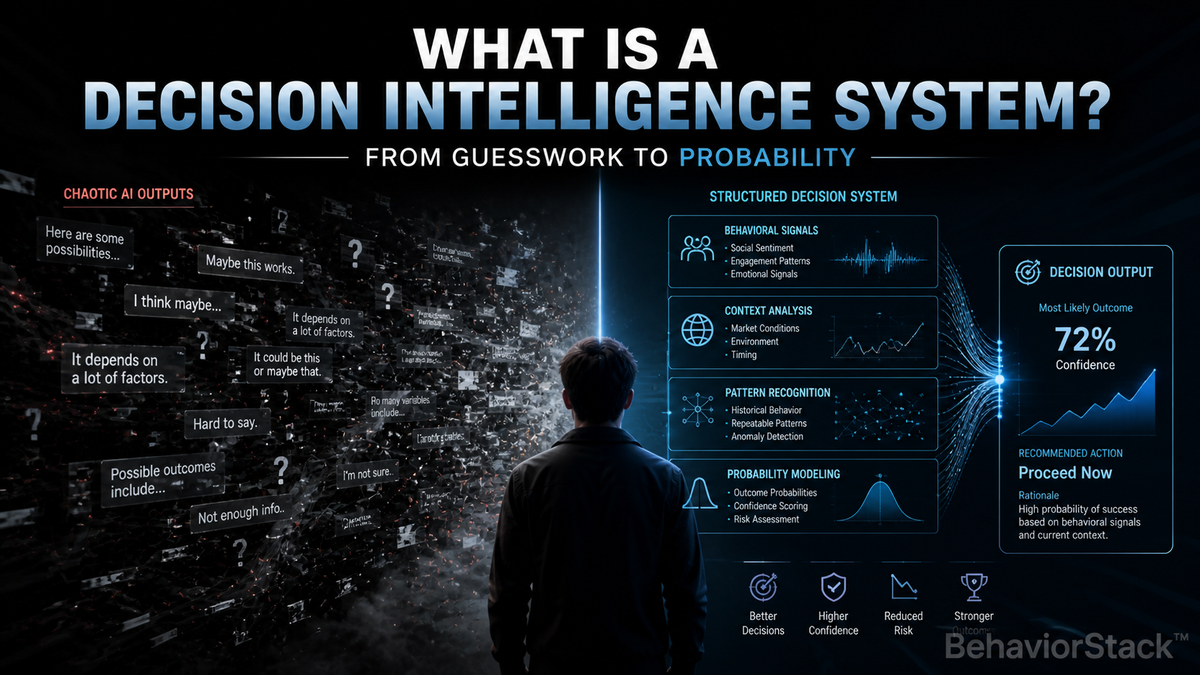
A decision intelligence system is a framework that combines data, human behavior, context, and probability to guide better decisions—rather than just generating information or executing tasks like traditional AI systems.
Artificial intelligence has changed how we interact with technology.
It can generate answers.
It can automate workflows.
It can complete complex tasks.
But there’s a critical limitation:
AI alone does not consistently help people make better decisions.
This is where a new approach emerges.
What Is a Decision Intelligence System?
Traditional AI focuses on outputs.
A decision intelligence system focuses on outcomes.
Instead of asking:
“What can the system do?”
It asks:
“What decision is most likely to work?”
It achieves this by combining:
- Behavioral understanding
- Context awareness
- Probability-based thinking
Why Decision Intelligence Matters
Most AI systems today are optimized for:
- Accuracy
- Completion
- Speed
But real-world decisions depend on:
- Human behavior
- Timing
- Context
- Uncertainty
Connecting those factors into a repeatable, reviewable system requires behavioral decision infrastructure—the layer that organizes decision inputs, behavioral context, human oversight, traceability, and feedback loops.
If you are comparing software that claims to provide these capabilities, use this decision intelligence platform evaluation checklist to verify decision fit, evidence quality, explainability, human oversight, governance, pilot readiness, and monitoring before trusting it.
This gap leads to:
- Decision paralysis
- Inconsistent outcomes
- Over-reliance on guesswork
The problem isn’t lack of information.
It’s lack of decision clarity.
Common Mistakes With Decision Intelligence
Most people:
- Assume more information leads to better decisions
- Focus on what is correct instead of what is likely
- Ignore how behavior impacts outcomes
This leads to decisions that look logical…
…but don’t perform well in real situations.
How to Improve Decision Intelligence
Instead of guessing, focus on:
- Behavioral signals
- Context
- Probability
This is where BehaviorStack™ comes in.
LLMs generate possibilities.
BehaviorStack™ prioritizes probabilities.
How BehaviorStack™ Works
Step 1: Signal Collection
BehaviorStack™ captures inputs such as behavior, context, and situational patterns.
Step 2: Pattern Recognition
It identifies repeatable patterns in how people think and act.
Step 3: Probability Modeling
It evaluates which outcomes are most likely—not just possible.
Step 4: Decision Output
It guides toward higher-probability decisions with clarity and direction.
Old Way vs. Better Way
Old Way
Guess → Action → Hope
Better Way
Signal → Insight → Higher-Probability Decision
Real-World Applications
Instead of:
- Making decisions based on instinct alone
- Overanalyzing without clear direction
You can:
- Use structured insight to guide decisions
- Focus on what is most likely to work
Result:
- More consistent outcomes
- Faster decisions
- Reduced uncertainty
Why This Creates an Advantage
Most people focus on:
What feels right
The advantage comes from understanding:
What is most likely to work
This is the shift from:
- Information
to - Decision intelligence
Related Topics and Next Steps
Continue exploring:
👉 Learn more in: What Is BehaviorStack™? The Framework Behind Smarter Decisions
👉 Read next: What Is Behavioral AI? And Why It Changes How Decisions Are Made
👉 Explore: BehaviorStack™ vs Standard AI Layers: The Missing Pieces
👉 How to Review an AI Recommendation Before Acting on It
Explore the tools:
👉 Try HeartSpark™
👉 Explore MarketSpark™
👉 Learn more about BehaviorStack™