What Is Behavioral AI? And Why It Changes How Decisions Are Made
Behavioral AI focuses on predicting decisions—not just generating responses—by analyzing patterns, incentives, and human behavior.

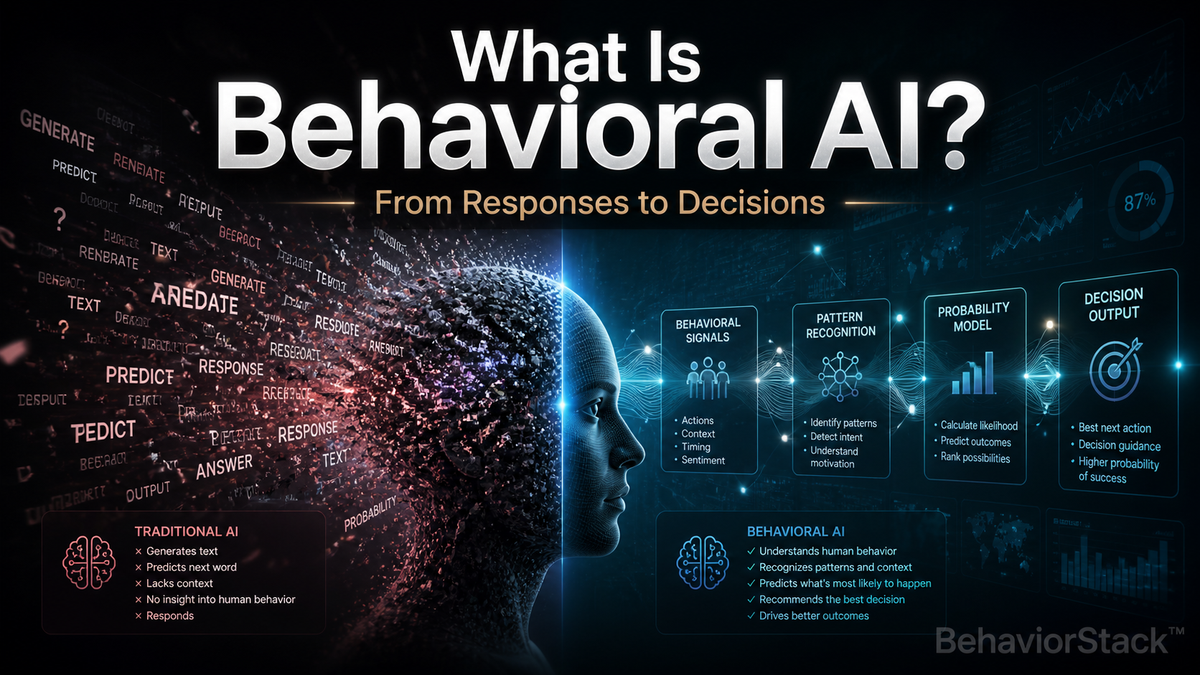
Artificial intelligence has advanced rapidly—but most AI still operates the same way:
It generates answers.
It does not guide decisions.
Behavioral AI represents a shift.
Instead of focusing on what can be said or done, it focuses on:
👉 What is most likely to happen
👉 What decision is most likely to work
What Is Behavioral AI?
Behavioral AI is an approach to artificial intelligence that analyzes:
- Human behavior
- Incentives
- Context
- Patterns over time
To produce:
👉 Probability-based insights about decisions
Unlike traditional AI, which predicts text or outcomes in isolation, Behavioral AI connects:
Behavior → Pattern → Probability → Decision
Why Behavioral AI Matters
Most AI systems today have a critical limitation:
They generate possibilities—but don’t prioritize outcomes.
This leads to:
- Decision paralysis
- Overconfidence in bad choices
- Inconsistent results
- Reliance on guesswork
The problem isn’t lack of information.
It’s lack of decision intelligence.
Common Mistakes With Behavioral AI
Most people misunderstand Behavioral AI by:
- Treating it like a chatbot
- Expecting it to give “answers” instead of insights
- Ignoring context and incentives
- Assuming more data = better decisions
But behavior is not just data.
It’s pattern + motivation + timing.
How to Improve Decision-Making With Behavioral AI
Instead of guessing, focus on:
- Behavioral signals (what people actually do)
- Context (when and why decisions happen)
- Probability (what is most likely to work)
This is where BehaviorStack™ comes in.
LLMs generate possibilities.
BehaviorStack™ prioritizes probabilities.
How BehaviorStack™ Applies Behavioral AI
Step 1: Signal Collection
Captures behavioral inputs such as actions, timing, sentiment, and context.
Step 2: Pattern Recognition
Identifies repeatable behavioral patterns across scenarios.
Step 3: Probability Modeling
Calculates likelihood of outcomes based on past behavior and current conditions.
Step 4: Decision Output
Generates guidance focused on the highest-probability action.
Old Way vs. Better Way
Old Way
Guess → Act → Hope
Better Way
Signal → Insight → Higher-Probability Decision
Real-World Applications
Instead of:
- Guessing when to enter a trade
- Overthinking what message to send
You can:
- Act based on behavioral probability
- Make decisions with structured confidence
Result:
- More consistent outcomes
- Reduced emotional bias
- Faster decision-making
Why This Creates an Advantage
Most people focus on:
👉 What feels right
The advantage comes from:
👉 What is most likely to work
That’s the difference between reacting…
…and making behavior-driven decisions.
Related Topics and Next Steps
Continue exploring:
👉 Learn more in: What Is BehaviorStack™? The Framework Behind Smarter Decisions
👉 Read next: Why Most AI Tools Fail at Decision-Making
👉 Explore: Behavioral AI vs Traditional AI
Explore the tools:
👉 Try HeartSpark™
👉 Explore MarketSpark™
👉 Learn more about BehaviorStack™