Why Most AI Tools Fail at Decision-Making
AI decision-making often fails because it lacks behavioral context, leading to inaccurate outcomes and poor real-world results.

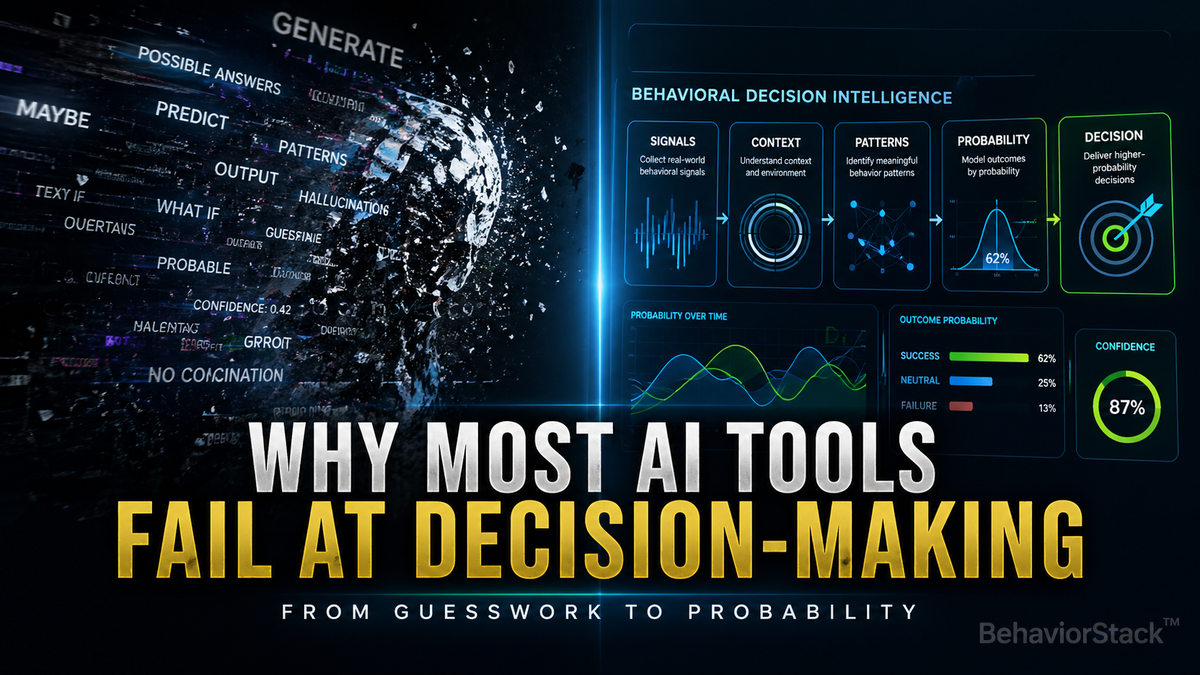
\AI has transformed how we generate content, analyze data, and automate tasks.
But when it comes to making decisions, something critical is missing.
Most AI systems are built to predict or generate—not to decide.
That’s where the gap begins.
What Is AI Decision-Making?
AI decision-making refers to how artificial intelligence systems analyze data and produce outputs intended to guide actions.
Traditionally, this is done through:
- Pattern recognition
- Statistical modeling
- Predictive outputs
But there’s a problem.
AI doesn’t actually understand:
- Human behavior
- Timing
- Incentives
It produces answers—but not necessarily the right decisions.
Why AI Decision-Making Matters
Decisions are not just about data.
They involve:
- Context
- Behavior
- Risk
- Timing
When AI ignores these elements, it leads to:
- Overconfidence in incorrect outputs
- Misaligned actions
- Poor real-world performance
Common Mistakes With AI Decision-Making
Most people:
- Trust AI outputs without questioning context
- Assume data equals accuracy
- Confuse generation with decision-making
The result is a false sense of confidence.
AI appears intelligent—but lacks decision depth.
The fix isn't blind trust or blanket distrust — it's a structured review. Here's how to review an AI recommendation before acting on it.
How to Improve AI Decision-Making
Instead of guessing, focus on:
- Behavioral signals
- Context
- Probability
This is where BehaviorStack™ comes in.
LLMs generate possibilities.
BehaviorStack™ prioritizes probabilities.
How BehaviorStack™ Works
Step 1: Signal Collection
BehaviorStack™ gathers behavioral and contextual signals beyond raw data.
Step 2: Pattern Recognition
It identifies meaningful behavioral patterns instead of surface-level trends.
Step 3: Probability Modeling
It evaluates what is most likely to happen—not just what could happen.
Step 4: Decision Output
It delivers decisions based on probability, not guesswork.
Where Ignite Platform™ Fits
BehaviorStack™ provides the behavioral ai decision-intelligence technology.
Ignite Platform™ uses that technology to create practical decision systems that structure inputs, evaluate behavioral signals, compare probable outcomes, and deliver actionable guidance.
The architecture follows a structured process:
Input → Behavioral Context → BehaviorStack™ Analysis → Probability Evaluation → Decision Logic → Actionable Guidance
This framework powers applications such as:
- HeartSpark™, which applies behavioral intelligence to communication, dating, and relationships
- MarketSpark™, which applies behavioral and probability-based analysis to market decisions
Instead of relying on an AI model to make decisions by itself, Ignite Platform™ combines BehaviorStack™ technology with AI to help users identify the action most likely to produce the desired outcome.
Old Way vs. Better Way
Old Way
Guess → Action → Hope
Better Way
Signal → Insight → Higher-Probability Decision
Real-World Applications
Instead of:
- Entering trades based on hype
- Sending messages based on instinct
You can:
- Act on high-probability market signals
- Communicate with behavioral insight
Result:
- Better timing
- Higher success rates
- Reduced risk
Why This Creates an Advantage
Most people focus on:
What feels right
The advantage comes from:
What is most likely to work
Related Topics and Next Steps
Continue exploring:
- What Is BehaviorStack™? The Framework Behind Smarter Decisions
- BehaviorStack™ vs LLM: What’s the Real Difference?
- How to Read Market Behavior: The Hidden Signals Most Traders Miss
- Ignite Platform™: The Behavioral Decision Intelligence Platform
Explore the tools:
👉 Try HeartSpark™
👉 Explore MarketSpark™
👉 Learn more about BehaviorStack™