Second-Order Effects: The Skill That Separates Tactical From Strategic Decisions
Second-order effects help decision-makers think beyond immediate outcomes to anticipate long-term consequences. Learn why this framework improves strategic thinking in business, AI, leadership, and everyday decisions.

Most decisions fail not because people lack information.
They fail because people stop thinking too soon.
Modern technology has made information nearly limitless. Artificial intelligence can summarize reports, generate ideas, answer questions, and automate workflows in seconds. Yet organizations still make poor strategic decisions, businesses pursue short-lived wins, investors chase trends, and relationships break down over avoidable misunderstandings.
Why?
Because most decisions focus on what happens next rather than what happens after next.
This is the difference between tactical thinking and strategic thinking.
Strategic thinkers don't simply ask, "What happens if I do this?"
They ask:
"Then what?"
The ability to anticipate second-order effects is one of the defining characteristics of exceptional decision-makers.
What Are Second-Order Effects?
Second-order effects are the indirect consequences that occur after an initial decision or action.
Most people naturally focus on first-order effects because they are immediate and obvious.
For example:
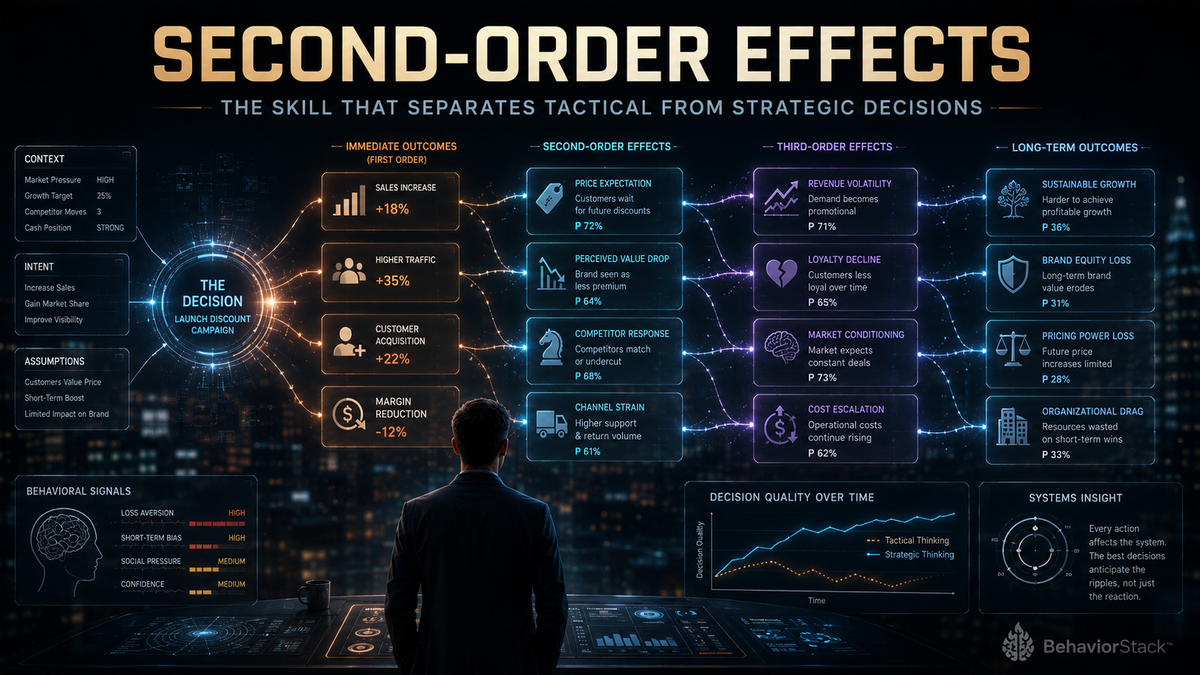
- Raising prices may increase short-term revenue.
- Cutting staff may reduce operating costs.
- Launching a discount may increase sales.
These are first-order effects.
Second-order effects explore what happens after those immediate results.
Will customers leave because prices increased?
Will employee morale decline after layoffs?
Will customers begin waiting for future discounts instead of buying at full price?
Strategic thinking requires moving beyond the first consequence and considering how systems, people, and incentives respond over time.
Supporting concepts include:
- delayed consequences
- feedback loops
- incentive structures
- systems thinking
- probability-based reasoning
Second-order thinking recognizes that every decision creates a chain reaction.
Why This Matters
The modern world is increasingly interconnected.
Technology accelerates change.
Markets evolve rapidly.
Consumer behavior shifts constantly.
Small decisions can create large downstream consequences.
Organizations that focus only on immediate results often optimize the wrong metrics.
They may improve quarterly performance while weakening long-term growth.
Individuals do the same.
They seek immediate comfort instead of sustainable progress.
Strategically, second-order thinking improves:
- decision quality
- long-term planning
- risk management
- innovation
- organizational resilience
It encourages leaders to evaluate consequences that are less visible but often more important.
As artificial intelligence becomes better at generating answers, human competitive advantage increasingly shifts toward asking better questions.
Second-order thinking is one of those questions.
The Core Problem
Most systems today rely on:
- information
- reaction
- surface-level outputs
These systems excel at identifying patterns in existing data.
They are much less effective at anticipating how humans will respond to change.
Real-world decisions involve variables that extend beyond facts.
They involve:
- incentives
- timing
- emotion
- behavioral context
Consider a company implementing AI to improve customer service.
The first-order effect may be lower operating costs.
The second-order effects might include:
- reduced customer trust
- lower employee engagement
- increased escalation rates
- weaker brand loyalty
None of these outcomes are visible if we only evaluate immediate results.
Strategic decisions require understanding how people adapt, react, and change over time.
A Better Framework
Instead of:
React → Guess → Repeat
A more effective decision framework is:
Observe → Understand → Decide
Observe
Gather information without rushing to conclusions.
Look beyond the obvious outcome.
Ask:
- What is changing?
- Who is affected?
- What assumptions am I making?
Understand
Evaluate how incentives, psychology, timing, and systems interact.
Questions include:
- How will people respond?
- What behaviors will this encourage?
- What unintended consequences may emerge?
Decide
Choose actions that maximize long-term value rather than immediate gratification.
Probability replaces certainty.
Structure replaces reaction.
Context replaces isolated facts.
This is where frameworks like BehaviorStack™ become valuable.
Rather than treating decisions as isolated events, behavioral decision systems evaluate the interaction between people, incentives, context, and likely outcomes.
Real-World Implications
Second-order thinking applies across nearly every domain.
AI Systems
An AI assistant may increase productivity.
But what happens when users become overly dependent on generated answers?
The second-order effect may be reduced critical thinking.
Relationships
Winning an argument may feel satisfying.
The second-order effect could be damaged trust and weaker communication.
Trading
Chasing a profitable trade may generate short-term gains.
The second-order consequence may be reinforcing poor risk management habits.
Leadership
A leader who solves every employee problem immediately may appear supportive.
Over time, however, employees may become less independent and less confident.
Negotiation
Making a concession may close a deal today.
But it may also establish expectations that weaken future negotiations.
Marketing
Aggressive discounts often increase immediate sales.
Repeated promotions can train customers to delay purchases until the next discount appears.
Strategic thinking asks not only what works today, but how today's decision shapes tomorrow's behavior.
Why Most People Miss This
Human beings naturally optimize for immediate outcomes.
We prefer:
- speed
- convenience
- certainty
- visible results
Our brains evolved to solve immediate problems.
Modern environments, however, reward long-term thinking.
Organizations that consistently outperform competitors rarely make decisions based solely on short-term metrics.
They build systems.
They recognize patterns.
They understand incentives.
They anticipate behavior.
Second-order thinking requires slowing down long enough to ask one additional question:
"What happens after this?"
That simple habit often separates exceptional decision-makers from average ones.
The Shift Happening Now
Artificial intelligence is changing how decisions are made.
The first generation of AI emphasized automation.
The current generation emphasizes information generation.
The next generation will increasingly focus on decision quality.
Emerging trends include:
- decision intelligence
- behavioral systems
- probability-driven frameworks
- contextual reasoning
- human-AI collaboration
The future is unlikely to belong to systems that simply generate more information.
It will belong to systems that help people anticipate consequences, evaluate trade-offs, and improve outcomes over time.
Behavioral frameworks will become increasingly important because they recognize that people—not algorithms—ultimately determine how decisions unfold.
Why This Creates an Advantage
Organizations and individuals that understand:
- behavior
- incentives
- timing
- psychology
consistently make better long-term decisions.
They recognize that every action influences future choices.
They avoid optimizing for temporary wins at the expense of lasting success.
Second-order thinking creates advantages because it shifts attention from isolated events to interconnected systems.
The result is better planning.
Better communication.
Better leadership.
Better innovation.
And ultimately, better outcomes.
Information is no longer the scarce resource it once was.
Strategic judgment is.
The ability to recognize second-order effects transforms decision-making from reactive problem-solving into long-term systems thinking.
It encourages leaders to anticipate unintended consequences, evaluate incentives, and understand how human behavior shapes outcomes over time.
As artificial intelligence continues to evolve, the organizations and individuals that thrive will not simply have access to more information.
They will possess better frameworks for interpreting it.
Second-order thinking is one of those frameworks.
It reminds us that every decision creates another decision, every action creates another reaction, and every outcome shapes what happens next.
The future belongs to those who can see beyond the first move.
CONTINUE EXPLORING
👉 Learn more about: What Is BehaviorStack™? The Framework Behind Smarter Decisions
👉 Read next: What Is Decision Intelligence? And Why AI Alone Isn't Enough
👉 Explore: Signal vs Noise: How To Filter Information When Decisions Are Fast
👉 Discover: MarketSpark™ — Behavioral Intelligence for Smarter Market Decisions