Signal vs Noise: How to Filter Information When Decisions Are Fast
Signal vs noise decision making helps individuals and organizations identify what truly matters, improving decision quality in fast-moving environments.

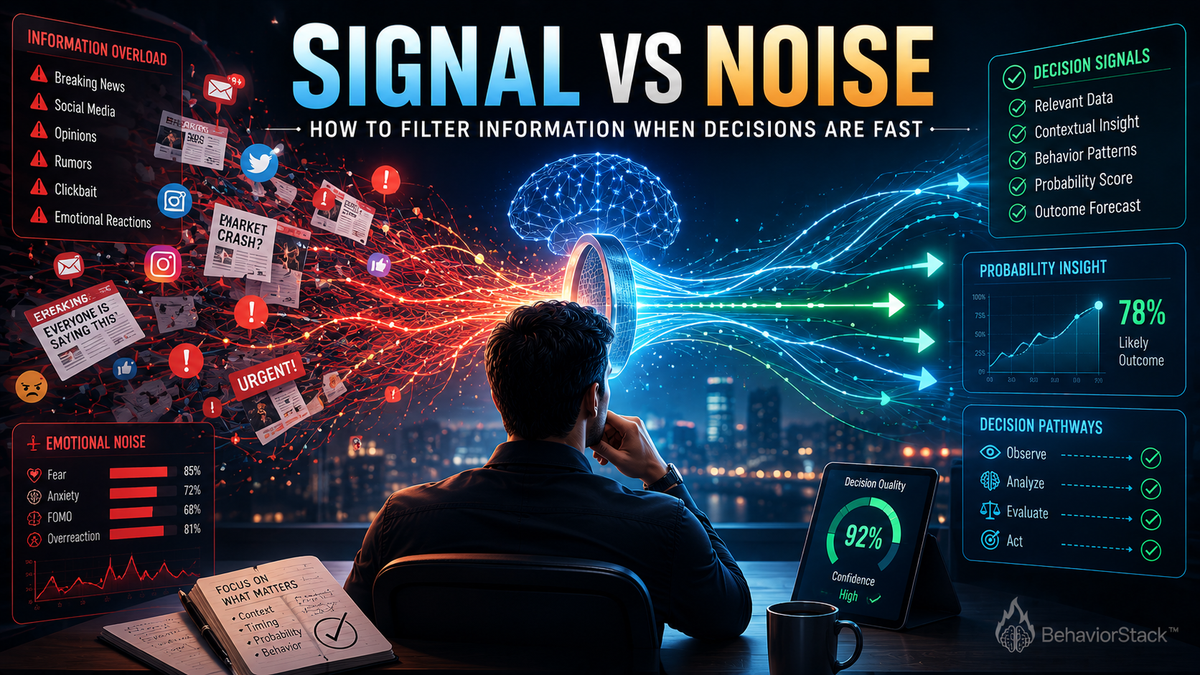
Information Has Never Been More Abundant. Good Decisions Have Never Been Harder.
Most AI systems generate outputs.
Very few improve decisions.
Today, people are overwhelmed with:
- alerts
- notifications
- opinions
- market data
- social media reactions
- AI-generated content
The problem isn't a lack of information.
It's an inability to determine which information actually matters.
When decisions need to be made quickly, the difference between success and failure often comes down to one skill:
Separating signal from noise.
Unfortunately, most people were never taught how to do it.
What Is Signal vs Noise Decision Making?
In decision science, a signal is information that meaningfully improves a decision.
Noise is information that creates distraction without improving the outcome.
The challenge is that noise often looks important.
Examples include:
- breaking news headlines
- emotional reactions
- social media trends
- isolated events
- random short-term fluctuations
Signals are usually different.
They tend to be:
- relevant
- repeatable
- contextual
- connected to outcomes
Decision intelligence focuses on identifying those signals and reducing the influence of noise.
Because making faster decisions isn't valuable if those decisions are worse.
What Is Decision Intelligence?
Decision intelligence is the practice of improving how decisions are made.
It combines:
- outcomes
- probability
- context
- structured reasoning
- behavioral awareness
Traditional systems often focus on generating answers.
Decision intelligence focuses on improving choices.
The distinction is important.
An answer can be technically correct and still lead to a poor outcome.
A high-quality decision considers far more than information alone.
It also considers:
- incentives
- uncertainty
- timing
- behavioral patterns
- likely consequences
Why More Information Doesn't Always Help
Most people assume better decisions come from gathering more information.
In reality, there is a point where additional information becomes harmful.
This is known as information overload.
When too much data enters the decision process, people often experience:
- analysis paralysis
- hesitation
- reduced confidence
- slower reactions
- inconsistent judgment
Ironically, the search for certainty often produces more confusion.
The goal should not be maximum information.
The goal should be maximum relevance.
Why Traditional AI Falls Short
Most AI systems are optimized for:
- prompts
- outputs
- automation
- content generation
Those capabilities are valuable.
But they don't necessarily improve decision quality.
Many AI systems struggle to evaluate:
- incentives
- emotional context
- behavioral patterns
- timing considerations
- probability distributions
As a result, users often receive more information without receiving better judgment.
The output may be impressive.
The decision may still be flawed.
The Missing Layer: Behavior
This is where BehaviorStack™ becomes important.
Behavior influences every decision.
It affects:
- communication
- perception
- confidence
- risk tolerance
- timing
- interpretation
Two people can receive identical information and reach completely different conclusions.
Why?
Because behavior shapes how information is processed.
Without understanding behavioral context, it becomes difficult to distinguish meaningful signals from emotional noise.
The Four Filters Of Behavioral Decision Intelligence
Awareness
The first step is recognizing your own biases.
Ask:
"Am I reacting to information or reacting to emotion?"
This question alone eliminates a surprising amount of noise.
Context
Information without context is often misleading.
A market decline may be significant.
Or it may be normal volatility.
A delayed text message may indicate disinterest.
Or it may simply indicate someone is busy.
Context determines meaning.
Probability
High-quality decision makers focus on likelihood rather than certainty.
Instead of asking:
"What will happen?"
Ask:
"What is most likely to happen?"
This shift dramatically improves decision quality.
Structure
Structured thinking prevents emotional reactions from dominating the process.
Rather than:
React → Guess → Repeat
Behavioral decision intelligence encourages:
Observe → Evaluate → Decide
Real-World Applications
Signal vs noise decision making has applications far beyond AI.
Relationships
Distinguish meaningful behavioral patterns from isolated emotional moments.
Leadership
Focus on metrics that predict outcomes rather than vanity metrics.
Trading
Separate market signals from emotional reactions and crowd behavior.
Marketing
Identify genuine customer intent instead of chasing temporary trends.
Strategic Planning
Recognize which variables actually drive success.
Across every domain, the goal remains the same:
Pay attention to what matters.
Ignore what doesn't.
Why This Changes The Future Of AI
The next generation of AI won't simply generate more content.
It will help humans make better decisions.
Future systems will increasingly focus on:
- behavioral understanding
- contextual reasoning
- probability analysis
- outcome optimization
The shift is subtle but significant.
The question is no longer:
"What can AI create?"
The more important question is:
"How can AI improve decision quality?"
That is the foundation of decision intelligence.
Why This Creates A Long-Term Advantage
The people who consistently outperform others are not always the smartest.
They're often the best at identifying signal.
They understand:
- incentives
- psychology
- timing
- probability
- behavior
They focus attention where it matters most.
And over time, that advantage compounds.
Because better decisions create better outcomes.
And better outcomes create more opportunities.
Conclusion
Information is abundant.
Attention is limited.
The ability to separate signal from noise has become one of the most valuable skills in modern decision-making.
Behavioral decision intelligence offers a framework for navigating complexity by combining:
- behavioral awareness
- contextual reasoning
- probability thinking
- structured decision processes
The future of AI isn't about generating more information.
It's about helping people make better decisions with the information they already have.
And that future begins with understanding the difference between signal and noise.
CONTINUE EXPLORING
👉 Learn more about:
What Is BehaviorStack™? The Framework Behind Smarter Decisions
👉 Read next:
Why Probability Matters More Than Prompts In AI
👉 Explore:
BehaviorStack™ vs Standard AI Layers: The Missing Piece
👉 Discover:
HeartSpark™ — Better Conversations. Higher-Probability Responses.