Why Probability Matters More Than Prompts in AI
AI probability systems focus on likely outcomes instead of prompts alone—representing the next evolution in decision intelligence and behavioral AI.

Introduction
Most AI systems today focus on prompts.
Users enter instructions.
AI generates responses.
That model has become the foundation of modern artificial intelligence.
But there is a growing problem:
Generating responses is not the same as improving outcomes.
Many AI systems can:
- write content
- automate workflows
- generate suggestions
- simulate intelligence
Yet they still struggle to answer a more important question:
👉 What outcome is most likely to succeed?
This is where probability-based Behavioral AI systems begin to change the future of decision-making.
What Are Probability-Based AI Systems?
Probability-based AI systems focus on evaluating likely outcomes instead of simply generating possible responses.
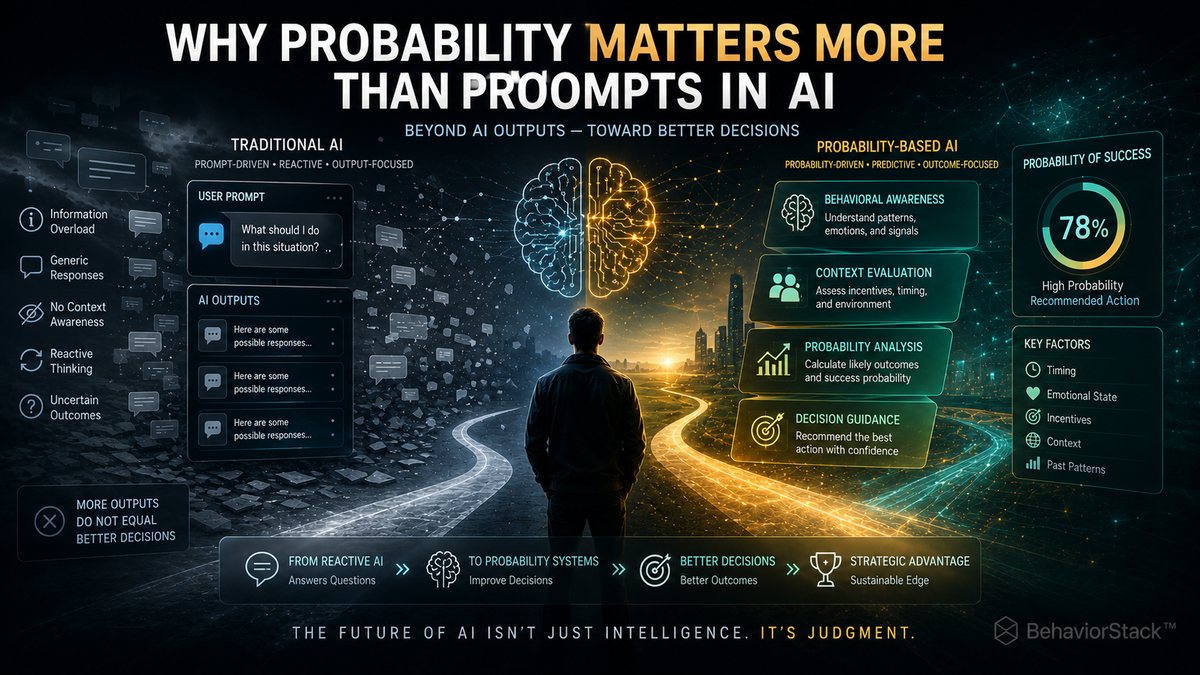
Traditional prompt-driven AI systems ask:
“What should the AI generate?”
Probability-oriented systems ask:
“What outcome is most likely to work?”
That distinction is significant.
Instead of optimizing for:
- output generation
- prompt completion
- conversational fluency
probability systems optimize for:
- decision quality
- contextual reasoning
- timing
- behavioral awareness
- likely outcomes
This represents a major evolution beyond traditional AI interaction models.
Why Prompt-Driven AI Falls Short
Most modern AI systems are fundamentally reactive.
They depend on:
- prompts
- instructions
- user inputs
- conversational context
The better the prompt…
the better the output.
But prompts alone cannot fully evaluate:
- incentives
- emotional reactions
- uncertainty
- timing
- behavioral probability
As a result:
many AI systems generate intelligent-sounding responses without improving real-world decisions.
A response may appear:
- persuasive
- logical
- informative
…and still produce poor outcomes.
Because information alone is not enough.
The Missing Layer: Probability
This is where probability systems become important.
Probability-based reasoning focuses on:
- likely outcomes
- behavioral patterns
- contextual timing
- strategic decision quality
Instead of asking:
“What can be generated?”
the system evaluates:
“What is most likely to succeed?”
This creates a major shift from:
- reactive AI
to - predictive decision intelligence
Systems like BehaviorStack™ help introduce this behavioral and probability-oriented layer into decision-making workflows.
How Probability-Based Decision Intelligence Works
Awareness
Probability systems begin by evaluating:
- emotional patterns
- behavioral tendencies
- reaction dynamics
- uncertainty signals
Context
Decisions rarely happen in isolation.
Probability-based systems evaluate:
- timing
- incentives
- environmental conditions
- behavioral context
instead of analyzing information alone.
Probability
Traditional AI often generates multiple possibilities.
Probability-oriented systems prioritize:
- likely outcomes
- strategic timing
- behavioral forecasting
- probability weighting
The focus shifts from:
“What could happen?”
to:
“What is most likely to happen?”
Structure
Probability systems introduce structure into decision-making.
Instead of:
Prompt → Response → Hope
The process becomes:
Signal → Probability → Decision
This creates more intentional and outcome-focused systems.
Real-World Applications
Probability-based AI systems can improve:
- communication
- negotiation
- leadership
- marketing
- trading
- strategic planning
- behavioral analysis
For example:
Traditional AI
“Here are five possible responses.”
Probability-Based System
“This response has the highest probability of creating a positive outcome based on timing, emotional context, and behavioral patterns.”
That is a fundamentally different approach to intelligence.
Why This Changes The Future of AI
The future of AI is not just:
better prompts.
It is:
better probability systems.
As AI becomes more accessible, the competitive advantage will increasingly come from systems that understand:
- human behavior
- contextual reasoning
- timing
- probability
- outcome optimization
The next generation of AI will likely evolve from:
- response engines
to - decision systems
That transition represents one of the biggest strategic shifts in modern AI architecture.
Why This Creates a Long-Term Advantage
People and organizations that understand:
- probability
- incentives
- psychology
- timing
- behavioral context
will consistently make:
higher-quality decisions over time.
This creates:
- stronger strategic thinking
- improved communication
- better timing
- more consistent outcomes
Probability compounds.
And so does better decision-making.
Conclusion
Prompt-driven AI systems changed how humans interact with machines.
But probability-based systems may change how humans make decisions.
That evolution moves AI beyond:
- interfaces
- prompts
- reactive outputs
and toward:
- contextual reasoning
- behavioral awareness
- probability-oriented intelligence
- outcome optimization
The future of intelligent systems will not simply be defined by:
what AI can generate.
It will increasingly be defined by:
👉 what AI can help humans achieve.
That is where probability-based decision intelligence becomes important.
CONTINUE EXPLORING
👉 Learn more about:
What Is BehaviorStack™? The Framework Behind Smarter Decisions
👉 Read next:
What Is Behavioral AI? And Why It Changes How Decisions Are Made
👉 Explore:
Why Most AI Apps Are Just Interfaces — And What Comes Next
👉 Discover:
HeartSpark™
or
MarketSpark™