Why Most AI Apps Are Just Interfaces — And What Comes Next
Most AI apps are interfaces layered on top of language models—but the next evolution is systems that improve decisions using behavior and probability.

What Are AI App Interfaces?
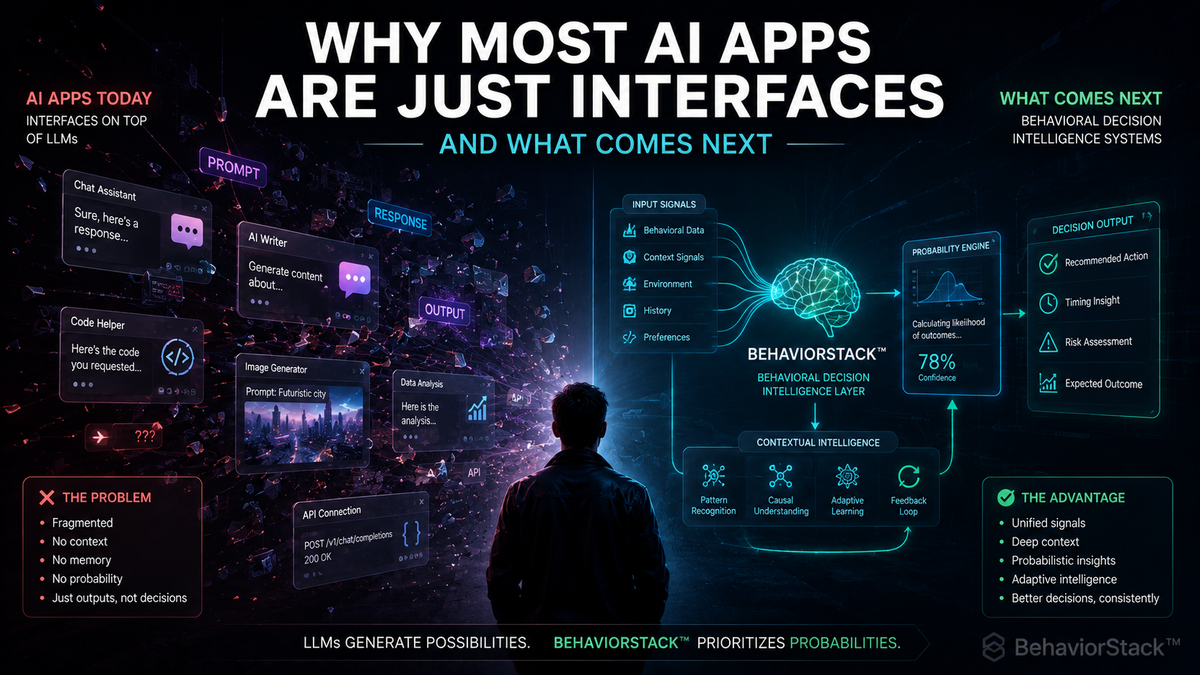
Most AI apps today are interfaces built on top of large language models, designed to generate responses, automate tasks, or simplify workflows—but not necessarily improve decision-making.
Artificial intelligence is evolving rapidly.
New AI apps launch every day promising:
- smarter automation
- better productivity
- faster workflows
But underneath many of these tools…
The architecture is surprisingly similar.
Most AI apps are simply:
👉 Interfaces connected to existing language models.
They may look different.
They may feel different.
But many rely on the same underlying systems.
That raises an important question:
What actually comes next?
Why AI App Interfaces Matter
Most modern AI applications focus on:
- generating outputs
- responding to prompts
- automating tasks
This is useful.
But it creates a major limitation:
Most systems still optimize for:
information generation
—not decision quality.
This leads to:
- generic outputs
- inconsistent results
- decision overload
The problem is no longer access to information.
It’s knowing:
👉 what to do with it.
Common Mistakes With AI Applications
Most people:
- confuse outputs with intelligence
- assume AI-generated responses improve decisions
- rely on prompts without understanding context
This creates systems that feel impressive…
…but often fail in real-world decision-making.
How to Improve AI Decision Systems
Instead of guessing, focus on:
- Behavioral signals
- Context
- Probability
This is where BehaviorStack™ comes in.
LLMs generate possibilities.
BehaviorStack™ prioritizes probabilities.
How BehaviorStack™ Works
Step 1: Signal Collection
BehaviorStack™ gathers contextual and behavioral signals—not just prompts.
This can include:
- interaction patterns
- behavioral context
- timing signals
- decision environments
Step 2: Pattern Recognition
Instead of evaluating isolated requests, the system identifies repeatable behavioral patterns over time.
Step 3: Probability Modeling
BehaviorStack™ evaluates likely outcomes—not just possible outputs.
The focus shifts from:
“What can be generated?”
to:
“What is most likely to work?”
Step 4: Decision Output
The result is not just information.
It’s:
- clearer decisions
- stronger timing
- higher-probability guidance
How Ignite Platform™ Turns BehaviorStack™ Into a Decision Platform
BehaviorStack™ is the behavioral decision technology.
Instead of building another interface that simply sends a prompt to a large language model, Ignite Platform™ creates a structured decision process:
Input
↓
Behavioral and contextual signals
↓
BehaviorStack™ analysis
↓
Structured behavioral variables
↓
Probability evaluation
↓
Decision logic
↓
AI-generated explanation
↓
Actionable recommendation
Within this architecture, the language model is not expected to make the entire decision by itself.
Its role is primarily to interpret information and communicate the result clearly.
BehaviorStack™ provides the behavioral framework used to:
- identify meaningful signals
- recognize behavioral patterns
- evaluate context
- compare likely outcomes
- prioritize higher-probability actions
Ignite Platform™ connects these capabilities into a reusable decision system that can support applications across different industries and decision environments.
For example:
- HeartSpark™ applies the system to dating, relationships, and communication decisions.
- MarketSpark™ applies it to market behavior, trading signals, and opportunity analysis.
- Future Ignite Platform™ products can apply the same underlying architecture to other categories of decisions.
The applications may address different problems, but they are powered by the same core idea:
AI should do more than generate possibilities. It should help people determine which action is most likely to produce the desired outcome.
Old Way vs. Better Way
Old Way
Guess → Action → Hope
Better Way
Signal → Insight → Higher-Probability Decision
Real-World Applications
Instead of:
- overwhelming users with possibilities
- generating endless generic responses
You can:
- prioritize likely outcomes
- guide better decisions using behavior and context
Result:
- reduced uncertainty
- more actionable intelligence
- improved decision quality
Why This Creates an Advantage
Most AI systems focus on:
what feels intelligent
The advantage comes from understanding:
what is most likely to work
That is the difference between:
- AI interfaces
and - behavioral decision systems
Related Topics and Next Steps
Continue exploring:
👉 Learn more in: What Is BehaviorStack™? The Framework Behind Smarter Decisions
👉 Read next: What Is a Decision Intelligence System? And Why AI Alone Isn’t Enough
👉 Explore: What Is FOMO in Decision Making?
Explore the tools
👉 Try HeartSpark™
Behavior-driven communication and conversation intelligence
👉 Explore MarketSpark™
Probability-driven behavioral decision insights
👉 Learn more about BehaviorStack™
The behavioral decision intelligence framework powering the ecosystem