
How Behavioral AI Predicts and Influences Decisions
Behavioral AI improves decision-making through probability, context, and behavioral understanding—moving beyond traditional AI outputs toward smarter outcomes.

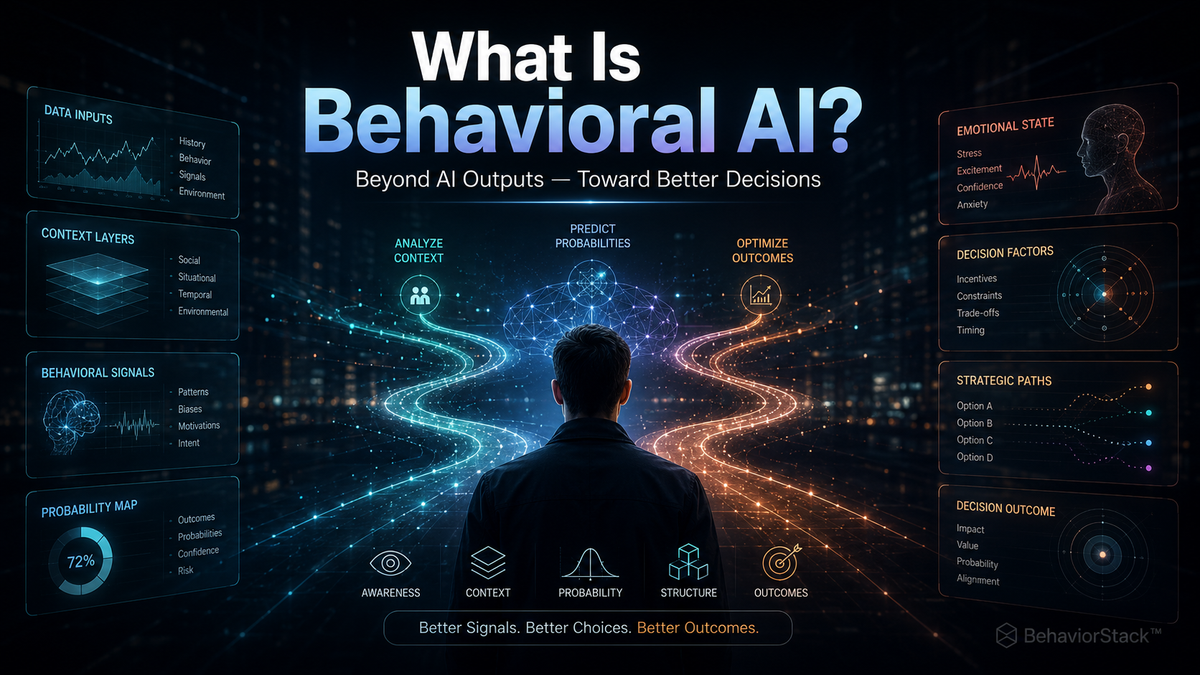
Most AI systems generate outputs.
Very few improve decisions.
That distinction is becoming increasingly important as artificial intelligence continues to evolve.
Today’s AI tools can:
- generate text
- automate tasks
- summarize information
- create recommendations
But many still struggle with:
- information overload
- reactive decision-making
- poor timing
- emotional context
- behavioral understanding
The result?
People receive more information than ever before…
…but still make poor decisions.
That’s where behavioral AI begins to change the conversation.
What Is Decision Intelligence?
Decision intelligence is the process of improving decisions through structured reasoning, contextual awareness, probability analysis, and behavioral understanding.
Unlike traditional AI systems that focus primarily on outputs, decision intelligence focuses on:
- outcomes
- probability
- timing
- context
- behavioral influence
The goal is not simply to provide answers.
The goal is to improve:
- judgment
- timing
- strategic thinking
- decision quality
This represents a major shift in how intelligent systems are designed.
Why Traditional AI Falls Short
Most AI systems focus on:
- prompts
- outputs
- automation
- surface-level responses
These systems can be highly capable at generating information.
But they often fail to understand:
- incentives
- emotion
- timing
- behavioral context
- probability
As a result:
many AI systems generate responses without improving outcomes.
A response may be:
- technically correct
- well-written
- logically structured
…and still lead to poor decisions if behavioral context is missing.
The Missing Layer: Behavior
This is where systems like BehaviorStack™ become important.
Behavior influences:
- communication
- timing
- perception
- confidence
- reactions
- risk assessment
Human decisions are rarely based on logic alone.
They are influenced by:
- emotion
- incentives
- social pressure
- uncertainty
- perceived reward
- perceived risk
Without behavioral context:
even accurate information can produce poor outcomes.
Behavioral AI attempts to bridge that gap.
How Behavioral Decision Intelligence Works
Awareness
Behavioral AI begins by understanding emotional and behavioral patterns.
This includes:
- reactions
- incentives
- emotional states
- behavioral tendencies
Context
Decisions are influenced by environment and timing.
Behavioral systems evaluate:
- situational context
- social dynamics
- urgency
- behavioral momentum
instead of analyzing information in isolation.
Probability
Traditional AI often generates possibilities.
Behavioral decision intelligence focuses on:
- likely outcomes
- probability weighting
- strategic timing
- behavioral forecasting
The focus shifts from:
“What can happen?”
to:
“What is most likely to happen?”
Structure
Behavioral AI introduces structure into decision-making.
Instead of:
React → Guess → Repeat
The process becomes:
Observe → Analyze → Decide
This creates more intentional and strategic thinking.
Real-World Applications
Behavioral decision intelligence can improve:
- relationships
- negotiation
- leadership
- marketing
- trading
- communication
- strategic planning
Any environment involving:
- uncertainty
- human behavior
- timing
- incentives
can benefit from behavioral decision systems.
Why This Changes The Future of AI
The future of AI is not simply:
better outputs.
It is:
better decisions.
The next generation of intelligent systems will increasingly focus on:
- behavioral understanding
- probability analysis
- contextual reasoning
- outcome optimization
This is a fundamental evolution beyond traditional AI interfaces.
As AI becomes more accessible, the real competitive advantage will come from:
understanding behavior and improving decision quality.
Why This Creates a Long-Term Advantage
People and organizations that understand:
- incentives
- psychology
- timing
- behavior
- probability
will consistently make:
- stronger strategic decisions
- better communication decisions
- higher-quality long-term outcomes
Behavioral intelligence compounds over time.
That creates a durable advantage.
Conclusion
Behavioral AI represents a shift away from systems that merely generate information…
toward systems that improve decisions.
The future of intelligent systems will increasingly depend on:
- behavioral understanding
- contextual reasoning
- probability-based thinking
- strategic timing
This evolution moves AI beyond:
- interfaces
- outputs
- automation
and toward:
decision intelligence.
As this transition continues, systems like BehaviorStack™ help illustrate what the next generation of AI may look like:
behavior-aware,
probability-focused,
and outcome-oriented.
CONTINUE EXPLORING
👉 Learn more about:
What Is BehaviorStack™? The Framework Behind Smarter Decisions
👉 Read next:
What Is a Decision Intelligence System? And Why AI Alone Isn’t Enough
👉 Explore:
Why Most AI Apps Are Just Interfaces — And What Comes Next
👉 Discover:
HeartSpark™
or
MarketSpark™