BehaviorStack™ vs Standard AI Layers: The Missing Piece in Modern AI Systems
BehaviorStack™ introduces a behavioral decision layer that standard AI stacks lack—focusing on probability, human behavior, and decision quality.

What Is Behavioral AI vs Standard AI?
Behavioral AI differs from standard AI by focusing on predicting decisions using human behavior, context, and probability—rather than just generating responses or executing tasks like traditional AI systems.
Artificial intelligence has advanced rapidly.
From large language models to agent-based systems, today’s AI stacks are powerful—but incomplete.
They can generate answers.
They can execute tasks.
But they still struggle with one critical function:
Making high-quality decisions.
That’s where BehaviorStack™ introduces a fundamental shift.
What Is Standard AI Layering?
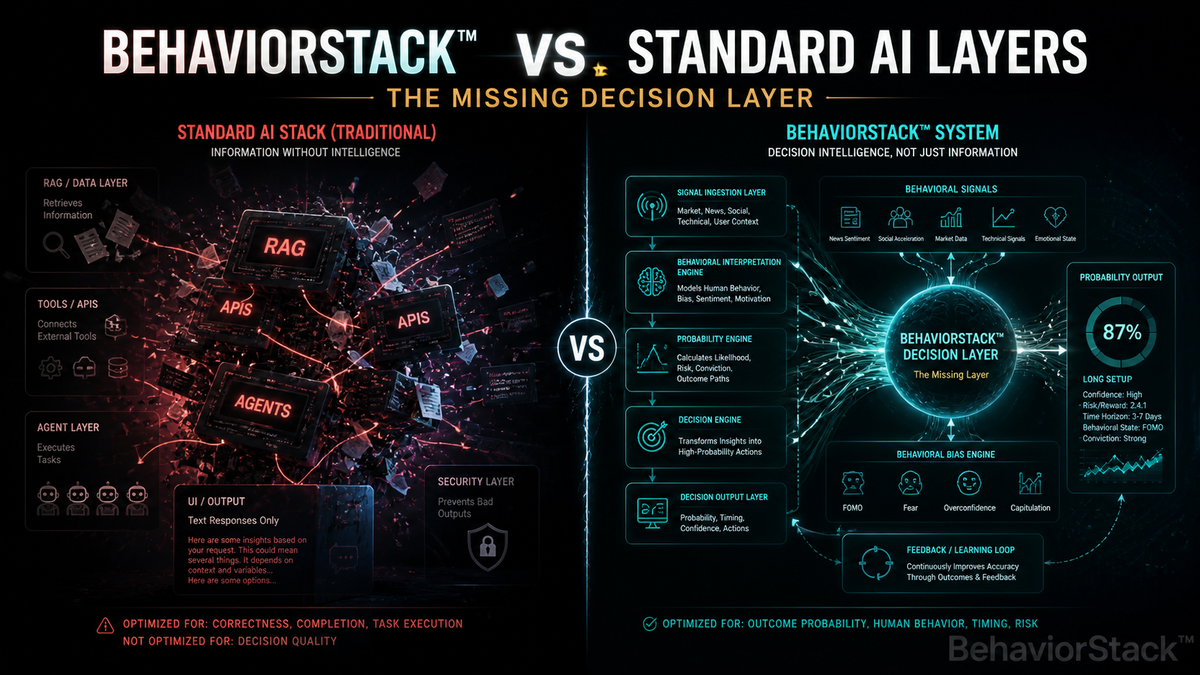
Most modern AI systems follow a layered architecture:
- Data Layer (retrieving information)
- Orchestration Layer (connecting tools and APIs)
- Agent Layer (executing tasks)
- UI Layer (displaying outputs)
- Security Layer (ensuring safe responses)
These systems are optimized for:
- Accuracy
- Completion
- Task execution
But they are not optimized for:
Decision quality.
What Is BehaviorStack™ and How Is It Different?
BehaviorStack™ is a behavioral decision layer that sits on top of traditional AI systems and transforms outputs into probability-based decisions.
Instead of:
User → AI → Answer
You get:
User → AI → BehaviorStack™ → Probability-Based Decision Output
This shift moves AI from:
- Information generation
to - Decision optimization
Why Do Standard AI Systems Fall Short?
Even advanced AI systems are missing a critical capability:
They do not evaluate decision quality.
They optimize for:
- Correctness
- Completion
- Execution
But real-world outcomes depend on:
- Human behavior
- Context
- Timing
- Probability
This gap is where most AI systems fail.
How Does BehaviorStack™ Work?
1. Behavioral Signal Awareness
BehaviorStack™ focuses on how people actually behave—not just what data says.
This includes:
- Patterns of action
- Emotional responses
- Contextual triggers
- Decision tendencies
2. Behavioral Interpretation
Instead of treating inputs as isolated data points, BehaviorStack™ interprets:
- Why people act
- When they act
- What influences their decisions
This adds meaning—not just information.
3. Probability-Based Decisioning
BehaviorStack™ shifts outputs from:
“What are the options?”
to:
“What is most likely to work?”
This creates:
- Clearer decisions
- Reduced guesswork
- More consistent outcomes
4. Decision-Oriented Output
Instead of overwhelming users with possibilities, BehaviorStack™ focuses on:
- Direction
- Timing
- Likelihood
The goal is not more information.
The goal is better decisions.
What Is Missing From Standard AI Architectures?
The biggest limitation in modern AI isn’t intelligence.
It’s lack of behavioral understanding.
Standard AI answers:
“What could happen?”
BehaviorStack™ answers:
“What is most likely to happen?”
How Can AI Systems Improve Decision-Making?
To move beyond traditional AI, systems must incorporate:
- Behavioral context
- Pattern recognition over time
- Probability-based thinking
This is where BehaviorStack™ creates a meaningful advantage.
What Makes Behavioral AI Powerful?
Behavioral AI introduces a new way of thinking:
Instead of relying on:
- Raw data
- Static outputs
- Generic responses
It focuses on:
- Human behavior
- Situational context
- Outcome probability
What Is the Difference Between Old AI and Behavioral AI?
Old Way:
Data → Analysis → Guess
Better Way:
Behavior → Context → Probability → Decision
Why Does This Create an Advantage?
Most systems focus on:
What is correct
The advantage comes from understanding:
What is most likely to work
That’s the difference between:
- Information tools
and - Decision intelligence systems
What Are Real-World Applications of Behavioral AI?
Behavioral AI applies anywhere decisions matter.
Instead of:
- Overthinking what to say
- Guessing the right move
- Reacting emotionally
You can:
- Act with structured confidence
- Make decisions based on probability
- Reduce uncertainty
Results:
- More consistent outcomes
- Faster decision-making
- Reduced emotional bias
Frequently Asked Questions
What is behavioral AI?
Behavioral AI is a type of artificial intelligence that predicts human decisions using behavior, context, and probability instead of just generating responses.
How is behavioral AI different from traditional AI?
Traditional AI focuses on generating outputs and completing tasks, while behavioral AI focuses on predicting outcomes and guiding decisions.
Why is behavioral AI important?
Behavioral AI improves decision-making by incorporating human behavior, timing, and probability—leading to more consistent results.
Final Positioning
Standard AI is:
AI that can do things
BehaviorStack™ is:
AI that understands what humans are likely to do next
Related Topics and Next Steps
👉 Learn more in: What Is BehaviorStack™? The Framework Behind Smarter Decisions
👉 Read next: Why Most AI Tools Fail at Decision-Making
👉 Explore: Behavioral AI vs Traditional AI
Explore the tools
👉 Try HeartSpark™
👉 Explore MarketSpark™
👉 Learn more about BehaviorStack™