Decision Latency: The Hidden Cost of Waiting Too Long to Decide
Decision latency is the hidden delay between recognizing a decision and taking action. Learn how reducing decision latency improves confidence, productivity, and long-term outcomes.

We've all experienced it.
A decision needs to be made.
You have enough information to move forward.
Yet instead of deciding, you wait.
You tell yourself you'll think about it tomorrow.
You'll gather one more opinion.
You'll read one more article.
You'll wait for the perfect moment.
Days become weeks.
Weeks become months.
Opportunities quietly disappear—not because you made the wrong decision, but because you didn't make one at all.
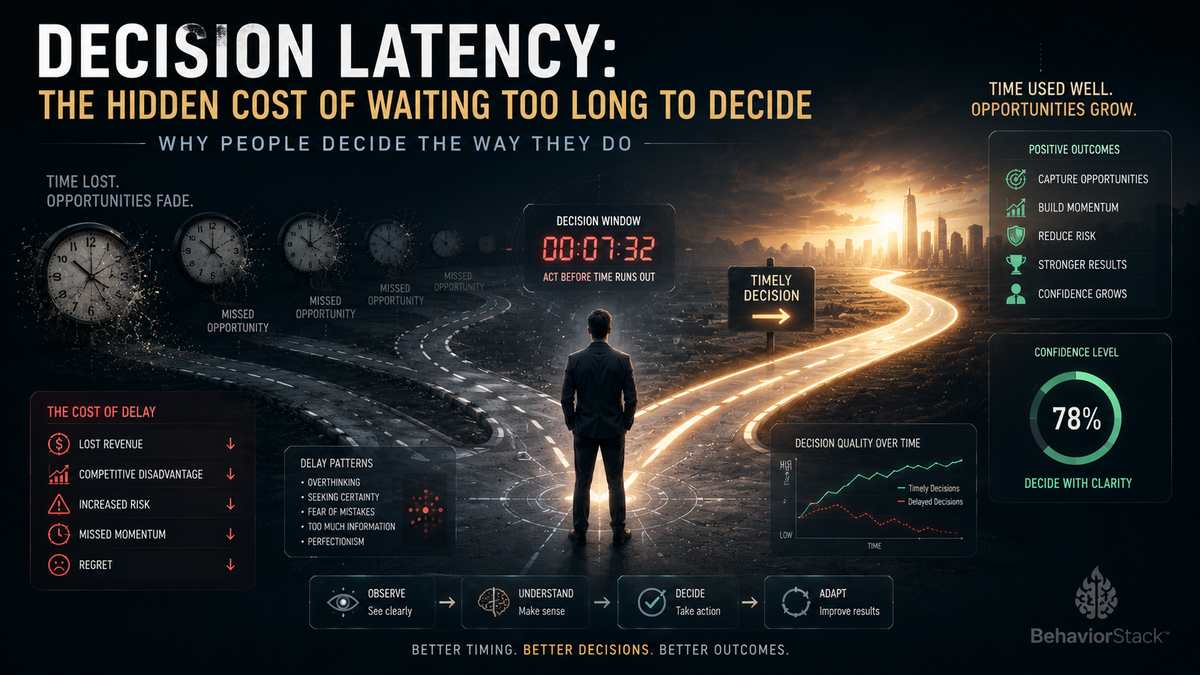
This hidden delay is known as decision latency, and it can quietly undermine success in business, investing, relationships, and everyday life.
What Is Decision Latency?
Decision latency is the amount of time between recognizing that a decision needs to be made and actually making it.
Some delay is healthy.
Important decisions deserve careful thought.
The problem occurs when additional waiting no longer improves decision quality.
Instead, it simply postpones action.
Decision latency often increases because of:
- uncertainty
- fear of making mistakes
- information overload
- perfectionism
- competing priorities
The longer unnecessary delays continue, the greater the potential cost.
Why Decision Latency Matters
Time is a factor in nearly every decision.
Opportunities have expiration dates.
Markets change.
People change.
Circumstances evolve.
Even the best decision can lose value if it's made too late.
Excessive decision latency often leads to:
- missed opportunities
- analysis paralysis
- reduced confidence
- slower execution
- increased stress
- poorer long-term outcomes
The cost isn't always visible.
Sometimes the greatest loss is the opportunity that never materialized because action came too late.
Common Mistakes People Make
Most people:
- Wait for complete certainty before acting.
- Continue gathering information after they already have enough.
- Confuse delaying a decision with improving a decision.
- Avoid difficult choices because they're uncomfortable.
- Let emotions determine timing instead of evidence.
These habits feel productive because they involve thinking.
But thinking without deciding eventually becomes procrastination disguised as preparation.
The goal isn't to make decisions quickly.
The goal is to make them at the right time.
How to Improve Decision Latency
Instead of reacting, focus on:
Awareness
Recognize when you're delaying because additional thinking genuinely improves the decision—and when you're simply avoiding commitment.
Ask yourself:
- What information am I still missing?
- Will waiting realistically change the outcome?
- Am I delaying because of fear?
Awareness often reveals that the obstacle isn't information.
It's uncertainty.
Patterns
Look for recurring situations where delays become costly.
Do you postpone:
- difficult conversations?
- investment decisions?
- hiring?
- launching projects?
Identifying patterns helps eliminate habitual delays.
Intent
Clarify what success actually looks like.
Rather than asking:
"When will I feel completely certain?"
Ask:
"When will I have enough evidence to make a good decision?"
Intent shifts the goal from certainty to progress.
This is where systems like BehaviorStack™ begin to matter.
Rather than encouraging endless analysis, behavioral decision frameworks organize information around context, incentives, timing, and probability—helping people decide with confidence instead of waiting for perfection.
Old Way vs Better Way
Old Way
React → Guess → Repeat
Wait.
Second-guess.
Delay.
Rush the decision when time runs out.
Repeat the cycle.
Better Way
Observe → Understand → Decide
Gather relevant information.
Understand the context.
Recognize when sufficient evidence exists.
Make the decision.
Adapt if new information emerges.
Better decisions don't always come from waiting longer.
They often come from following a better process.
Real-World Examples
Business
Instead of:
- Waiting months to launch a product.
- Delaying hiring until every candidate seems perfect.
You can:
- Launch a minimum viable product.
- Hire when the strongest available evidence supports the decision.
Results:
- Faster learning.
- Earlier customer feedback.
- Greater competitive advantage.
Investing
Instead of:
- Waiting until everyone agrees the market is safe.
- Chasing opportunities after they've already peaked.
You can:
- Follow a structured investment strategy.
- Base decisions on probability rather than headlines.
Results:
- Better timing.
- Reduced emotional investing.
- Improved long-term consistency.
Relationships
Instead of:
- Avoiding difficult conversations.
- Waiting for the "perfect" time to address concerns.
You can:
- Communicate early.
- Address issues before frustration builds.
Results:
- Stronger trust.
- Better communication.
- Fewer unresolved conflicts.
Why This Gives You an Edge
Most people don't lose opportunities because they're unintelligent.
They lose them because they hesitate.
Decision latency quietly accumulates.
Small delays become missed opportunities.
Missed opportunities become long-term regret.
People who consistently make better decisions aren't necessarily faster thinkers.
They're better at recognizing when enough evidence exists to move forward.
Awareness.
Structure.
Timely action.
Those three habits create a significant advantage over time.
Every decision has a window of opportunity.
Act too quickly and you may ignore important information.
Wait too long and the opportunity may disappear.
Decision latency is about finding the balance.
The most effective decision-makers don't chase certainty.
They recognize when they have enough information, understand the risks, and move forward with intention.
In a world where change happens faster every year, reducing unnecessary decision latency may become one of the most valuable competitive advantages you can develop.
Better outcomes rarely belong to those who wait the longest.
They belong to those who know when it's time to decide.
CONTINUE EXPLORING
👉 Learn more about: What Is BehaviorStack™? The Framework Behind Smarter Decisions
👉 Read next: Signal vs Noise: How To Filter Information When Decisions Are Fast
👉 Explore: Cognitive Load: Why Complex Systems Create Bad Decisions
👉 Try: MarketSpark™ — Behavioral Intelligence for Smarter Market Decisions