
Cognitive Load: Why Complex Systems Create Bad Decisions
Cognitive load decision making explains why too much information, complexity, and mental effort often lead to poor choices. Learn how to reduce cognitive load and improve decision quality.

Introduction
Have you ever spent so much time analyzing a decision that you ended up making no decision at all?
Maybe you compared dozens of products before making a purchase.
Maybe you reviewed endless data before making a business decision.
Maybe you tried to consider every possible outcome before taking action.
Most people assume that more information automatically leads to better decisions.
In reality, too much information can have the opposite effect.
When the brain becomes overloaded, decision quality often declines.
This phenomenon is known as cognitive load.
What Is Cognitive Load?
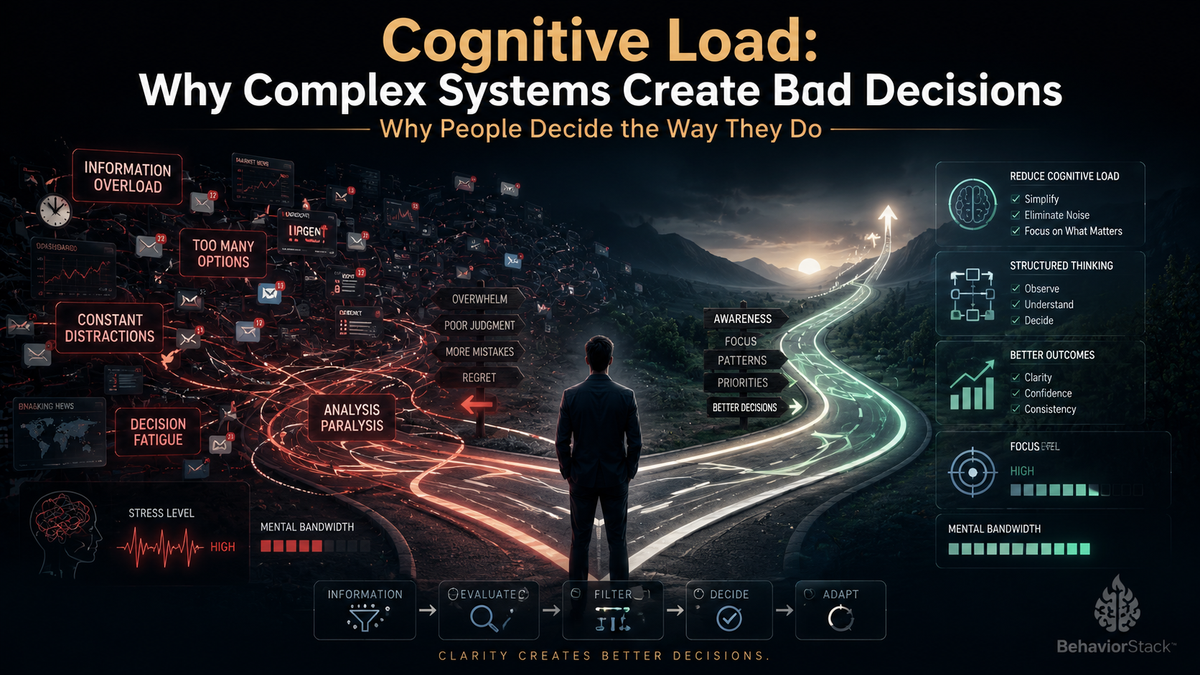
Cognitive load refers to the amount of mental effort required to process information, solve problems, and make decisions.
Your brain has limited capacity.
When too much information competes for attention at the same time, performance begins to suffer.
Supporting factors include:
- Information overload
- Too many options
- Excessive complexity
- Constant interruptions
- Emotional stress
The more mental resources a task requires, the higher the cognitive load becomes.
When cognitive load exceeds what the brain can comfortably manage, decision-making becomes slower, less accurate, and more emotionally driven.
Why Cognitive Load Matters
Modern life constantly bombards people with information.
Emails.
Notifications.
News.
Meetings.
Social media.
Data dashboards.
Text messages.
Every piece of information competes for limited cognitive resources.
As cognitive load increases, the brain begins looking for shortcuts.
This often leads to:
- Poor judgment
- Decision fatigue
- Increased mistakes
- Emotional reactions
- Analysis paralysis
- Impulsive choices
The result is often worse outcomes despite having more information available.
Common Mistakes People Make
Most people:
- Assume more information is always better
- Try to analyze every possible outcome
- Constantly switch between tasks
- Delay decisions while seeking certainty
- Overcomplicate simple choices
The problem isn't intelligence.
The problem is overload.
When the brain becomes overwhelmed, even highly capable people begin making lower-quality decisions.
Complexity creates friction.
Friction creates fatigue.
Fatigue creates mistakes.
How to Improve Cognitive Load Decision Making
Instead of reacting, focus on:
Awareness
Recognize when you are mentally overloaded.
Warning signs include:
- Difficulty concentrating
- Constant second-guessing
- Increased frustration
- Decision avoidance
Awareness helps prevent overload from silently influencing decisions.
Patterns
Look for recurring situations that create unnecessary complexity.
Ask yourself:
- What information actually matters?
- What information is simply noise?
- What decisions repeat frequently?
Patterns help reduce mental effort by creating consistency.
Intent
Focus on the outcome you are trying to achieve.
Many people become distracted by information that feels important but has little impact on the final decision.
Intent keeps attention directed toward meaningful factors.
This is where systems like BehaviorStack™ begin to matter.
Rather than simply providing more information, behavioral decision frameworks help organize information around probability, context, incentives, and outcomes.
The goal is not more thinking.
The goal is better thinking.
Old Way vs Better Way
Old Way
React → Guess → Repeat
Information arrives.
Emotions increase.
Decisions become rushed.
Mistakes compound.
The cycle repeats.
Better Way
Observe → Understand → Decide
Gather information.
Identify what matters.
Reduce complexity.
Make a decision based on context and probability.
Move forward with confidence.
This approach creates clarity instead of overload.
Real-World Examples
Business Decisions
Instead of:
- Reviewing every available metric
- Chasing every new opportunity
You can:
- Focus on key performance indicators
- Prioritize the highest-impact actions
Results:
- Faster decisions
- Better execution
- Less overwhelm
Relationships
Instead of:
- Overanalyzing every text message
- Assuming negative intentions
You can:
- Look for patterns over time
- Consider context before reacting
Results:
- Better communication
- Fewer misunderstandings
- Stronger relationships
Investing
Instead of:
- Following every market headline
- Reacting emotionally to volatility
You can:
- Follow a structured process
- Focus on probability rather than prediction
Results:
- More consistency
- Better risk management
- Improved long-term outcomes
Why This Gives You an Edge
Most people react emotionally when complexity increases.
The brain seeks certainty.
When certainty cannot be found, people often:
- Freeze
- Panic
- Overanalyze
- Make impulsive decisions
Awareness creates an advantage.
Structure creates an advantage.
People who learn to manage cognitive load make better decisions because they can focus on what truly matters.
Instead of being controlled by information, they control how information influences them.
Better outcomes come from:
Awareness + Structure.
Conclusion
Complex systems often create bad decisions because they overwhelm the brain's ability to process information effectively.
More information is not always better.
More complexity is not always smarter.
The best decision-makers learn how to reduce unnecessary cognitive load, focus on what matters most, and make decisions using structure rather than emotion.
In a world overflowing with information, clarity becomes a competitive advantage.
The people who can simplify complexity will often outperform those who simply consume more data.
CONTINUE EXPLORING
👉 Learn more about: What Is BehaviorStack™? The Framework Behind Smarter Decisions
👉 Read next: Signal vs Noise: How To Filter Information When Decisions Are Fast
👉 Explore: What Is Decision Fatigue? And How To Avoid It
👉 Try: HeartSpark™ — Behavioral Intelligence for Better Conversations