What Is Decision Fatigue? (And How to Avoid It)
Decision fatigue reduces decision quality over time, leading to emotional reactions and poor judgment. Learn how to recognize and avoid it.

Have You Ever Felt Mentally Exhausted By Simple Decisions?
You start the day focused and productive (This is the day!)
By the afternoon, even small decisions begin to feel frustrating. (Do I present my new idea or work on it more?)
Questions that should be easy suddenly become difficult:
- What should I work on next?
- Should I respond now or later?
- Is this the right choice?
- What if I make the wrong decision?
Many people assume they're simply tired.
But there is a specific psychological phenomenon behind this experience:
decision fatigue.
The Hidden Cost of Constant Decision-Making
Every decision requires mental energy.
Some decisions are significant.
Others seem insignificant:
- what to wear
- what to eat
- which email to answer first
- what task deserves attention
But the brain doesn't completely separate major decisions from minor ones.
As the number of choices increases, mental resources gradually decline.
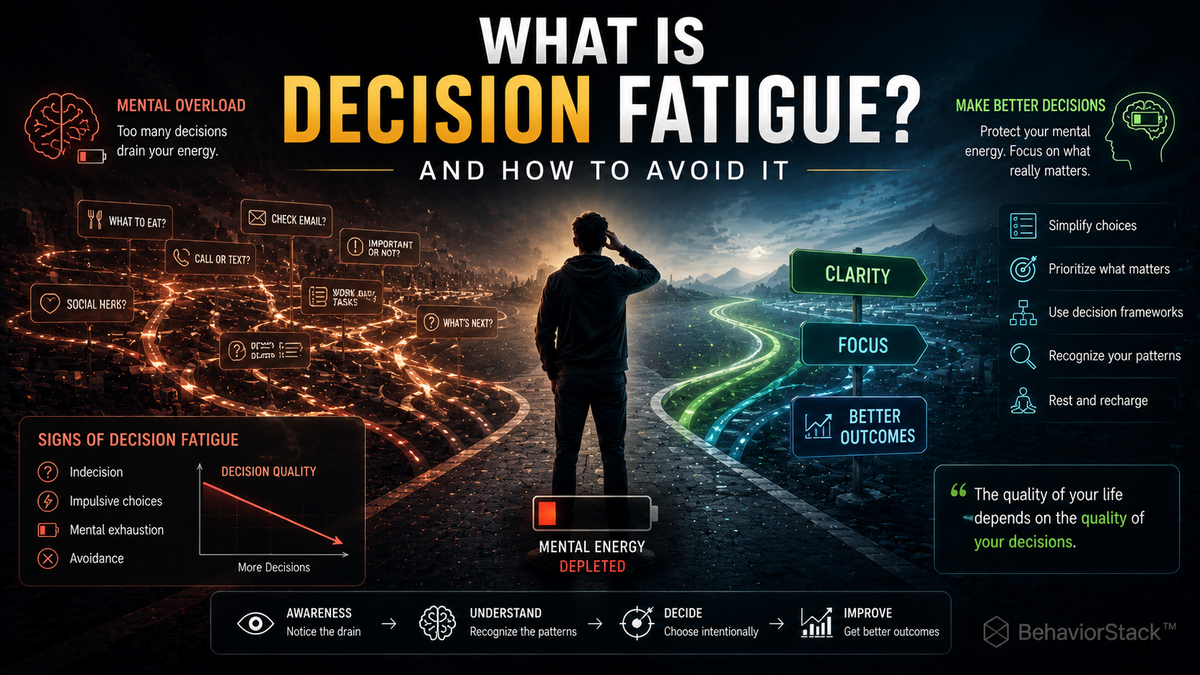
Over time, people become more likely to:
- avoid decisions entirely
- make impulsive choices
- default to familiar habits
- react emotionally
This is decision fatigue in action.
What Is Decision Fatigue?
Decision fatigue is the deterioration of decision quality after making a large number of decisions over time.
In simple terms:
the more decisions you make, the harder it becomes to make good ones.
Research in psychology has shown that mental energy is limited.
As cognitive resources become depleted, people often rely on shortcuts rather than thoughtful evaluation.
This can lead to:
- poor judgment
- inconsistent choices
- emotional reactions
- reduced self-control
Signs You May Be Experiencing Decision Fatigue
Many people don't recognize it when it's happening.
Common warning signs include:
Indecision
You delay decisions because everything feels equally difficult.
Impulsiveness
You choose the fastest option simply to stop thinking about it.
Mental Exhaustion
Even simple choices feel overwhelming.
Avoidance
You postpone decisions altogether.
These behaviors often appear gradually and become normalized over time.
Why Decision Fatigue Matters
Decision fatigue influences:
- relationships
- leadership
- communication
- investing
- productivity
- strategic planning
The consequences can be surprisingly significant.
People experiencing decision fatigue often:
- overlook important details
- make emotionally driven decisions
- avoid opportunities
- rely on habits instead of analysis
The issue isn't intelligence.
It's depleted mental resources.
Breaking The Cycle
Many people try to solve decision fatigue by gathering more information.
But information is rarely the problem.
The real solution is reducing unnecessary cognitive load.
Strategies include:
Simplify Routine Decisions
Reduce repetitive choices whenever possible.
Prioritize Important Decisions Early
Mental energy is strongest earlier in the day.
Create Decision Frameworks
Structured processes reduce emotional decision-making.
Recognize Behavioral Patterns
Awareness often prevents automatic reactions.
This is where systems like BehaviorStack™ begin to matter.
Behavioral awareness helps people identify patterns before fatigue begins influencing decisions.
A Practical Example
Imagine two office workers facing the same important business decision late in the day.
Person One
- has spent hours making small decisions
- feels mentally exhausted
- reacts emotionally
Result:
A rushed decision with unnecessary risk.
Person Two
- recognizes decision fatigue
- delays evaluation until mentally refreshed
- uses a structured decision process
Result:
A more thoughtful and higher-quality outcome.
The difference isn't intelligence.
It's awareness.
Better Decisions Require More Than Information
Many people believe better decisions come from having more options.
In reality:
more options often create more fatigue.
The goal isn't maximizing information.
The goal is improving decision quality.
That requires:
- awareness
- structure
- intentional thinking
Decision fatigue affects almost everyone.
The more decisions people make, the more vulnerable they become to:
- emotional reactions
- poor judgment
- impulsive choices
- mental exhaustion
Understanding decision fatigue is the first step toward improving decision quality.
Because better decisions are rarely the result of thinking harder.
They are often the result of thinking more intentionally.
CONTINUE EXPLORING
👉 Learn more about:
What Is BehaviorStack™? The Framework Behind Smarter Decisions
👉 Read next:
Why Overthinking Leads to Worse Decisions
👉 Explore:
Why Emotions Drive Most Decisions (Not Logic)
👉 Try: