Why Overthinking Leads to Worse Decisions
Overthinking decisions creates hesitation, stress, and emotional paralysis—understanding behavioral patterns can improve clarity and decision-making.

Introduction
Most people believe that thinking longer leads to better decisions.
But often…
the opposite happens.
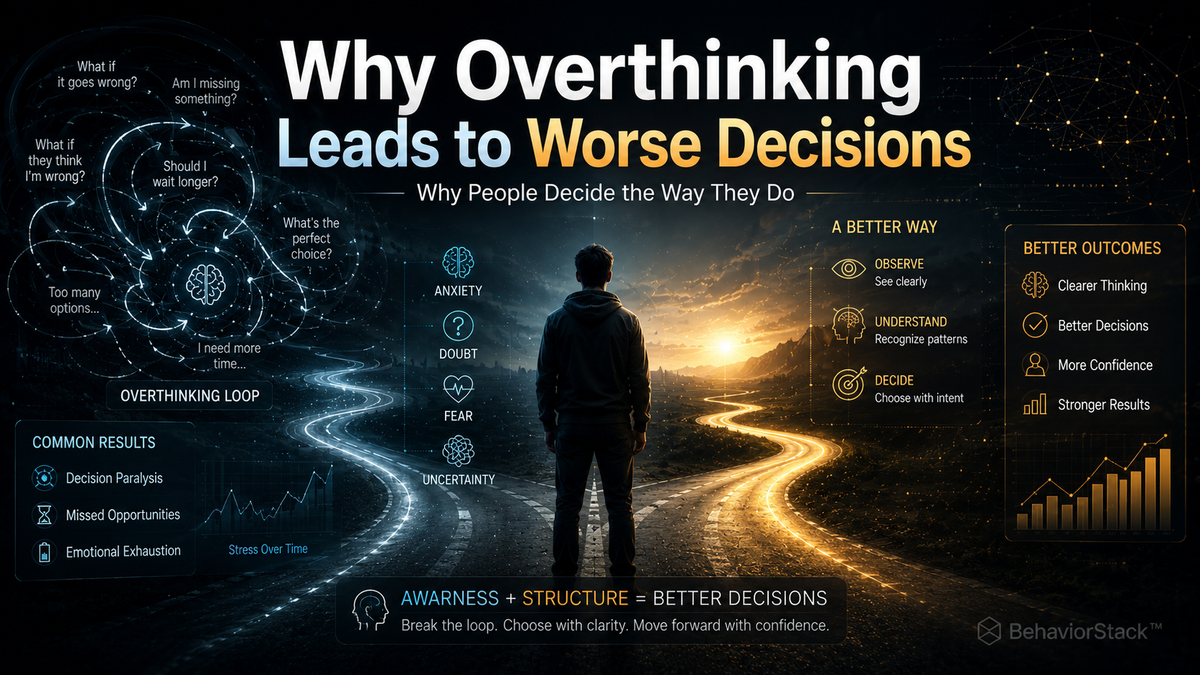
Overthinking creates:
- hesitation
- anxiety
- confusion
- emotional exhaustion
- delayed action
Instead of improving clarity, excessive analysis can make decisions harder.
People become trapped in cycles of:
- second-guessing
- uncertainty
- fear of making mistakes
- endless information processing
The result?
Poorer decisions—not better ones.
What Is Overthinking?
Overthinking occurs when someone repeatedly analyzes a situation beyond the point where additional thinking improves the outcome.
It usually involves:
- excessive worry
- repeated mental replay
- fear-based analysis
- inability to commit to action
Supporting points:
- Overthinking often increases emotional stress rather than improving clarity.
- The brain begins focusing on uncertainty instead of probability.
At that point, thinking becomes:
reactive instead of productive.
Why Overthinking Matters
Overthinking affects:
- relationships
- communication
- leadership
- decision-making
- productivity
- confidence
This often leads to:
- delayed action
- missed opportunities
- emotional burnout
Many people believe they are being “careful”…
when they are actually avoiding uncertainty.
Common Mistakes People Make
Most people:
- seek perfect certainty before acting
- continuously replay scenarios
- confuse more thinking with better judgment
This creates decision paralysis.
Instead of improving outcomes, overthinking often:
- increases fear
- weakens confidence
- delays necessary action
The longer people stay trapped in analysis loops, the more emotionally reactive decisions become.
How to Improve Overthinking Decisions
Instead of reacting, focus on:
- Awareness
- Patterns
- Intent
Ask yourself:
- Is additional thinking improving the outcome?
or - Am I trying to eliminate uncertainty completely?
Most decisions do not require:
perfect certainty.
They require:
clearer structure and better awareness.
This is where systems like BehaviorStack™ begin to matter.
Behavioral awareness helps reduce reactive thinking and creates more intentional decision-making patterns.
Old Way vs Better Way
Old Way
React → Guess → Repeat
Better Way
Observe → Understand → Decide
Real-World Examples
Instead of:
- replaying conversations repeatedly
- delaying decisions because of uncertainty
You can:
- evaluate situations more objectively
- focus on probability instead of perfection
Results:
- clearer thinking
- faster decision-making
- reduced emotional stress
Why This Gives You an Edge
Most people react emotionally.
Better outcomes come from:
Awareness + structure.
People who learn to recognize overthinking patterns gain the ability to:
- act more intentionally
- reduce emotional noise
- improve decision consistency over time
Conclusion
Overthinking is often misunderstood as intelligence or caution.
In reality, excessive analysis frequently creates:
- hesitation
- emotional exhaustion
- weaker decisions
The goal is not:
thinking less.
The goal is:
thinking more strategically.
As behavioral psychology and decision intelligence continue evolving, the ability to recognize and manage overthinking becomes a major advantage.
Better decisions begin with awareness.
CONTINUE EXPLORING
👉 Learn more about:
What Is BehaviorStack™? The Framework Behind Smarter Decisions
👉 Read next:
Why Emotions Drive Most Decisions (Not Logic)
👉 Explore:
What Is Loss Aversion? (And How It Affects Your Decisions)
👉 Try:
HeartSpark™
or
MarketSpark™