What Is Loss Aversion? (And How It Affects Your Decisions)
Loss aversion influences decisions by making people fear losses more than they value gains—understanding it can improve awareness and decision-making.

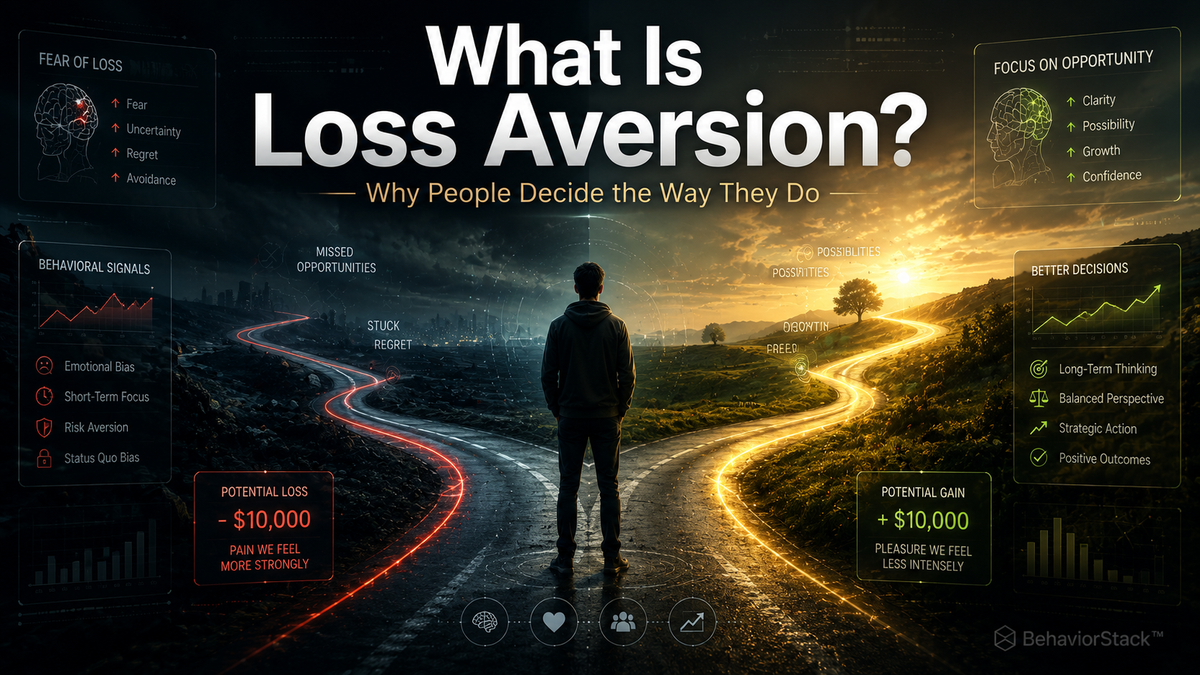
Most people fear losing something more than they value gaining something.
That single psychological tendency influences:
- money decisions
- relationships
- communication
- risk-taking
- timing
- opportunity evaluation
People often avoid action not because the opportunity is bad…
…but because the fear of loss feels stronger than the potential reward.
This psychological pattern is known as:
loss aversion.
What Is Loss Aversion?
Loss aversion is a behavioral psychology principle where people feel the pain of losses more strongly than the pleasure of equivalent gains.
In simple terms:
Losing $100 usually feels worse than gaining $100 feels good.
Supporting points:
- Humans are naturally wired to avoid perceived threats and losses.
- Emotional reactions to loss often override logical decision-making.
This can lead people to:
- avoid opportunities
- hesitate too long
- make emotionally defensive decisions
even when the potential upside outweighs the risk.
Why Loss Aversion Matters
Loss aversion affects decisions in everyday life.
It influences:
- investing
- negotiation
- communication
- leadership
- relationships
- career decisions
This often leads to:
- missed opportunities
- emotional reactions
- poor long-term decision-making
Many people believe they are being cautious…
when they are actually being controlled by fear of loss.
Common Mistakes People Make
Most people:
- avoid action because of short-term fear
- focus more on potential losses than long-term outcomes
- stay emotionally attached to bad decisions
This creates situations where people:
- hesitate too long
- hold onto failing strategies
- avoid beneficial change
The emotional discomfort of losing often becomes stronger than rational analysis.
How to Improve Loss Aversion
Instead of reacting, focus on:
- Awareness
- Patterns
- Intent
Ask yourself:
- Am I avoiding this because it’s truly risky? or
- Am I simply uncomfortable with uncertainty?
This is where systems like BehaviorStack™ begin to matter.
Behavioral awareness helps create more structured decision-making instead of purely emotional reactions.
Old Way vs Better Way
Old Way
React → Guess → Repeat
Better Way
Observe → Understand → Decide
Real-World Examples
Instead of:
- avoiding opportunities out of fear
- making defensive emotional decisions
You can:
- evaluate risk more objectively
- focus on probability instead of emotion
Results:
- clearer decision-making
- reduced emotional bias
- improved long-term outcomes
Why This Gives You an Edge
Most people react emotionally.
Better outcomes come from:
Awareness + structure.
When you recognize loss aversion, you gain the ability to:
- slow down emotional reactions
- evaluate context more clearly
- make higher-quality decisions over time
Loss aversion is one of the most powerful behavioral forces influencing human decisions.
Understanding it creates a major advantage because it helps separate:
- emotional reactions from
- intentional decision-making
As behavioral psychology and decision intelligence continue evolving, awareness of patterns like loss aversion becomes increasingly valuable.
Better decisions begin with understanding behavior.
CONTINUE EXPLORING
👉 Learn more about:
What Is BehaviorStack™? The Framework Behind Smarter Decisions
👉 Read next:
Why Emotions Drive Most Decisions (Not Logic)
👉 Explore:
What Is FOMO in Decision Making?
👉 Try:
or