FOMO Trading: A Pre-Trade Checklist to Stop Chasing
Use this practical FOMO trading checklist to stop chasing trades, reduce emotional decisions, and improve consistency.

The Trade Is Already Moving… And Suddenly You Need To Be In It
Every trader has experienced it.
You see a chart exploding upward.
Social media is talking about it.
The fear starts creeping in.
Thoughts quickly appear:
- "I'm going to miss this move."
- "Everyone else is making money."
- "I have to get in now."
Five minutes later, you enter the trade.
Ten minutes later, it reverses.
This is FOMO trading.
And it has very little to do with intelligence.
It has everything to do with psychology.
Why FOMO Happens In The First Place
FOMO (Fear Of Missing Out) is an emotional response to perceived opportunity scarcity.
Your brain interprets movement as urgency.
Several psychological systems activate at once:
- social proof
- greed
- urgency
- scarcity
- loss aversion
The result?
Emotion begins driving the decision instead of structure.
To understand why that pressure can feel useful even when it distorts judgment, read FOMO in Trading: Is It Good or Bad—and What Exactly Is It?.
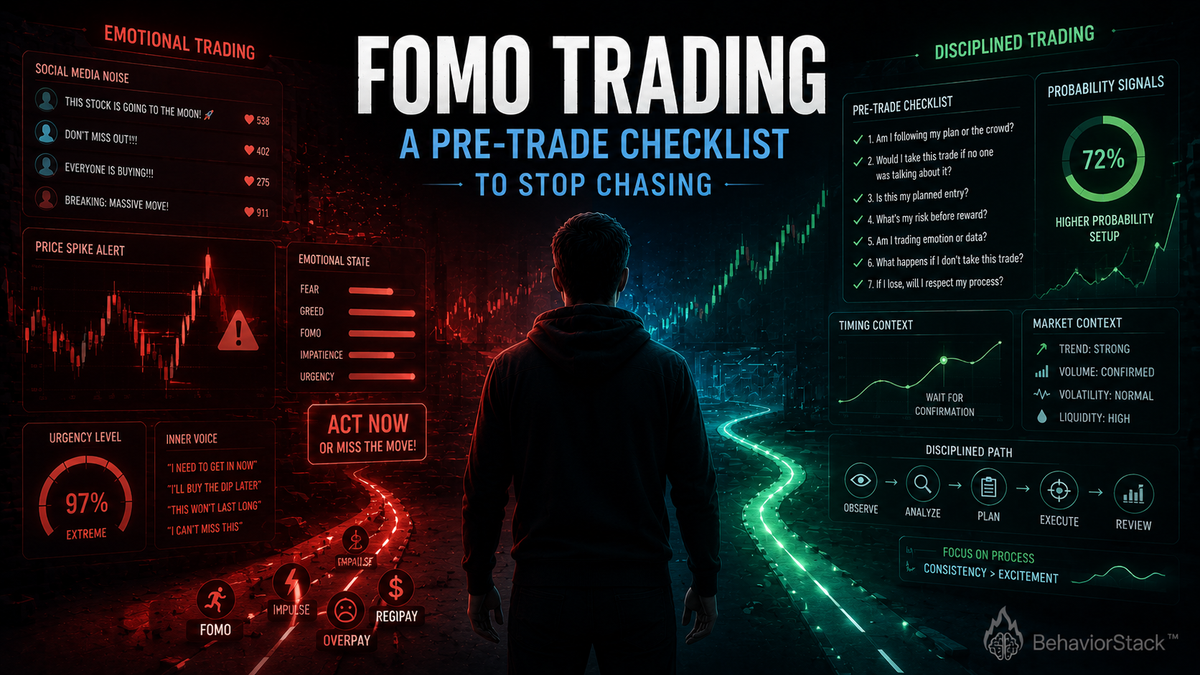
The Hidden Cycle Every Trader Repeats
Most FOMO trades follow the exact same pattern.
Information
↓
Excitement
↓
Urgency
↓
Reaction
↓
Poor Entry
↓
Regret
↓
Repeat
The irony?
Most traders aren't afraid of losing money.
They're afraid of missing potential gains.
That emotional pressure creates bad timing.
The 7-Step Pre-Trade Checklist
Before entering any trade, pause for 30 seconds and answer these questions.
✅ 1. Am I Following A Plan Or Following A Crowd?
If social media is driving your decision, stop.
✅ 2. Would I Enter This Trade If Nobody Was Talking About It?
Remove external influence.
Evaluate the setup independently.
✅ 3. Is This My Planned Entry?
If you're chasing price, the answer is often no.
✅ 4. What's My Risk Before I Think About Reward?
Many FOMO traders skip this question entirely.
✅ 5. Am I Trading Emotion Or Data?
Identify your dominant emotion:
- excitement
- greed
- anxiety
- urgency
Emotions are signals.
They should not be instructions.
✅ 6. What Happens If I Don't Take This Trade?
Most traders realize something important:
Another opportunity will always come.
✅ 7. If I Lose This Trade, Will I Be Angry At My Process Or My Emotion?
This is usually the most revealing question.
Build A Decision Filter Instead Of Fighting Emotion
The goal is not to eliminate emotions.
That's impossible.
The goal is to slow them down.
Top traders create filters between stimulus and action.
Instead of:
See Move → Enter Trade
They create:
Signal → Context → Decision
That small adjustment changes everything.
Old Way vs Better Way
Old Way
See → Chase → Regret
Examples:
- Buy after large moves
- Enter because everyone else is entering
- Ignore risk management
Better Way
Observe → Evaluate → Execute
Examples:
- Wait for confirmation
- Follow predetermined rules
- Prioritize timing over emotion
Why MarketSpark™ Fits Into This Process
MarketSpark™ isn't designed to predict markets.
It's designed to improve decisions around them.
Powered by BehaviorStack™, MarketSpark™ helps users evaluate:
Behavioral Signals
Recognize emotional patterns before they become actions.
Timing Context
Determine whether urgency is real or perceived.
Probability Frameworks
Focus on higher-probability opportunities instead of emotional reactions.
Decision Consistency
Create repeatable systems that reduce impulsive trading.
Because consistency often beats excitement.
Why This Gives You An Edge
Most traders optimize for:
- speed
- excitement
- action
Professional decision makers optimize for:
- patience
- timing
- consistency
The biggest opportunities often come from the trades you don't take.
Because avoiding bad decisions compounds just as powerfully as making good ones.
Conclusion
FOMO trading isn't a strategy problem.
It's a psychology problem.
The solution isn't finding more information.
The solution is building better decision filters.
When traders create structure between emotion and execution, performance often improves dramatically.
Because successful trading is rarely about catching every opportunity.
It's about consistently choosing the right ones.
CONTINUE EXPLORING
👉 Learn more about:
What Is BehaviorStack™? The Framework Behind Smarter Decisions
👉 Read next:
Revenge Trading: The Psychology Behind It (And How To Stop)
👉 Explore:
Time Pressure Bias: Why "Urgent" Decisions Are Often Wrong
👉 Try: