Time Pressure Bias: Why “Urgent” Decisions Are Often Wrong
Time pressure bias causes people to mistake urgency for importance, leading to rushed decisions and poor outcomes. Learn how to recognize and avoid it.

The Clock Is Lying To You
Imagine receiving a message that says:
- "Limited time offer."
- "Last chance."
- "Act now."
- "We need an answer immediately."
Most people feel the same thing:
pressure.
The moment urgency enters a situation, decision quality often begins to decline.
The problem is not time itself.
The problem is how humans react to perceived time pressure.
This behavioral tendency is known as time pressure bias, and it quietly influences decisions every day.
Why Urgency Changes How We Think
The human brain evolved to respond quickly to threats.
When something feels urgent, the brain often assumes:
urgent = important
But those two things are not always the same.
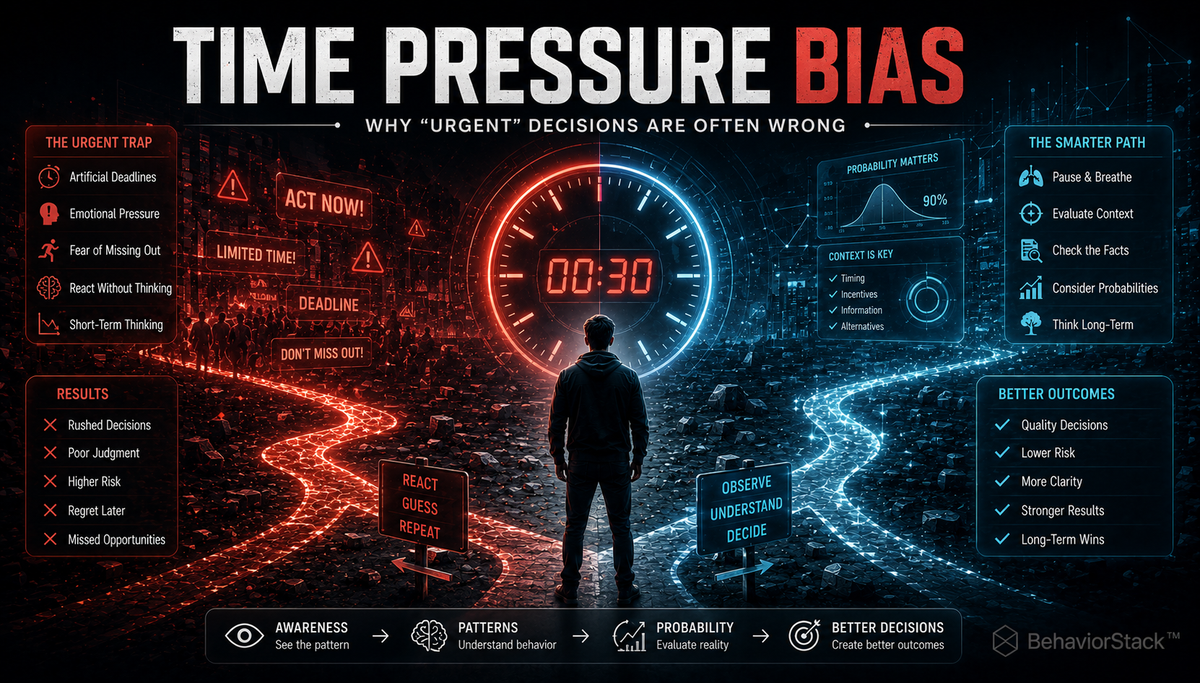
Time pressure tends to reduce:
- analytical thinking
- probability assessment
- contextual awareness
- long-term evaluation
At the same time, it increases:
- emotional reactions
- impulsive behavior
- fear of missing out
- decision shortcuts
The result is a predictable shift from thoughtful reasoning to reactive action.
The Three Questions Most People Forget To Ask
When urgency appears, people rarely stop to ask:
Is This Actually Important?
Many situations feel urgent but have little long-term impact.
Who Benefits From The Urgency?
In negotiations, marketing, sales, and communication, urgency is often intentionally created.
The person creating the pressure may gain an advantage when others react quickly.
What Happens If I Wait?
This is often the most important question.
Many decisions improve when given:
- more context
- more information
- more emotional distance
Yet urgency convinces people that waiting is dangerous.
How Time Pressure Distorts Decision-Making
Time pressure bias often creates four predictable behaviors.
1. Premature Commitment
People lock into decisions before evaluating alternatives.
2. Reduced Risk Assessment
Potential downsides receive less attention.
3. Emotional Overreaction
Stress replaces objective thinking.
4. False Certainty
People become overly confident simply because they acted quickly.
Ironically, speed often creates the illusion of confidence.
The Hidden Cost Of Fast Decisions
Not every fast decision is bad.
The problem is that many people confuse:
speed
with
quality.
High-quality decisions often require:
- reflection
- context
- pattern recognition
- probability evaluation
Without these elements, urgency can become expensive.
Organizations experience this through:
- failed initiatives
- rushed hiring decisions
- poor strategic planning
Individuals experience it through:
- emotional purchases
- communication mistakes
- relationship conflicts
- missed opportunities
What High-Level Decision Makers Do Differently
Experienced decision makers often follow a different process.
Instead of asking:
"What should I do right now?"
They ask:
"What information changes if I wait?"
This subtle shift creates enormous advantages.
It transforms:
Urgency → Reaction
into
Observation → Evaluation → Decision
The goal is not to move slower.
The goal is to avoid moving blindly.
Where Time Pressure Bias Shows Up
Time pressure bias appears in surprising places.
Business
Quarter-end decisions, negotiations, hiring, acquisitions.
Investing
Market volatility, news events, crowd reactions.
Relationships
Emotional arguments, misunderstandings, impulsive responses.
Communication
Feeling compelled to respond immediately rather than thoughtfully.
Artificial Intelligence
Acting on generated outputs before evaluating context and probability.
The pattern is remarkably consistent:
the more pressure people feel, the more likely they are to overlook important variables.
Why Timing Is A Decision Variable
Many people think timing only matters after a decision is made.
In reality, timing is often part of the decision itself.
A good decision at the wrong time can produce poor results.
A mediocre decision at the right time can outperform expectations.
Understanding timing means evaluating:
- urgency
- readiness
- probability
- context
- incentives
This is where systems like BehaviorStack™ begin to matter.
Behavioral awareness helps identify when urgency is influencing decisions before it becomes costly.
The Competitive Advantage Of Deliberate Thinking
Most people assume faster decisions create advantages.
Sometimes they do.
But in complex situations, the bigger advantage often comes from:
recognizing when not to react.
People who understand time pressure bias become better at:
- separating urgency from importance
- resisting emotional pressure
- evaluating probability
- protecting decision quality
Over time, those advantages compound.
Time pressure bias is one of the most common distortions in human decision-making.
It causes people to mistake urgency for importance and speed for quality.
The best decision makers are not necessarily the fastest.
They are the ones who recognize when urgency is influencing their thinking.
Because better decisions rarely come from reacting to the clock.
They come from understanding what the clock is doing to your behavior.
CONTINUE EXPLORING
👉 Learn more about:
What Is BehaviorStack™? The Framework Behind Smarter Decisions
👉 Read next:
Base Rate Neglect: The Most Common Reason Forecasts Fail
👉 Explore:
What Is Decision Fatigue? (And How to Avoid It)
👉 Try: