
Expected Value (EV) for Real Life: How to Make Better Calls Under Uncertainty
Expected value decision making is the fastest way to improve decision quality under uncertainty — especially when you pair probability with behavioral context and timing.

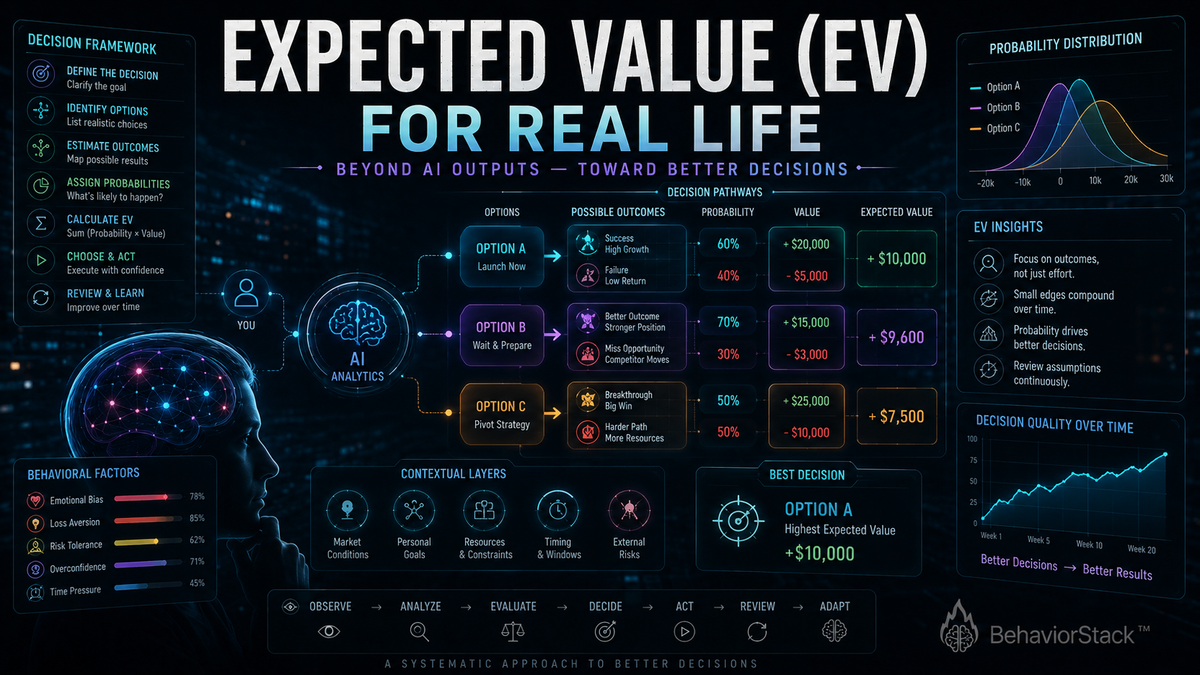
Most people think “good decisions” are the ones that work out.
But outcomes are noisy. Timing matters. Other people behave unpredictably. And even the “right” move can lose in the short run.
That’s why expected value (EV) is one of the cleanest mental models for decision intelligence: it separates decision quality from outcome luck.
Expected value isn’t just for poker tables or trading desks.
It’s for:
- choosing what to build next
- deciding when to have a hard conversation
- taking (or skipping) a career risk
- saying yes to an opportunity with uncertain upside
In this article, you’ll learn how to use EV as a practical tool for real-world decision-making — and how behavioral context (the layer most AI systems ignore) determines whether EV thinking actually improves outcomes.
What Is Decision Intelligence?
Decision intelligence is the discipline of improving decisions as a system.
It focuses on:
- outcomes: what you’re actually optimizing for
- probability: what’s likely, not what you hope
- context: incentives, constraints, and timing
- structured reasoning: repeatable frameworks over intuition
- behavioral awareness: emotion, bias, and human dynamics
Decision intelligence is not “getting answers.”
It’s improving the quality of choices under uncertainty — consistently.
Expected value is one of the core primitives inside decision intelligence because it forces you to make uncertainty explicit, rather than letting it hide inside vague intuition.
Why Traditional AI Falls Short
Most AI tools are optimized for:
- prompts
- outputs
- automation
- surface-level reasoning
They can generate convincing explanations, but they rarely help you choose.
Where they often fail:
- incentives: what each actor truly wants
- emotion: how fear, pride, or attachment distort judgment
- timing: when a decision is actionable vs premature
- behavioral context: patterns that predict reactions
- probability discipline: the difference between a story and a forecast
As a result, many AI systems increase information while leaving decision quality unchanged — or worse, they accelerate reactive behavior.
The Missing Layer: Behavior
Even a perfect EV calculation can fail if you ignore behavior.
Because real decisions live inside systems of:
- communication
- perception
- trust
- identity
- risk tolerance
- emotional volatility
This is why systems like BehaviorStack™ matter:
they treat decision-making as a behavioral system — not just a logic problem.
Behavior influences:
- what you notice
- what you interpret
- what you choose
- what you avoid
- how others respond after you act
Without behavioral context, “rational” decisions become unrealistic decisions.
How Behavioral Decision Intelligence Works
Awareness
Identify what’s driving your internal state:
- stress vs calm
- scarcity vs abundance
- ego protection vs learning
- attachment vs clarity
If you’re emotionally hijacked, your probability estimates will be biased — and EV collapses.
Context
Map the environment:
- constraints (time, cash, attention)
- incentives (yours and others)
- second-order effects
- timing windows
EV depends on context because probabilities are not universal — they are conditional.
Probability
Make uncertainty explicit:
- list plausible outcomes
- assign rough probabilities (even imperfect ones)
- estimate impact for each outcome
The goal is not “perfect probabilities.”
The goal is avoiding the common error of treating uncertainty as certainty.
Structure
Turn EV into a repeatable process:
- define the decision
- define the options
- define the outcomes
- estimate probabilities and impacts
- choose based on expected value plus risk tolerance and constraints
This is how you move from reactive thinking toward strategic decision-making.
Real-World Applications
Expected value becomes powerful when you stop using it as math and start using it as a decision lens.
1) Relationship and communication decisions
Question: “Should I bring this up now?”
Outcomes include:
- clarity and deeper trust
- conflict and defensiveness
- temporary peace but long-term resentment
Behavioral context changes probabilities dramatically:
- their stress level
- how safe they feel
- your tone, timing, and framing
EV isn’t just “what happens” — it’s “what happens given this behavioral state.”
2) Leadership and negotiation
A leader deciding whether to confront underperformance:
- high upside: performance improves, standards rise
- downside: morale drops, trust erodes, attrition risk
The EV depends on:
- the person’s coachability
- incentive structure
- your credibility and consistency
- whether the team believes standards are real
3) Marketing and content strategy
Should you publish a bold point of view?
- upside: differentiation, authority, higher-intent traffic
- downside: pushback, misinterpretation, polarizing response
Behavioral signals matter:
- audience sophistication
- trust level
- message framing
- timing in the market narrative
4) Trading and financial choices
This is the classic domain:
- define edge
- estimate probability of outcomes
- manage position sizing and risk
But even here, behavior is the hidden variable:
overconfidence, revenge trading, fear, and fatigue change your execution — which changes your real EV.
Why This Changes The Future of AI
The next generation of AI will not win by producing better text.
It will win by improving decisions.
That requires tools that understand:
- behavioral patterns
- incentive dynamics
- contextual timing
- probability discipline
- outcome optimization
EV is a foundational building block for that future.
But EV alone isn’t enough — because decisions are made by humans inside emotional and social systems.
Decision intelligence becomes transformational when EV thinking is paired with behavioral awareness.
Why This Creates a Long-Term Advantage
People and organizations who consistently win under uncertainty don’t do it by being “smarter.”
They do it by running better decision systems.
They understand:
- incentives
- psychology
- timing
- behavior
- probability
And that creates compounding advantage:
better decisions → better outcomes → better learning loops → even better decisions.
Expected value is one of the simplest tools that can upgrade your decision system immediately.
Expected value is the antidote to outcome-driven thinking.
It helps you:
- judge decisions by process, not luck
- make uncertainty explicit
- choose based on probabilities and impact
- stay strategic instead of reactive
But EV becomes truly practical when you account for behavior:
what you’ll actually do under pressure, and how others will respond in real life.
That is the shift from “AI outputs” to decision intelligence:
not more information — better calls.
CONTINUE EXPLORING
👉 Learn more about:
BehaviorStack™ — the behavioral layer for decision intelligence
👉 Read next:
Decision Stack: How to Build a System That Produces Better Decisions
👉 Explore:
OODA Loop Explained — Observe → Orient → Decide → Act (and why most people get stuck in React → Guess → Repeat)
👉 Discover:
MarketSpark™ (for trading psychology) or HeartSpark™ (for relationship dynamics)