What Is a Decision Stack? A Simple Architecture for Consistent Choices
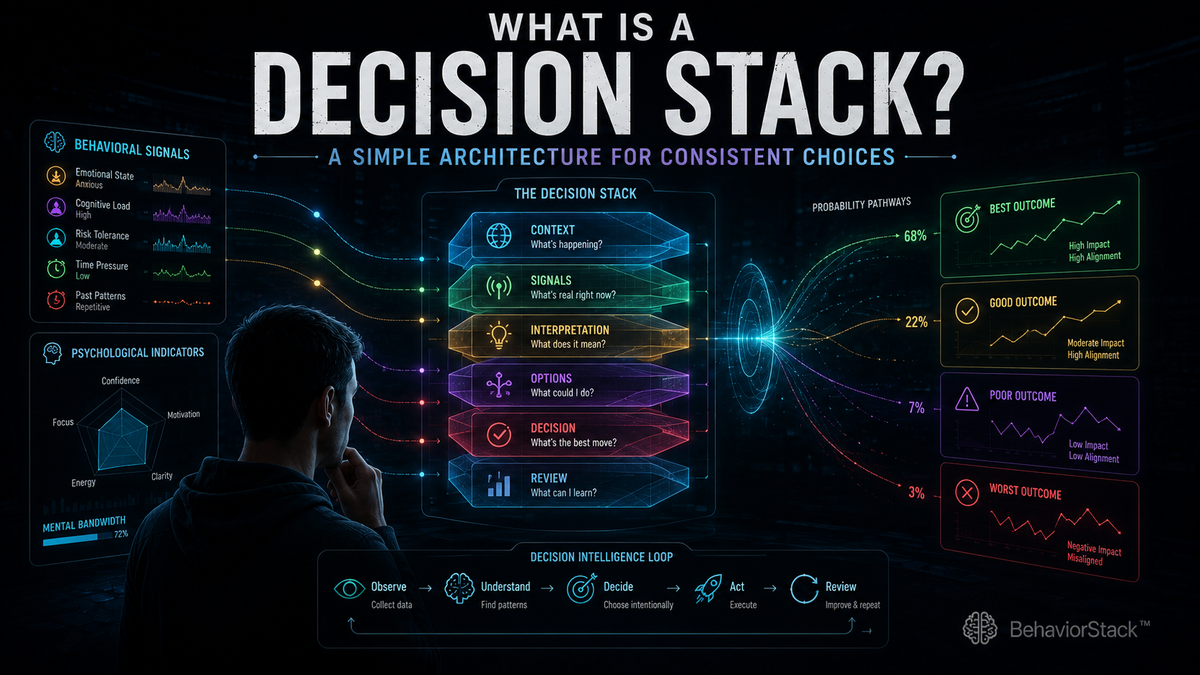
A decision stack is a simple architecture for consistent choices: signals → context → behavior → probability → decision → feedback. It’s the missing framework for better outcomes in life, business, and AI systems.

Primary idea: A “decision stack” is the full architecture that turns information into consistently better choices — by combining data, logic, behavior, and feedback (not just AI outputs).
The problem: most “decision systems” don’t actually improve decisions
Most people think a better decision comes from:
- more information
- faster responses
- smarter tools
- “just add AI”
But in the real world, decisions fail because the decision environment is messy:
- incentives distort judgment
- emotions hijack timing
- context changes faster than plans
- probability gets ignored
- people optimize for speed, convenience, or outputs
If your process is basically:
React → Guess → Repeat
you don’t have a decision system — you have a loop of improvisation.
A decision stack is how you break that loop.
What is a decision stack?
A decision stack is a layered architecture that reliably converts:
signals → interpretation → choice → outcome learning
It’s the difference between:
- an app that generates answers, and
- a system that improves outcomes.
In other words: Decision intelligence is not just “what should I do?”
It’s “what increases the likelihood of a better outcome — given this context?”
A simple definition
A decision stack is a structured set of layers that:
- observes reality (signals + data),
- understands behavioral context (emotion, incentives, timing),
- reasons through choices (tradeoffs + probability),
- produces a decision (not just content),
- learns from results (feedback loops).
Why a stack (not a single tool)?
Because decision quality is never produced by one component.
Even high-performing teams fail when they rely on one layer:
- data alone (no behavioral context)
- intuition alone (no probability discipline)
- AI alone (outputs without outcome alignment)
- speed alone (timing without awareness)
A decision stack forces you to build the whole system, not just a clever interface.
The core layers of a decision stack
Below is a clean, practical version of the architecture.
1) Signal + Data Layer
This is what you observe:
- facts
- metrics
- constraints
- history
- environmental signals
Without this layer, decisions become narrative-driven and reactive.
2) Context Layer (the “what’s really going on?” layer)
Context is where most models fail.
This layer captures:
- incentives (what people optimize for)
- timing (why now?)
- stakes and risk tolerance
- interpersonal dynamics
- environment (market conditions, relationship state, organizational constraints)
Same data, different context = different best choice.
3) Behavioral Layer (BehaviorStack™ concept)
This is the missing layer in most decision tools.
Behavior shapes:
- perception
- confidence
- reactions
- communication
- risk assessment
- emotional timing
Without behavioral context, even accurate information can produce bad decisions.
BehaviorStack™ fits here as the behavioral decision layer — optimizing decisions around:
- incentives
- timing
- emotion
- human behavior patterns
- probability-based outcomes
4) Probability + Tradeoff Layer
Good decisions are rarely “right vs wrong.” They’re tradeoffs.
This layer asks:
- What are the likely outcomes?
- What’s the downside scenario?
- What assumptions are being made?
- What evidence would change the decision?
It moves decision-making from certainty theater to probability discipline.
5) Decision Layer (commitment + clarity)
This layer turns analysis into action:
- choose the option
- define what “success” means
- set the next action
- establish decision boundaries
A stack that never commits is just intellectual entertainment.
6) Feedback + Learning Layer
This is how you compound advantage:
- track outcomes
- compare expected vs actual
- detect recurring errors (bias, timing mistakes, incentive conflicts)
- update the stack
Without feedback loops, you’re not improving — you’re repeating.
The “bad system” vs the “stacked system”
Most people operate like this:
React → Guess → Repeat
A decision stack shifts you to:
Observe → Understand → Decide
That single shift is the difference between:
- reactive living, and
- strategic compounding.
Real-world implications: where this shows up
A decision stack isn’t theoretical — it applies anywhere decisions matter under uncertainty:
- Leadership: incentives, politics, timing, organizational behavior
- Negotiation: perception, emotion, leverage, probability of agreement
- Marketing: audience psychology, message timing, conversion tradeoffs
- Relationships: emotional context, communication decisions, attachment dynamics
- Trading / investing: risk management, probability discipline, revenge impulses
- AI systems: safe retrieval, permissioning, behavior-aware reasoning
Why most people miss this
Most people optimize for:
- speed
- convenience
- “the best answer”
- surface-level outputs
But long-term advantage comes from:
- structure
- behavioral awareness
- probability thinking
- feedback loops
In other words: systems beat moments.
The shift happening now: from AI outputs to decision intelligence
Most AI systems today are still optimized for responses.
The next generation will be optimized for outcomes:
- context-aware reasoning
- controlled retrieval (not raw data exposure)
- behavior-aware decision layers
- probability-driven recommendations
This is why “decision stack” thinking is becoming a serious competitive edge — especially as AI becomes ubiquitous.
Why this creates an advantage
Organizations and individuals who build a real decision stack:
- stop being surprised by predictable patterns
- make fewer expensive timing mistakes
- reduce emotionally-driven failures
- improve decision speed without sacrificing quality
- compound learning over time
The result is simple:
better long-term decisions, with higher probability.
Conclusion: the decision stack is how you stop improvising
A decision stack is a practical architecture for consistent choices.
It’s how you move from:
- reactive guessing
to
- structured decision intelligence
And when you add a behavioral layer (like BehaviorStack™), the stack becomes more than logic:
it becomes human-aware decision architecture.
CONTINUE EXPLORING
👉 Learn more about:
BehaviorStack™ (behavioral decision layer)
👉 Read next:
BehaviorStack™ vs Standard AI Layers: The Missing Piece
👉 Explore:
Decision Intelligence concepts (probability, context, incentives)
👉 Discover:
HeartSpark™ (relationship decisions) or MarketSpark™ (market decisions)