Prompting vs Systems: Why “Better Prompts” Won’t Fix Bad Choice Selection
Prompting is a UI layer — systems improve decision inputs. Learn why better prompts can’t fix missing context, incentives, timing, or probability, and how structured decision input stacks create better outcomes.

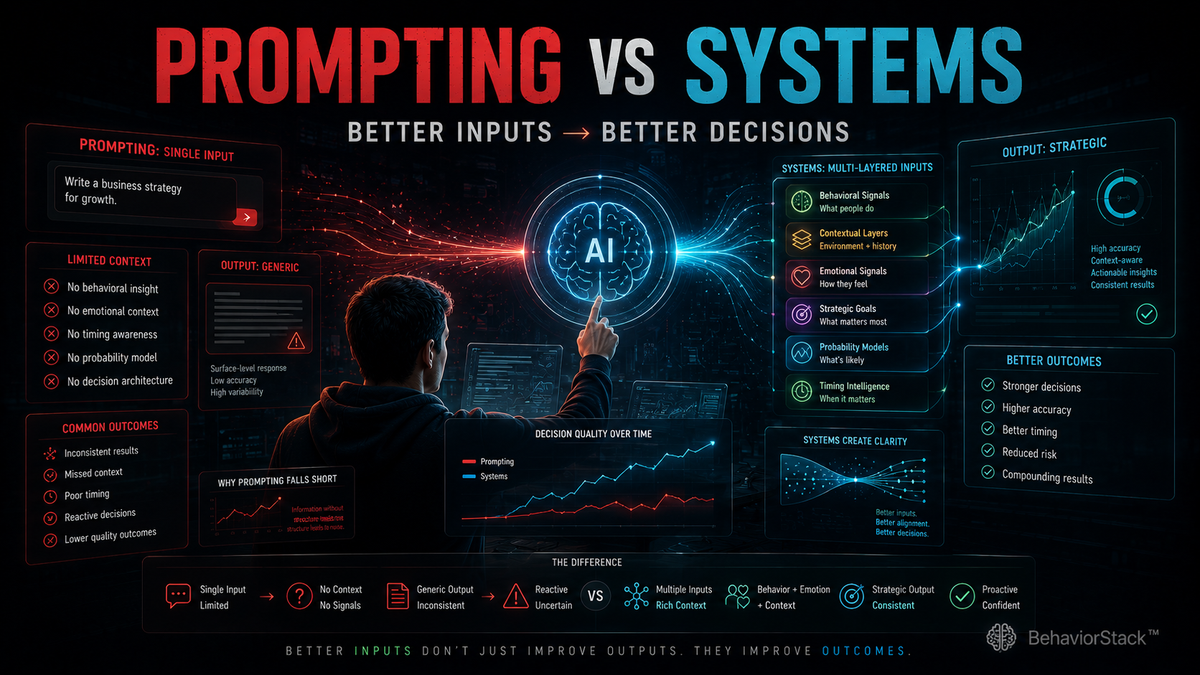
- Prompting is a UI layer. It can clarify a request, but it can’t fix missing context, incentives, or timing.
- Decision quality is input quality. If inputs are distorted, reactive, or incomplete, outputs will be “confident noise.”
- Systems beat prompts because they structure decision inputs: context, behavioral signals, probability, constraints, and feedback loops.
THE NEW STRUCTURE: INPUTS → DECISIONS → OUTCOMES
1) The real problem isn’t the prompt — it’s the input
Most teams think the AI failure mode looks like this:
- “The prompt wasn’t specific enough.”
- “We need a better template.”
- “Let’s add more instructions.”
But the more common failure mode is:
- The prompt is fine. The inputs are wrong.
If your decision inputs are:
- incomplete,
- biased,
- emotionally distorted,
- poorly timed,
- incentive-misaligned,
then AI will amplify the distortion.
A better prompt can make a bad input sound coherent.
It can’t make it true.
2) Prompting optimizes for answers. Systems optimize for decisions.
Prompting is optimized for:
- clarity of question
- tone and formatting
- completeness of response
- speed
A Behavioral AI decision system is optimized for:
- context completeness
- behavioral reality
- probability + uncertainty
- tradeoffs + constraints
- feedback loops
- repeatability under stress
This is the difference between:
- “Give me a great answer right now”
and
- “Help me make the right decision consistently”
3) The hidden cost: AI that increases confidence without increasing correctness
Bad decision inputs + fluent AI output creates a dangerous combo:
- You feel clarity.
- You feel certainty.
- You move faster.
But speed isn’t leverage if direction is wrong.
The subtle risk is not “AI makes mistakes.”
The risk is:
AI makes you more decisive about the wrong thing.
The countermeasure is a structured pre-action review — how to review an AI recommendation before acting on it before you commit.
THE 5 INPUT FAILURES PROMPTS CAN’T FIX
Failure 1: Missing incentives
If incentives aren’t captured, AI will recommend “logical” actions that people won’t follow.
System question:
What does each actor actually want, protect, or avoid?
Failure 2: Missing behavioral state
Decisions are not made by “rational agents.”
They’re made by humans in states: threat, pride, urgency, shame, excitement, fatigue.
System question:
What emotional state is driving the next move?
Failure 3: Bad timing
Even correct information can be wrong now.
System question:
What timing window makes this decision high-leverage vs low-leverage?
Failure 4: Unstated constraints
Most “bad AI advice” is advice that ignores constraints you didn’t say out loud.
System question:
What can’t you do? What can’t you risk? What must remain true?
Failure 5: No probability framing
Prompts default to “best answer.”
Decisions require “most likely outcomes” and “risk distribution.”
System question:
What are the top 3 outcome paths and their likelihoods?
THE DECISION INPUT STACK (A SIMPLE SYSTEM)
Use this before asking AI for “the answer.”
Step A — Define the decision
- What decision is being made?
- What does “success” look like?
- What is the deadline?
Step B — Capture context (minimum viable context)
- What happened?
- What matters?
- What changed?
- What’s unknown?
Step C — Map incentives + friction
- Who are the actors?
- What are they optimizing for?
- What do they fear?
- What makes action hard?
Step D — Add behavioral signals
- What emotional/behavioral pattern is present?
- What state is each actor likely in?
- What triggers escalation, avoidance, or impulsive action?
Step E — Move to probability
- Best case / base case / worst case
- Confidence level (low/med/high)
- What would change your mind?
Step F — Decide + define the next test
- What do you do next?
- What is the smallest test that reduces uncertainty?
- What feedback signal will you watch?
A QUICK EXAMPLE: “BETTER PROMPT” VS “BETTER SYSTEM”
Scenario
You’re about to send a high-stakes message (business, relationship, or negotiation) and you ask AI:
“Write the perfect message.”
Prompting approach (common)
AI produces a polished message that:
- sounds reasonable
- covers points
- feels confident
But it may miss:
- the other person’s incentives
- emotional state
- timing
- hidden constraints
- escalation risk
System approach (BehaviorStack™ style)
You feed AI the decision inputs first:
- goal of the message
- relationship temperature (calm / tense / fragile)
- known triggers
- timing window
- constraints (what you can’t say, can’t promise, can’t risk)
- probability outcomes (what happens if they interpret it as X?)
Now AI is not writing “a message.”
It’s helping you run a decision process.
That’s the upgrade.
WHY THIS MATTERS: THE FUTURE OF AI IS DECISION INFRASTRUCTURE
The next wave of AI advantage won’t come from:
- bigger models
- better prompts
- more tools
It will come from:
- better decision inputs
- behavior-aware systems
- probability framing
- repeatable structure
- feedback loops
In other words:
AI that improves outcomes — not just outputs.
This is the purpose of Ignite Platform™: a behavioral decision-intelligence platform that uses BehaviorStack™ technology to structure inputs, analyze behavioral context, evaluate probable outcomes, and turn AI-generated information into actionable guidance. Applications such as HeartSpark™ and MarketSpark™ apply this decision infrastructure to specific domains.
If your decision inputs are weak, “better prompts” are a cosmetic fix.
If your decision inputs are structured, AI becomes leverage.
Prompting is useful.
But systems are decisive.
BehaviorStack™ is built around that premise:
behavioral signals + decision structure + probability → better decisions over time.
CONTINUE EXPLORING
👉 Learn more about:
BehaviorStack™ (Behavioral Decision Intelligence)
👉 Read next:
What is Decision Intelligence and why AI isn't enough.
👉 Explore:
AI systems architecture for human behavior (framework article)