Cynefin Framework Explained: A Sensemaking Model for Complex Decisions
Cynefin is a sensemaking model that helps you choose the right decision mode—best practice, expert analysis, experimentation, or rapid stabilization—based on whether your situation is clear, complicated, complex, or chaotic.

Most decision frameworks assume a hidden premise: that the world is legible if you just gather enough information.
That premise fails in the environments that matter most—product strategy, AI deployment, markets, crisis response, organizational change—where cause and effect are not stable and “best practice” turns into cargo cult.
The Cynefin Framework (pronounced kuh-NEV-in) is a sensemaking model that helps you answer a more fundamental question:
What kind of situation am I actually in—and what type of decision-making fits that situation?
This is not a “do this and win” checklist. It’s a map for choosing the right operating mode when the environment shifts faster than your certainty.
What Is the Cynefin Framework?
The Cynefin Framework is a way to categorize situations into different “domains” based on the relationship between cause and effect.
It helps leaders and builders avoid the two classic failures:
- using simple rules for complex systems
- over-analyzing when fast action is required
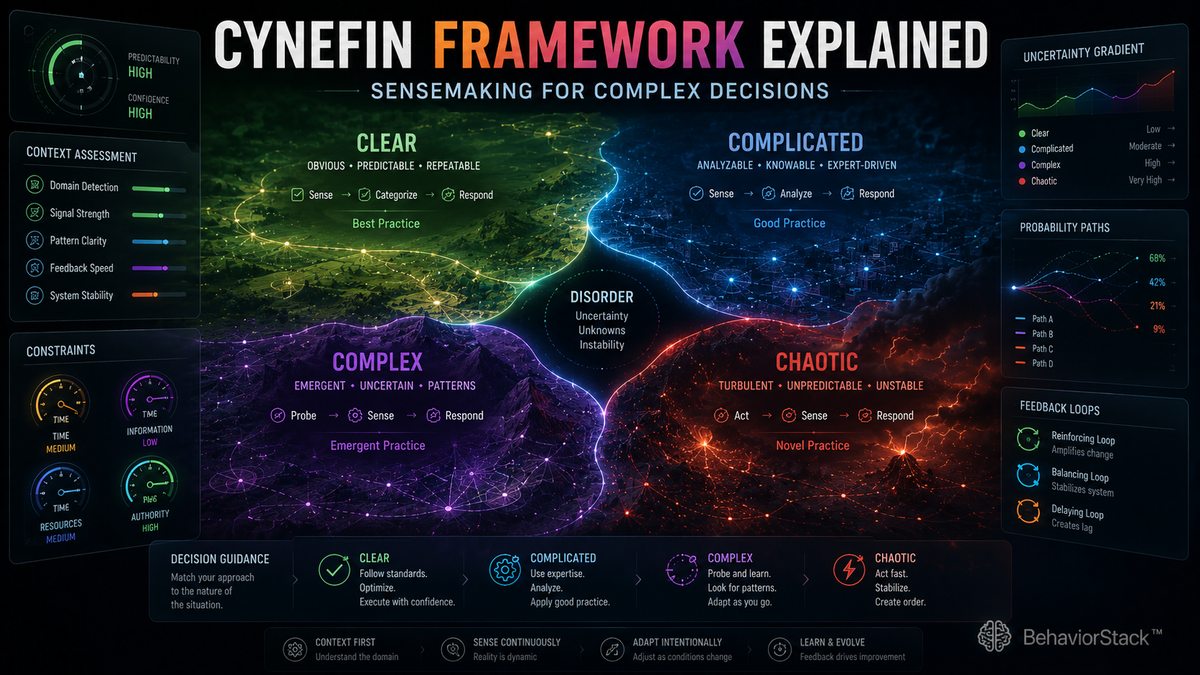
At a high level, Cynefin separates contexts into five domains:
- Clear (Simple): Cause and effect are obvious; repeatable best practice exists.
- Complicated: Cause and effect exist but require expertise; analysis and good practice win.
- Complex: Cause and effect can only be understood in retrospect; you must probe and learn.
- Chaotic: No perceivable cause/effect; you must act to stabilize first.
- Confused (Disorder): You don’t know which domain you’re in; different people pull in different directions.
Supporting concepts (the “why” under the model):
- Sensemaking beats certainty: your first job is to classify reality, not debate opinions.
- Constraints shape behavior: systems behave differently when constraints are tight vs loose.
- Learning loops matter: in complex domains, you don’t “solve,” you evolve.
Why This Matters
Cynefin matters because most high-stakes environments are not “complicated”—they are complex, meaning:
- small actions can create disproportionate outcomes
- interventions change the system you’re trying to understand
- the “right answer” is often unknowable until after you learn by doing
In practice, decision quality depends less on intelligence and more on:
- choosing the correct decision mode (rule-following vs analysis vs experimentation)
- recognizing when the environment has shifted domains
- avoiding overconfidence that comes from misclassification
In other words: better decisions start with better diagnosis.
The Core Problem
Most modern systems—teams, AI workflows, leadership playbooks—default to:
- more information
- faster reaction
- surface-level outputs (dashboards, metrics, summaries)
But they often fail to account for:
- incentives (what people/agents are rewarded for)
- timing (when actions compound vs backfire)
- emotion (fear, ego, status, loss aversion)
- behavioral context (norms, identity, trust, power)
When you ignore those factors, you misread the domain:
- you treat complexity like complicated analysis
- you treat chaos like complex experimentation
- you treat “clear” processes like they need constant reinvention
Cynefin is essentially an anti-misclassification system.
A Better Framework
Cynefin gives you a simple decision sequence:
- Diagnose the domain
- Use the matching response pattern
- Watch for signals that the domain is shifting
- Adjust constraints and feedback loops
The key response patterns:
- Clear: Sense → Categorize → RespondFollow best practices. Standardize. Automate.
- Complicated: Sense → Analyze → RespondBring in expertise. Compare options. Optimize.
- Complex: Probe → Sense → RespondRun safe-to-fail experiments. Learn. Scale what works.
- Chaotic: Act → Sense → RespondStabilize. Create order. Then move into complex/complicated modes.
Notice the asymmetry:
- In complex environments, analysis comes after probing, not before.
- In chaos, action comes before understanding, because waiting increases harm.
This aligns with a BehaviorStack-style loop:
Observe → Understand → Decide
…where “Understand” means understanding the domain you’re operating in (not just gathering facts).
Real-World Implications
Cynefin shows up everywhere once you start looking:
- AI systems:Model performance shifts as the environment changes; you need monitoring + experiment loops, not one-time optimization.
- Product strategy:Early-stage markets are complex; late-stage execution often becomes clear/complicated.
- Leadership:Crisis response is chaotic; rebuilding is complex; scaling operations becomes complicated/clear.
- Negotiation and communication:Trust dynamics are complex; rigid scripts can backfire.
- Trading and markets:Regimes shift; backtests often assume complicated stability when reality is complex.
Cynefin’s value is not theoretical—it prevents category errors that create expensive failures.
Why Most People Miss This
People miss Cynefin because they’re rewarded for the wrong things:
- speed (quick answers)
- confidence (certainty signaling)
- outputs (documents, plans, dashboards)
But high-leverage advantage comes from:
- recognizing patterns early
- designing constraints that shape behavior
- building feedback loops that learn faster than the environment changes
Misclassification is comfortable. Sensemaking is work.
The Shift Happening Now
Three trends make Cynefin more relevant than ever:
- AI acceleration: systems evolve fast, and “best practice” expires quickly.
- Decision intelligence as a discipline: organizations are finally treating decisions as a design surface.
- Complexity everywhere: markets, attention, regulation, geopolitics, and platforms are more coupled and less predictable.
In this world, leaders don’t need more playbooks—they need better domain detection and faster learning loops.
Why This Creates an Advantage
Organizations and individuals that can reliably:
- identify complexity vs complication
- run safe-to-fail experiments without ego attachment
- stabilize chaos quickly and shift into learning modes
- design incentives and constraints intentionally
…will consistently make better long-term decisions, because they will:
- waste less time optimizing the wrong thing
- adapt faster to regime shifts
- avoid brittle “one-size-fits-all” strategies
Cynefin is a map. The advantage comes from using it under pressure.
Cynefin is not a productivity hack. It’s a sensemaking architecture—a way to align decision behavior with the true nature of the environment.
If you remember one thing, make it this:
Before you decide what to do, decide what kind of situation you’re in.
That single move upgrades everything downstream—strategy, AI deployment, leadership, and how you build systems that remain resilient when certainty breaks.
CONTINUE EXPLORING
👉 Learn more about:
BehaviorStack™: decision loops, constraints, incentives, and behavioral context
👉 Read next:
Prompting vs Systems: Why “Better Prompts” Won’t Fix Bad Decision Inputs
👉 Explore:
A Decision Stack: how to structure decisions into repeatable systems
👉 Discover:
MarketSpark™ (decision-making under uncertainty) or HeartSpark™ (communication + relationship decisions)