The Peak-End Rule: Why People Recall Things Wrong
The Peak-End Rule explains why people remember experiences inaccurately and how those memories influence future decisions.

Your Memory Is Editing Reality
Have you ever said:
- "That vacation was amazing."
Even though several days were stressful?
Or:
- "That meeting was terrible."
Even though most of it was productive?
Or:
- "That relationship was awful."
Even though many moments were actually positive?
This happens because humans do not remember experiences objectively.
We remember moments.
More specifically, we disproportionately remember:
- the most emotionally intense moment
- how the experience ended
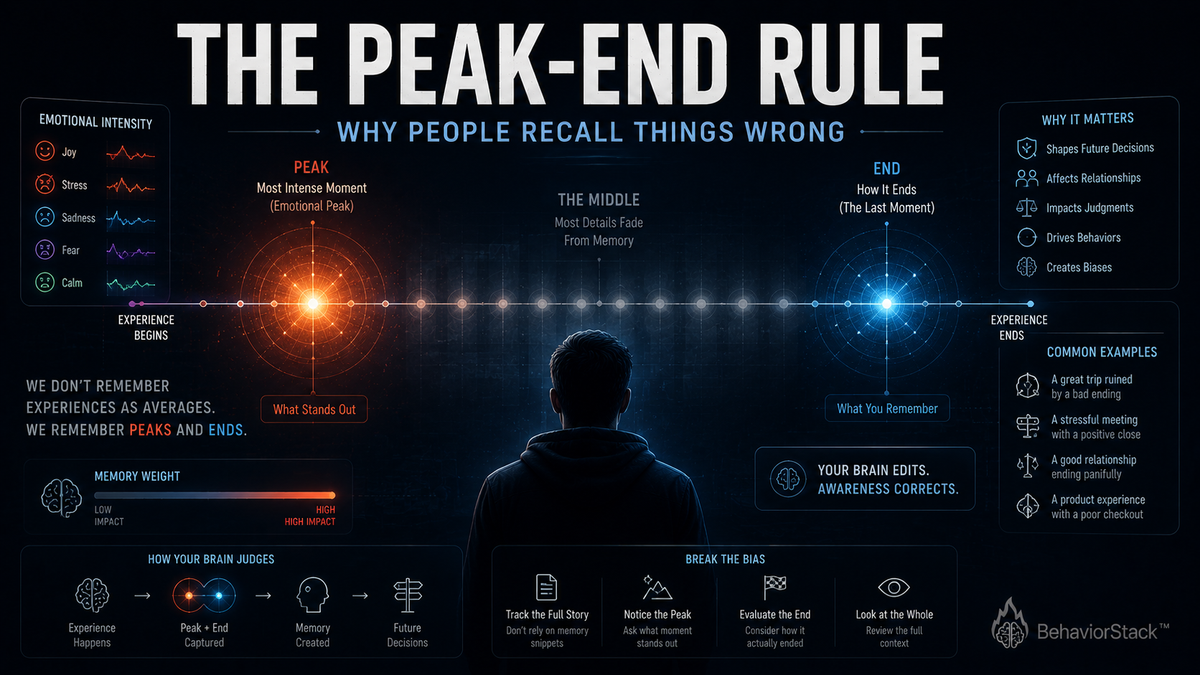
This psychological tendency is called the Peak-End Rule.
And it quietly shapes many of our decisions every day.
What Is The Peak-End Rule?
The Peak-End Rule is a cognitive bias that explains how people evaluate past experiences.
Instead of averaging an entire experience, the brain heavily weights two moments:
The Peak
The most emotionally intense point.
This could be:
- exciting
- painful
- embarrassing
- joyful
- stressful
The End
How the experience concluded.
The brain then combines these two memories and creates an overall story.
That story often becomes our reality.
Even when it isn't entirely accurate.
Why This Matters More Than You Think
Memory influences future decisions.
People often believe they are making rational choices.
In reality, many choices are based on remembered emotions.
This affects:
- relationships
- communication
- customer experiences
- leadership
- investing
- decision-making
The danger is that memory itself can be biased.
This often leads to:
- overreacting to isolated events
- making decisions from incomplete memories
- repeating unnecessary patterns
The Hidden Formula Behind Many Decisions
Many experiences follow this process:
Experience
↓
Emotional Peak
↓
Ending
↓
Memory
↓
Future Decision
The problem?
Entire experiences become compressed into tiny emotional snapshots.
Your brain essentially creates a highlight reel.
And highlight reels rarely tell the whole story.
Real-World Examples
Relationships
One argument at the end of a date can overshadow hours of enjoyable conversation.
Work
A stressful ending to a project can make months of progress feel disappointing.
Customer Experiences
One poor interaction at checkout can damage an otherwise excellent experience.
Investing
One bad day in the market can make investors abandon long-term strategies.
Why People Misinterpret Their Own Experiences
Most people make three mistakes.
They Overweight Emotional Moments
The brain treats emotional intensity as importance.
Those are not always the same thing.
They Ignore The Middle
The majority of an experience often receives very little attention later.
They Make Future Decisions From Faulty Memories
The remembered version replaces the actual version.
This creates behavioral loops.
A Better Mental Model
Instead of asking:
"How did that feel?"
Ask:
"What actually happened over time?"
Break experiences into three parts:
Beginning
How did it start?
Middle
What was consistently happening?
End
How did it conclude?
Then ask:
"Am I judging the entire experience or just one moment?"
That question alone can dramatically improve decision quality.
Old Way vs Better Way
Old Way
Feel → Remember → Decide
Examples:
- One bad text ruins a relationship.
- One losing trade changes a strategy.
- One stressful day ruins an entire week.
Better Way
Observe → Evaluate → Decide
Examples:
- Look for patterns instead of moments.
- Evaluate consistency instead of intensity.
- Separate emotions from evidence.
Why This Gives You An Edge
Most people react to memories.
Very few analyze them.
People who understand the Peak-End Rule become better at:
- communication
- leadership
- relationships
- decision-making
- emotional regulation
They stop allowing isolated moments to dictate long-term choices.
Where BehaviorStack™ Fits
This is where systems like BehaviorStack™ begin to matter.
Behavioral awareness helps identify:
- emotional distortions
- recurring patterns
- timing effects
- decision biases
before they become future decisions.
Because awareness is often the first step toward better outcomes.
Conclusion
The brain is an incredible storyteller.
But sometimes it tells incomplete stories.
The Peak-End Rule reminds us that memory is not always reality.
The experiences that shape our future decisions are often filtered through emotional shortcuts.
The people who learn to recognize those shortcuts gain an enormous advantage.
Because better decisions rarely come from stronger emotions.
They come from stronger awareness.
CONTINUE EXPLORING
👉 Learn more about:
What Is BehaviorStack™? The Framework Behind Smarter Decisions
👉 Read next:
Why Emotions Drive Most Decisions (Not Logic)
👉 Explore:
Time Pressure Bias: Why "Urgent" Decisions Are Often Wrong
👉 Try:
HeartSpark™ — Better Conversations. Higher-Probability Responses.