Base Rate Neglect: The Most Common Reason Forecasts Fail
Base rate neglect causes people to ignore historical probabilities, leading to poor forecasts and weaker decisions. Learn why probability matters more than confidence.

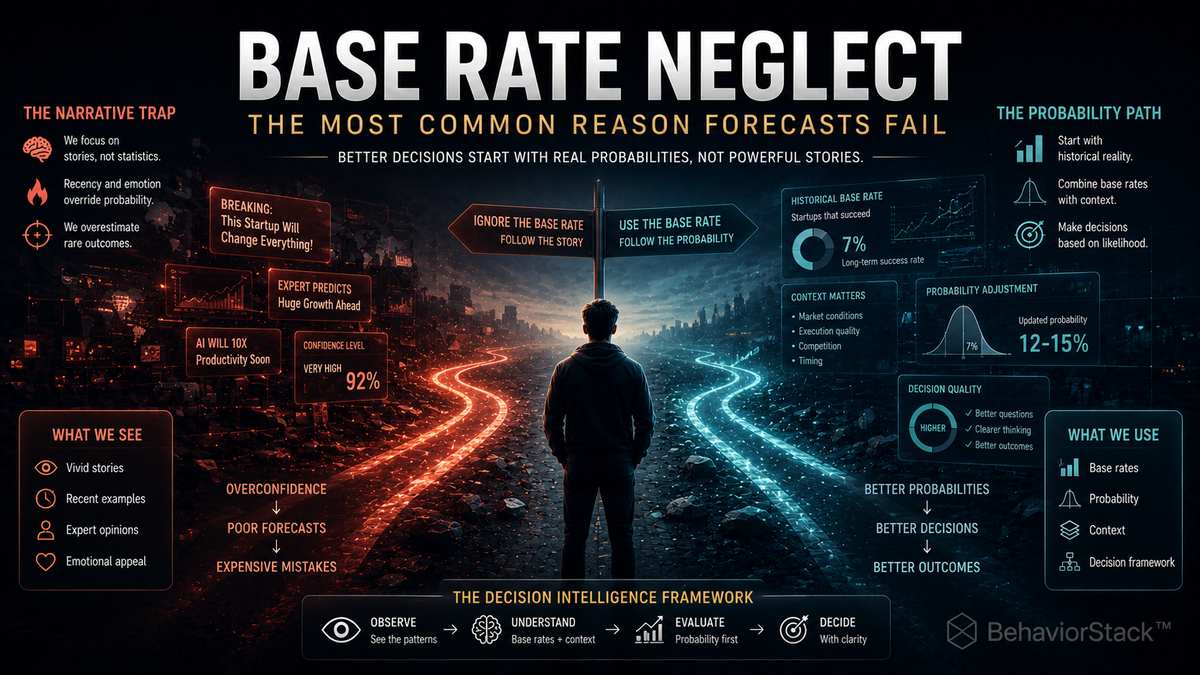
Why Smart Predictions Often Turn Into Bad Decisions
People love predictions.
Organizations spend billions trying to forecast:
- market behavior
- customer actions
- business outcomes
- economic trends
- technological shifts
Yet forecasts fail surprisingly often.
The reason is not always poor data.
It is frequently something much more subtle:
people ignore probabilities that already exist.
This mistake is known as base rate neglect, and it may be one of the most important concepts in decision science.
The Hidden Information Most People Ignore
Imagine someone tells you:
"This startup has an incredible founder, amazing technology, and huge momentum."
Many people immediately become optimistic.
But before evaluating the story, a critical question should be asked:
What percentage of startups succeed in general?
That number is called a base rate.
A base rate represents the historical probability of an outcome before considering additional information.
Examples include:
- the percentage of startups that survive
- the percentage of negotiations that close
- the percentage of products that succeed
- the percentage of forecasts that prove accurate
Base rates provide context.
And context is often more valuable than confidence.
Why Human Brains Struggle With Probability
Humans are naturally drawn toward stories.
We prefer:
- compelling narratives
- vivid examples
- emotional evidence
- recent experiences
What we often ignore are:
- statistical realities
- historical probabilities
- long-term patterns
As a result, people frequently overestimate:
- rare events
- exceptional outcomes
- extraordinary opportunities
while underestimating what usually happens.
This creates a gap between:
perception
and
probability.
The Forecasting Trap
Many forecasts begin with good intentions.
Analysts gather:
- information
- opinions
- trends
- expert insights
But then something dangerous happens.
The new information becomes so persuasive that people forget to ask:
"How often does this outcome actually occur?"
The forecast becomes driven by narrative rather than probability.
That is often where forecasting accuracy begins to deteriorate.
Why Base Rates Matter More Than Confidence
Confidence can be persuasive.
Probability is predictive.
The two are not the same.
History is full of examples where:
- highly confident forecasts failed
- low-confidence forecasts proved accurate
because confidence measures belief.
Probability measures likelihood.
Decision intelligence depends on understanding the difference.
A Different Way To Think About Decisions
Most people follow this process:
Information → Opinion → Decision
A more effective framework looks like this:
Base Rate → Context → Probability → Decision
The order matters.
Start with:
- historical patterns
- statistical reality
- known probabilities
Then layer in:
- context
- behavioral signals
- timing
- environmental factors
This approach creates a much stronger decision foundation.
Where Base Rate Neglect Appears
Base rate neglect influences far more than forecasting.
It affects:
Leadership
Leaders often overestimate success probabilities because they focus on exceptional cases.
Investing
Investors frequently chase stories while ignoring historical performance patterns.
Marketing
Teams assume campaigns will succeed because they resemble successful examples.
Relationships
People make assumptions about outcomes without considering broader behavioral patterns.
Artificial Intelligence
AI systems can generate convincing narratives while failing to evaluate underlying probabilities.
Why This Matters For Decision Intelligence
Decision intelligence is not about finding more information.
It is about improving decision quality.
That requires balancing:
- context
- probability
- behavior
- timing
- incentives
Base rates represent one of the most overlooked components of this process.
Without them, decisions become vulnerable to:
- overconfidence
- emotional reasoning
- narrative bias
- poor forecasting
The Next Evolution Of Intelligent Systems
Traditional systems focus on:
- information retrieval
- outputs
- automation
- prediction generation
The next generation of systems will increasingly focus on:
- probability assessment
- contextual reasoning
- behavioral modeling
- decision quality
This shift moves intelligence away from:
"What sounds plausible?"
toward:
"What is most likely to happen?"
That is a fundamentally different question.
And often a far more useful one.
Most forecasting failures do not occur because people lack information.
They occur because people misunderstand probability.
Base rate neglect causes decision-makers to become distracted by:
- stories
- confidence
- excitement
- recent events
while ignoring the historical patterns that often matter most.
As decision environments become increasingly complex, the organizations and individuals who understand probability will gain a significant advantage.
Because the future rarely belongs to those who tell the most convincing stories.
It often belongs to those who understand the odds.
CONTINUE EXPLORING
👉 Learn more about:
What Is BehaviorStack™? The Framework Behind Smarter Decisions
👉 Read next:
Why Probability Matters More Than Prompts in AI
👉 Explore:
BehaviorStack™ vs Standard AI Layers: The Missing Piece
👉 Discover: