Revenge Trading: The Psychology Behind It (And How to Stop)
Revenge trading psychology causes traders to react emotionally after losses, leading to poor decisions and increased risk. Learn how to recognize and stop it.

One Bad Trade Can Trigger Ten More
Most traders don't lose money because they lack intelligence.
They lose money because they become emotional.
A trade goes wrong.
The market moves unexpectedly.
A stop-loss gets hit.
Instead of accepting the outcome and reassessing the situation, many traders feel an overwhelming urge to "get it back."
That emotional reaction is known as revenge trading.
And it is one of the fastest ways to turn a manageable loss into a much larger problem.
What Is Revenge Trading?
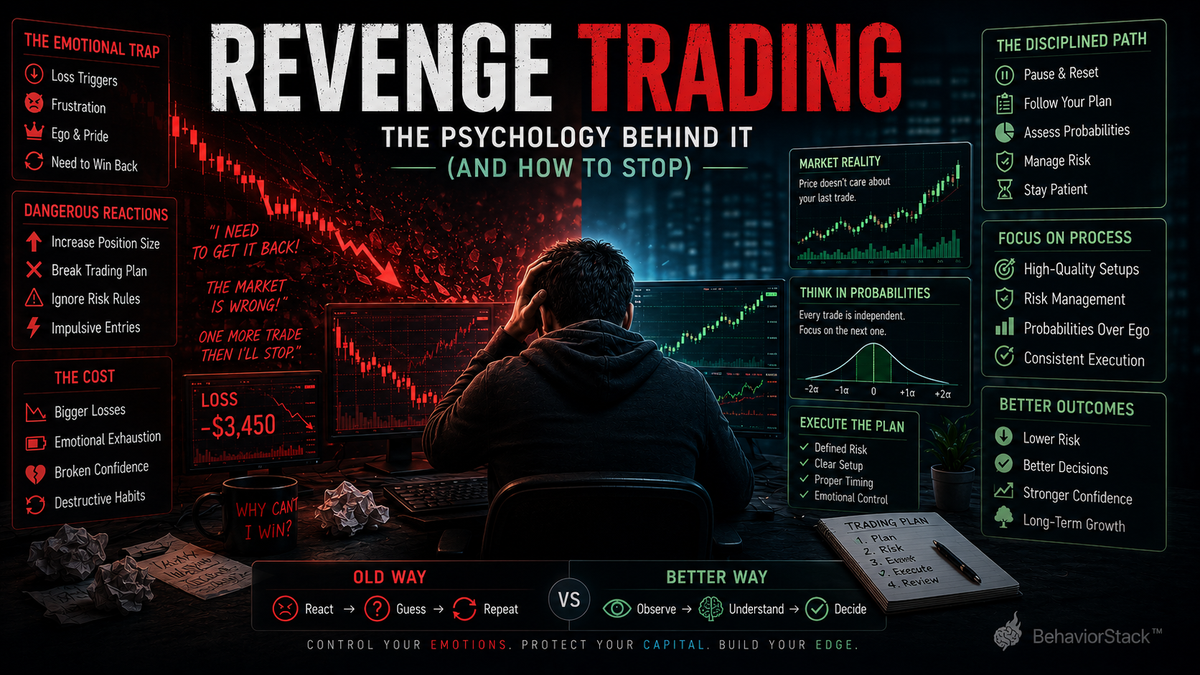
Revenge trading occurs when a trader makes decisions based on frustration, anger, or the desire to recover losses rather than objective analysis.
The goal shifts from:
Making a good trade
to
Recovering emotional pain.
Common signs include:
- Increasing position sizes after a loss
- Taking trades outside a trading plan
- Entering positions impulsively
- Ignoring risk management
- Feeling the need to "win back" money immediately
At that point, the market is no longer the opponent.
Your emotions are.
Why The Brain Falls Into This Trap
Losses create emotional discomfort.
Psychologically, humans dislike losses far more than they enjoy equivalent gains.
This creates a powerful internal pressure:
"I need to fix this."
The problem is that markets do not care about:
- previous trades
- personal losses
- emotional frustration
Yet the brain often treats losses as a challenge that must be corrected immediately.
This causes traders to abandon:
- patience
- probability
- discipline
- structure
in favor of emotional action.
The Warning Signs Most Traders Miss
Revenge trading usually begins long before the next trade is placed.
Watch for signals such as:
Emotional Self-Talk
- "I can't believe that happened."
- "The market is wrong."
- "I need to make that back."
Increased Urgency
The feeling that you must act immediately.
Rule Bending
Ignoring entry criteria that normally matter.
Position Inflation
Risking more capital than originally planned.
These behaviors often appear subtle at first but can escalate rapidly.
The Real Cost Of Revenge Trading
Most traders focus on financial losses.
The greater damage is often behavioral.
Revenge trading can create:
- loss of discipline
- poor timing
- emotional exhaustion
- reduced confidence
- destructive trading habits
Over time, a single emotional decision can evolve into a repeated pattern.
And patterns are what ultimately shape outcomes.
A Better Response After A Losing Trade
Professional traders rarely ask:
"How do I get my money back?"
Instead, they ask:
"What information does this loss provide?"
That shift changes everything.
The focus moves from:
Loss → Emotion → Reaction
to
Loss → Observation → Learning
A losing trade becomes feedback rather than a personal attack.
If the loss followed a fear-driven exit, first review whether panic selling replaced the original decision process before placing another trade.
Not every post-loss overcorrection becomes more aggressive. If a losing streak leads to hesitation, skipped valid setups, or indefinite undersizing, use this process-first guide to rebuilding trading confidence to diagnose the response before changing the plan.
How To Stop Revenge Trading
Create A Pause Rule
Require a waiting period after significant losses.
This creates emotional distance.
Follow Position Sizing Rules
Never increase risk because of frustration.
Review The Process
Evaluate:
- entry quality
- risk management
- market conditions
before placing another trade.
Separate Outcome From Quality
Good trades sometimes lose.
Bad trades sometimes win.
Judge the process, not the outcome.
What High-Probability Traders Understand
Successful traders recognize that:
the market owes them nothing.
Every trade is independent.
Previous losses do not increase the probability of future gains.
This mindset allows traders to focus on:
- probability
- discipline
- timing
- risk management
instead of emotional recovery.
Why Behavioral Awareness Matters
Markets are ultimately environments of uncertainty.
In uncertain environments, behavior becomes critical.
Many trading mistakes are not caused by:
- lack of information
- lack of intelligence
- lack of opportunity
They are caused by emotional reactions.
Why Behavioral Awareness Matters
Markets are ultimately environments of uncertainty.
In uncertain environments, behavior becomes critical.
Many trading mistakes are not caused by:
- lack of information
- lack of intelligence
- lack of opportunity
They are caused by emotional reactions.
This is where systems like BehaviorStack™ begin to matter.
One practical example is MarketSpark™, a behavior-driven market intelligence platform powered by BehaviorStack™. Rather than simply reporting market news or generating AI commentary, MarketSpark™ analyzes behavioral patterns, market context, and probability-driven signals to help traders recognize higher-probability opportunities before emotion takes over. Learn more about MarketSpark™ →
Behavioral awareness helps identify:
- emotional escalation
- decision distortions
- reaction patterns
- timing mistakes
before they influence outcomes.Behavioral awareness helps identify:
- emotional escalation
- decision distortions
- reaction patterns
- timing mistakes
before they influence outcomes.
Revenge trading is rarely about money.
It is about emotion.
The desire to immediately recover a loss often creates the very conditions that produce larger losses.
Understanding revenge trading psychology allows traders to recognize when frustration is influencing decisions.
Because long-term success is not determined by how quickly losses are recovered.
It is determined by how consistently emotions are managed.
CONTINUE EXPLORING
👉 Learn more about:
What Is BehaviorStack™? The Framework Behind Smarter Decisions
👉 Read next:
Time Pressure Bias: Why "Urgent" Decisions Are Often Wrong
👉 Explore:
How to Avoid Emotional Decisions in High-Stakes Situations
👉 Try: