How to Repair After a Fight: A 10-Minute Reset Script (HeartSpark Method)
Use this repair after a fight script to reduce tension, improve communication, and reconnect faster after conflict.

The Conversation That Happens After The Argument Matters Most
Most people assume the damage happens during the fight.
Often, the real damage happens afterward.
Hours pass.
Neither person reaches out.
Both people replay the conversation.
Assumptions grow.
Defensiveness hardens.
The emotional distance becomes larger than the original disagreement.
The truth is that healthy relationships are not built by avoiding conflict.
They're built by repairing it.
And the faster that repair happens, the better the outcome tends to be.
Why Most Repair Attempts Fail
People usually make one of three mistakes.
They Try To Win
Instead of solving the problem, they continue arguing.
They Avoid The Conversation
They hope time will fix everything.
Sometimes it does.
Often it doesn't.
They Apologize Without Understanding
Statements like:
"I'm sorry you feel that way."
may sound like an apology.
But they rarely address the underlying issue.
As a result, neither person feels understood.
What A Good Repair Actually Does
A repair conversation has one purpose:
Reduce emotional threat so productive communication can begin again.
Notice what it is not trying to do.
It is not:
- proving who's right
- relitigating the argument
- forcing agreement
- assigning blame
A repair conversation simply creates enough safety to move forward.
The HeartSpark™ 10-Minute Reset Script
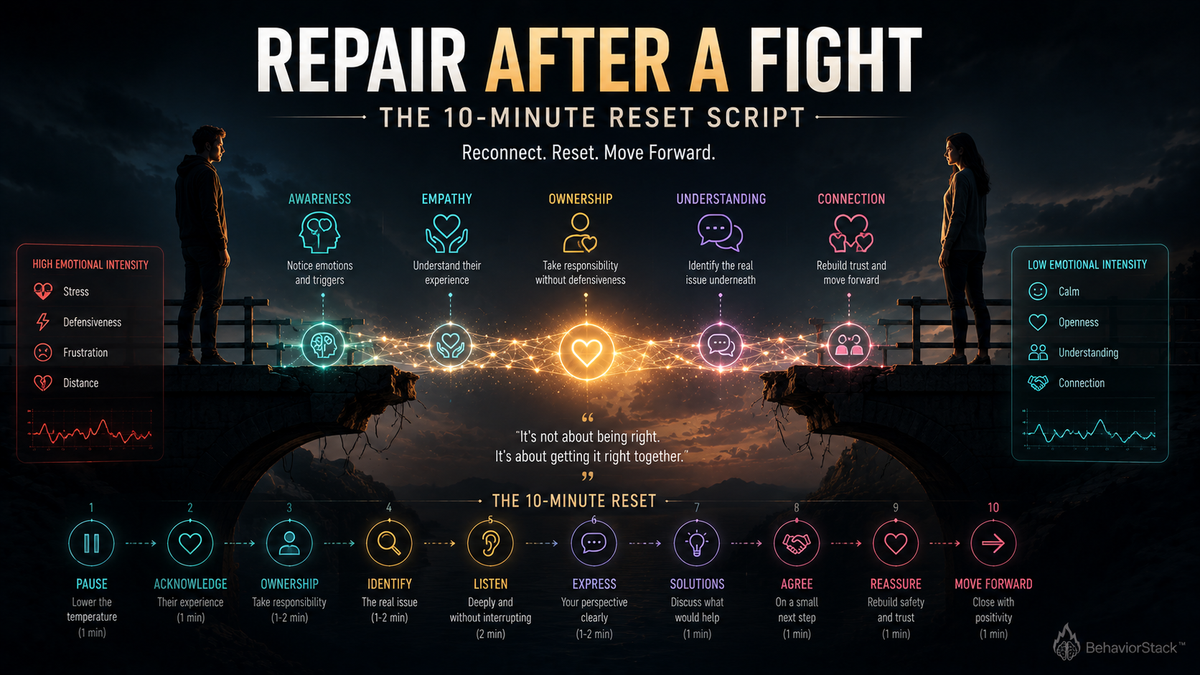
Minute 1: Lower The Temperature
Start with:
"I don't want us fighting. I'd rather understand what happened."
This immediately changes the goal of the conversation.
Minute 2: Acknowledge Their Experience
Even if you disagree with their perspective.
Try:
"I can see why that felt frustrating."
or
"I understand why that upset you."
Acknowledgment is not agreement.
It's recognition.
Minute 3–4: Take Ownership
Own your contribution without overexplaining.
Example:
"I should have communicated better."
or
"I can see how my reaction made things worse."
Avoid:
- excuses
- justifications
- counterattacks
Minute 5–6: Identify The Real Issue
Ask:
"What do you think was really underneath this?"
You may discover the fight wasn't about:
- dishes
- texting
- schedules
- money
It was about:
- feeling ignored
- feeling unimportant
- feeling misunderstood
Minute 7–8: Discuss What Would Help
Ask:
"What would make this feel better moving forward?"
Focus on solutions rather than blame.
Minute 9–10: Create A Small Agreement
Keep it simple.
Examples:
- Better communication
- Faster responses
- More clarity
- More check-ins
Small agreements are easier to follow than large promises.
The Pattern Most Couples Never Notice
Most arguments follow this cycle:
Trigger
↓
Emotion
↓
Reaction
↓
Defensiveness
↓
Escalation
↓
Distance
The repair process interrupts that pattern.
A better sequence looks like:
Trigger
↓
Awareness
↓
Understanding
↓
Repair
↓
Connection
Old Way vs Better Way
Old Way
Fight → Defend → Withdraw
Examples:
- proving your point
- waiting for the other person to apologize
- avoiding difficult conversations
Result:
Lingering tension and unresolved issues.
Better Way
Pause → Understand → Repair
Examples:
- acknowledge emotions
- identify needs
- create next steps
Result:
Faster recovery and stronger communication.
Why Timing Matters More Than The Perfect Words
Many people search for the perfect message.
The perfect apology.
The perfect explanation.
In reality, timing often matters more.
A good message sent at the wrong moment can fail.
A simple message sent at the right moment can succeed.
This is where systems like BehaviorStack™ begin to matter.
Behavioral awareness helps identify:
- emotional readiness
- communication patterns
- escalation triggers
- timing opportunities
before conversations spiral further.
Why This Gives You An Edge
Most people treat conflict as something to avoid.
Strong communicators treat conflict as something to navigate.
The goal isn't perfection.
The goal is recovery.
Relationships become stronger when people learn how to repair quickly and consistently.
Conclusion
Arguments are inevitable.
Disconnection doesn't have to be.
The people who build the strongest relationships aren't the ones who never fight.
They're the ones who know how to reconnect afterward.
A simple repair conversation can prevent days, weeks, or even months of unnecessary distance.
And often, all it takes is ten intentional minutes.
CONTINUE EXPLORING
👉 Learn more about:
What Is BehaviorStack™? The Framework Behind Smarter Decisions
👉 Read next:
Emotion vs Need: A Simple Decoder For Better Conversations
👉 Explore:
How to De-Escalate a Text Argument in 5 Messages or Less
👉 Try:
HeartSpark™ — Better Conversations. Higher-Probability Responses.