
Position Sizing 101: The Fastest Way to Reduce Risk Without Reducing Opportunity
Learn how position sizing reduces risk, improves consistency, and helps traders make better decisions without sacrificing opportunity.

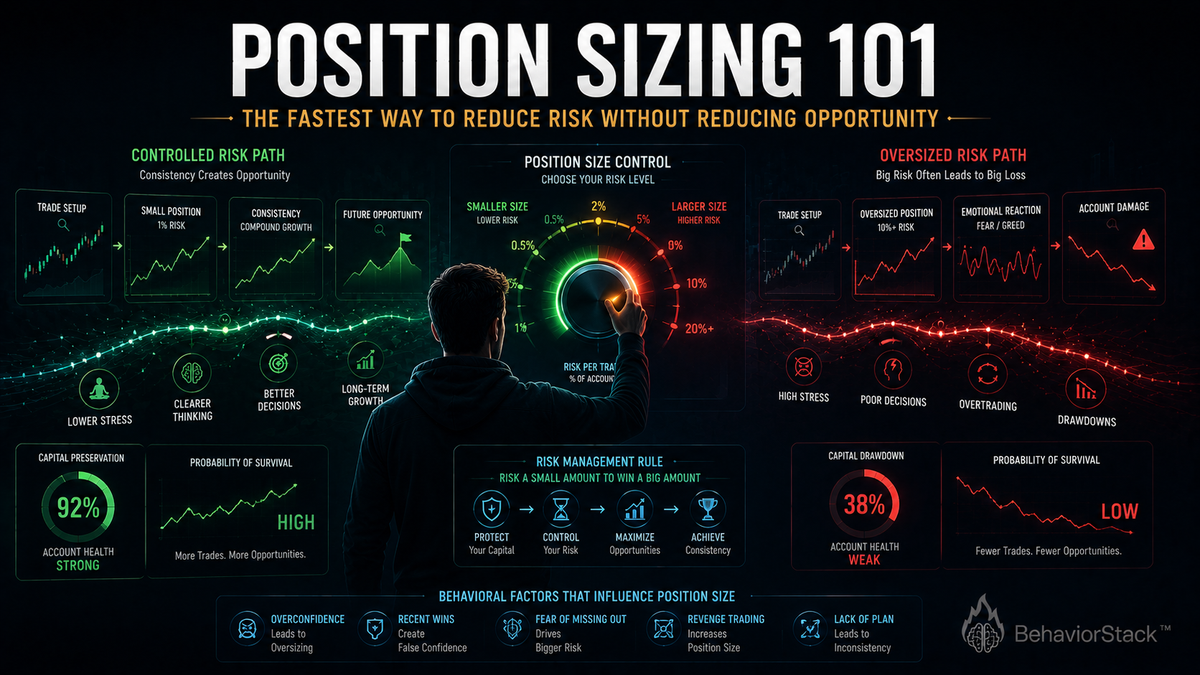
Most Trading Losses Start Before The Trade
Ask a new trader what matters most.
You'll often hear:
- finding the perfect entry
- predicting market direction
- identifying the next big move
Ask an experienced trader.
The answer is often different.
Many professionals know that a trade can be correct and still lose money.
Why?
Because risk isn't determined by the setup alone.
It's determined by position size.
And position sizing is one of the most overlooked decision variables in trading.
What Is Position Sizing?
Position sizing is the process of determining how much capital to allocate to a trade.
It answers a simple question:
"How much should I risk if I'm wrong?"
Position sizing is not:
- market prediction
- technical analysis
- trade selection
It's risk management.
And over time, risk management often matters more than individual trades.
Why Traders Get This Wrong
Most traders think in terms of opportunity.
They ask:
- "How much can I make?"
- "What if this explodes higher?"
- "What if I miss the move?"
Far fewer ask:
- "What happens if I'm wrong?"
This creates a dangerous imbalance.
The brain naturally focuses on reward.
It often underestimates risk.
This is especially true during:
- strong momentum
- market excitement
- social media hype
- emotional trading periods
The Real Goal Isn't Maximizing Profit
The goal is surviving long enough to compound gains.
Many traders lose because they accidentally treat every trade as a high-conviction opportunity.
When conviction is highest, sizing discipline matters most. Signal Confidence vs Position Size: How to Avoid Overexposure shows how to keep confidence from expanding your risk budget.
Professional traders understand something different.
No setup is guaranteed.
Every trade contains uncertainty.
Position sizing acknowledges uncertainty instead of ignoring it.
The Hidden Math Behind Consistency
Imagine two traders.
Trader A
Risks 20% of their account on each trade.
A few losses create massive damage.
Recovery becomes difficult.
Trader B
Risks 1% per trade.
Losses occur.
But capital remains intact.
Future opportunities remain available.
The difference isn't intelligence.
It's exposure.
Position sizing controls exposure.
Small positions still need an account-level review: different coins may depend on the same market conditions. Our guide to why several small crypto trades can still be one big bet shows how to map possible shared exposure without treating the exercise as a trading signal.
The Psychological Advantage
Position sizing isn't just a financial tool.
It's a behavioral tool.
When position sizes become too large:
- emotions increase
- fear increases
- greed increases
- impulsive decisions increase
When risk is controlled:
- patience improves
- objectivity improves
- consistency improves
Smaller emotional swings often produce better decisions.
The Pattern Most Traders Never Notice
Many trading mistakes follow this sequence:
Excitement
↓
Oversized Position
↓
Emotional Stress
↓
Poor Decisions
↓
Larger Losses
↓
More Emotional Trading
↓
Repeat
The problem isn't the market.
The problem is often the decision structure.
Old Way vs Better Way
Old Way
Opportunity → Excitement → Oversize Position
Examples:
- betting too heavily on one idea
- chasing momentum
- increasing size after emotional wins
Result:
Higher stress and inconsistent performance.
Better Way
Risk → Position Size → Opportunity
Examples:
- define risk first
- calculate exposure
- execute consistently
Result:
Greater longevity and improved decision quality.
A Simple Position Sizing Checklist
Before entering any trade, ask:
1. How Much Am I Willing To Lose?
Determine acceptable risk before calculating reward.
2. Does This Position Fit My Plan?
Avoid increasing size based on emotion.
3. Would I Still Take This Trade At Half The Size?
This question often reveals hidden greed.
4. Am I Trading Opportunity Or Probability?
Opportunity feels exciting.
Probability creates consistency.
Where BehaviorStack™ Fits
Position sizing appears mathematical.
But the decision behind it is behavioral.
BehaviorStack™ focuses on the hidden drivers behind decision-making:
- emotional reactions
- confidence levels
- timing
- incentives
- probability
Because many trading losses are behavioral long before they become financial.
This is the same behavioral framework that powers MarketSpark™. Instead of simply summarizing charts or market news, MarketSpark™ uses BehaviorStack™ to evaluate behavioral context, probability-driven signals, and decision factors that can influence trading outcomes. The goal isn't to predict the future—it's to help traders make more disciplined, informed decisions before entering a position. Learn more about MarketSpark™ →
Why This Gives You An Edge
Most traders focus on:
- entries
- indicators
- predictions
Consistent traders focus on:
- risk
- exposure
- probability
- decision quality
The market will always create opportunities.
Position sizing helps ensure you're still around to take them.
Conclusion
Position sizing isn't the most exciting part of trading.
That's exactly why it matters.
While most traders spend their time searching for better setups, experienced decision makers focus on protecting capital.
Because success isn't determined by your best trade.
It's determined by how well you manage risk across hundreds of trades.
And position sizing is one of the fastest ways to improve that process.
CONTINUE EXPLORING
👉 Learn more about:
What Is BehaviorStack™? The Framework Behind Smarter Decisions
👉 Read next:
FOMO Trading: A Pre-Trade Checklist To Stop Chasing
👉 Explore:
Revenge Trading: The Psychology Behind It (And How To Stop)
👉 Try: