
Stop-Loss Rules That Actually Work: A Decision System for MarketSpark™
Learn a stop-loss rules system that reduces emotional trading, improves consistency, and helps you make higher-probability decisions with MarketSpark™.

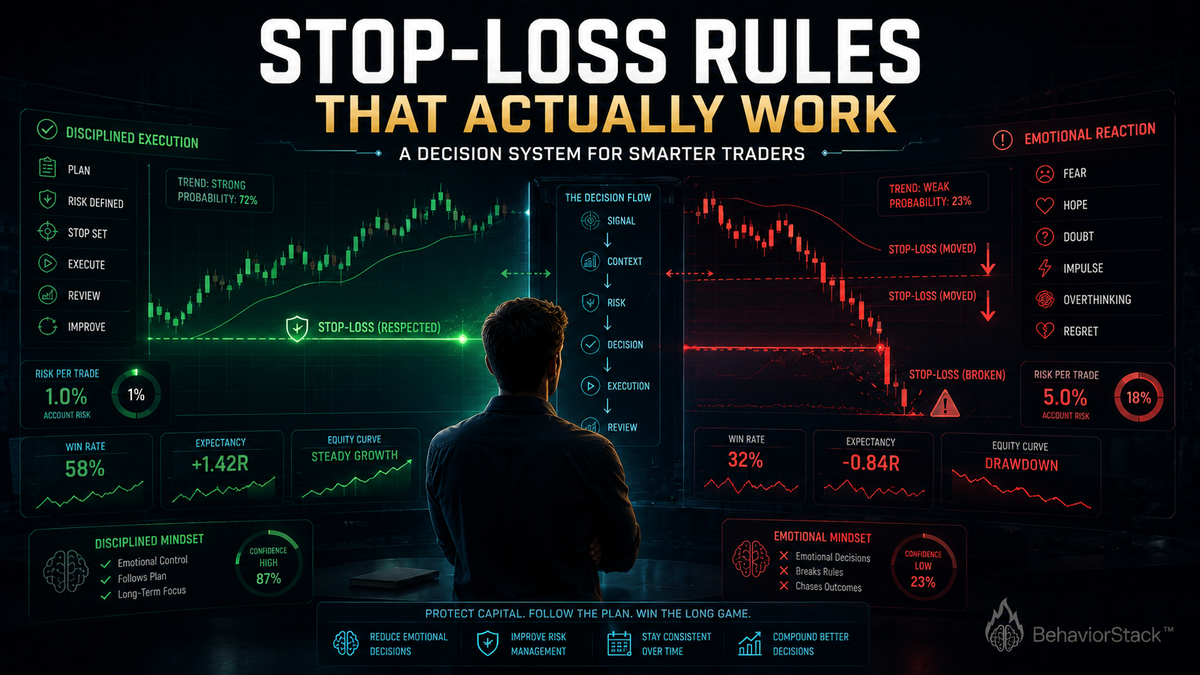
The Trade Was Perfect... Until You Moved Your Stop
You've done your analysis.
You planned your entry.
You calculated your risk.
Everything looked good.
Then the market moved against you.
Instead of accepting a small loss, you told yourself:
"I'll give it a little more room."
Five minutes later...
You moved your stop again.
Suddenly a planned loss became a much larger one.
Sound familiar?
The problem usually isn't your trading strategy.
It's your decision-making after the trade begins.
Why Smart Traders Still Break Their Own Rules
Most traders believe they struggle because they need:
- better indicators
- more market knowledge
- improved chart analysis
Those things certainly matter.
But many trading mistakes happen after the trade is entered.
Why?
Because once real money is involved, psychology begins competing with logic.
Emotions like:
- hope
- fear
- greed
- regret
can quietly override a perfectly good trading plan.
This isn't a knowledge problem.
It's a behavioral problem.
The Pattern That Turns Small Losses Into Big Ones
Many losing trades follow the same sequence.
Plan
↓
Enter Trade
↓
Market Moves Against You
↓
Emotional Discomfort
↓
Move Stop-Loss
↓
Larger Loss
↓
Regret
↓
Repeat
Notice what happened.
The market didn't create the biggest mistake.
The decision did.
Most traders don't lose because they placed a stop-loss.
They lose because they abandoned it.
A Better Way To Think About Stop-Losses
Instead of asking:
"Where should I move my stop?"
Ask:
"What decision did I make before emotion entered the picture?"
This simple shift changes everything.
Professional traders don't treat stop-losses as predictions.
They treat them as commitments.
A healthier decision framework looks like this:
Signal → Risk → Commitment → Execution
Not:
Hope → Emotion → Adjustment → Regret
The stop-loss isn't there to protect a trade.
It's there to protect your decision process.
That distinction becomes especially important during market stress, when fear capitulation in trading can make immediate emotional relief feel like disciplined risk management.
When the temptation extends beyond the stop itself, use this mid-trade checklist for detecting trading plan drift to compare the proposed change with the thesis, evidence standard, and original risk boundary.
That same precommitment should cover profitable exits: define when to take partial profits instead of holding for a full target and how the stop on the remaining position will be managed before the trade begins.
Build A Decision System, Not Just A Trading Rule
Rather than relying on willpower, create a repeatable framework.
Rule 1: Define Risk Before Entering
Know exactly how much you're willing to lose before clicking "Buy" or "Sell."
Rule 2: Separate Analysis From Emotion
Once the trade is active, avoid making decisions based on temporary price movement alone.
Rule 3: Review After The Trade
Don't judge yourself by whether the trade won or lost.
Judge yourself by whether you followed your process.
Consistency compounds.
In paper-trading software, checking a target or stop also depends on what the available price record can establish. This case study of historical paper-trade evaluation explains why uncertain history should not become a guessed outcome or an automatic account settlement. Intended clickable anchor: “case study of historical paper-trade evaluation.” Target URL: verification required — this article’s Blog URL is blank. Link this anchor only to the verified final article URL after publication clearance.
Rule 4: Accept That Losses Are Part Of The System
Every successful trader takes losses.
The goal isn't to eliminate them.
The goal is to prevent them from becoming unnecessarily large.
How MarketSpark™ Fits Into The Process
MarketSpark™ is designed to improve the quality of the decisions surrounding them.
It isn't designed to eliminate losing trades.
Powered by BehaviorStack™, it acts as a behavioral decision-support system.
Understand Signals
Recognize when fear or hope is beginning to influence your thinking.
Identify Patterns
Detect recurring behaviors like moving stop-losses or increasing risk after losses.
Improve Timing
Separate moments that require action from moments that simply feel urgent.
Make More Confident Decisions
Follow a structured decision framework instead of reacting emotionally.
Because consistent decision-making usually produces more consistent trading.
A Side-By-Side Example
Typical Approach
The trade moves against you.
You widen the stop.
You hope the market turns around.
Result:
- larger losses
- emotional frustration
- inconsistent execution
Behavior-Aware Approach
The trade reaches the predetermined stop.
You exit.
You document the trade.
You prepare for the next opportunity.
Result:
- controlled risk
- preserved capital
- confidence in your trading system
Why This Creates A Long-Term Edge
Most traders optimize for:
- avoiding losses
- being right
- maximizing every opportunity
Experienced traders optimize for:
- discipline
- repeatability
- probability
- consistency
Those priorities create better long-term outcomes.
One disciplined decision might not seem significant.
Hundreds of disciplined decisions can transform an entire trading career.
Conclusion
The best stop-loss isn't necessarily the tightest one.
It's the one you're willing to respect.
Trading success isn't built on perfect predictions.
It's built on repeatable decision systems that protect you from your own emotions.
MarketSpark™ helps shift the focus away from reacting to every price movement and toward making higher-quality decisions over time.
Because the strongest trading edge isn't predicting every market move.
It's consistently making better decisions than you made yesterday.
CONTINUE EXPLORING
👉 Learn more about:
What Is BehaviorStack™? The Framework Behind Smarter Decisions
👉 Read next:
Position Sizing 101: The Fastest Way to Reduce Risk Without Reducing Opportunity
👉 Explore:
FOMO Trading: A Pre-Trade Checklist to Stop Chasing
👉 Try:
MarketSpark™ — Better Timing. Smarter Decisions.
FEATURED IMAGE PROMPT
Behavior-driven trading visualization:
A professional trader stands before a futuristic trading dashboard. One side shows a glowing stop-loss line being respected with calm probability indicators. The opposite side shows an emotional trader dragging the stop-loss lower as warning signals, fear indicators, and increasing risk gauges illuminate.
Overlay:
Behavioral signals, probability pathways, stop-loss zones, emotional gauges, risk meters, disciplined execution indicators, and decision-flow visualization.
Style:
Modern, clean, futuristic, psychological, cinematic, dark UI aesthetic, high-tech trading dashboard, 16:9.
Headline:
"Stop-Loss Rules That Actually Work"
Subheadline:
"A Decision System For Smarter Traders"
Watermark:
Small monochrome BehaviorStack™ flame-brain logo with accompanying "BehaviorStack™" text. Light gray, 15–25% opacity, no glow, publication-style branding positioned bottom-right. Must not compete with the headline or main visual.