The Sunk Cost Fallacy: Why Smart People Double Down on Bad Decisions
The sunk cost fallacy explains why smart people continue investing in bad decisions and how behavioral awareness helps break the cycle.

Sometimes Walking Away Is The Smartest Decision
Have you ever found yourself saying:
- "I've already invested too much time."
- "I've already spent too much money."
- "I've come too far to quit now."
Maybe it's a relationship.
Maybe it's a business project.
Maybe it's an investment.
Deep down, you know something isn't working.
But instead of leaving, you double down.
Ironically, smart people often struggle with this the most.
The reason?
The brain hates the idea of loss.
This psychological trap is called the Sunk Cost Fallacy.
And it quietly influences thousands of decisions throughout our lives.
What Is The Sunk Cost Fallacy?
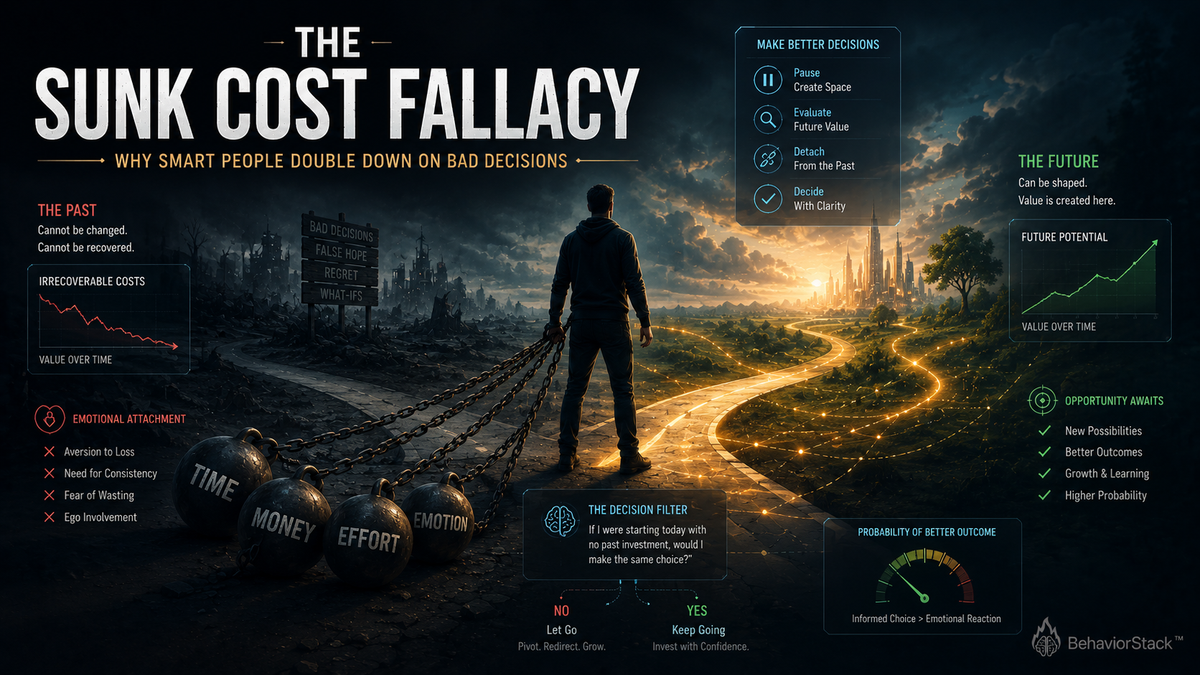
The Sunk Cost Fallacy is the tendency to continue investing in something because of resources you've already committed.
Those resources may include:
- time
- money
- effort
- energy
- emotions
The problem is simple:
Past investments cannot be recovered.
Yet people often allow yesterday's costs to influence today's decisions.
Rational decisions should focus on future value.
The sunk cost fallacy focuses on the past.
Why Smart People Are Especially Vulnerable
Intelligence doesn't protect you from this bias.
In fact, it can sometimes make it worse.
Highly capable people are often excellent at creating justifications.
They tell themselves:
- "I just need more time."
- "One more adjustment will fix everything."
- "I can't waste everything I've already invested."
Eventually, effort becomes attachment.
And attachment clouds judgment.
Where This Shows Up In Everyday Life
Relationships
Staying because you've already spent years together.
Careers
Remaining in jobs that drain your energy because you've invested years building expertise.
Investing
Holding losing positions simply because you've already lost money.
Business
Continuing projects because so many resources have already been spent.
Personal Goals
Persisting with strategies that clearly aren't working.
The common denominator is the same.
Past investments begin controlling future decisions.
The Hidden Cycle Most People Never See
The pattern usually looks like this:
Investment
↓
Resistance To Change
↓
Emotional Attachment
↓
More Investment
↓
Bigger Losses
↓
Repeat
Over time, every additional investment makes walking away feel harder.
But that's often exactly when walking away becomes most valuable.
The Question That Changes Everything
When facing a difficult decision, ask yourself:
"If I were starting today with no previous investment, would I make this same choice?"
If the answer is no, the sunk cost fallacy may be influencing your thinking.
This question forces your brain to evaluate the future instead of defending the past.
Old Way vs Better Way
Old Way
Past Investment → Emotional Attachment → Double Down
Examples:
- Protect the past
- Defend previous choices
- Continue investing automatically
Better Way
Observe → Evaluate → Decide
Examples:
- Separate emotions from evidence
- Evaluate future value
- Make objective decisions
Real-World Examples
Instead Of:
Staying in a failing project because you've already invested six months.
You Can:
Evaluate whether the next six months will actually create value.
Instead Of:
Remaining in an unhealthy relationship because you've invested years.
You Can:
Ask if you'd choose the relationship again today.
Results:
- Better opportunities
- More objective thinking
- Improved confidence
- Faster course correction
How To Break The Cycle
Three simple principles help.
Awareness
Recognize when the past is influencing the present.
Patterns
Identify repeated situations where you struggle to let go.
Intent
Ask whether your actions are creating future value.
This is where systems like BehaviorStack™ begin to matter.
Behavioral awareness helps expose invisible biases before they become expensive decisions.
Why This Gives You An Edge
Most people protect their past.
High performers protect their future.
The goal isn't to avoid mistakes.
The goal is to stop compounding them.
Every decision creates a new opportunity to reset.
The people who learn when to pivot often outperform those who simply persist.
The sunk cost fallacy isn't about money.
It's about attachment.
Humans naturally want their previous investments to mean something.
But good decisions aren't built around what you've already spent.
They're built around what's most likely to create value moving forward.
Sometimes the smartest decision isn't doubling down.
It's letting go.
CONTINUE EXPLORING
👉 Learn more about:
What Is BehaviorStack™? The Framework Behind Smarter Decisions
👉 Read next:
What Is Cognitive Dissonance? (And How It Shapes Belief + Behavior)
👉 Explore:
The Peak-End Rule: Why People Recall Things Wrong
👉 Try:
HeartSpark™ — Better Conversations. Higher-Probability Responses