What's Cognitive Dissonance? (And How It Shapes Belief + Behavior)
Cognitive dissonance explains why people justify contradictory behaviors instead of changing them. Learn how awareness improves decision-making.

The Brain Hates Contradictions
Have you ever done something you knew wasn't good for you… and then immediately justified it?
Examples:
- Buying something expensive you didn't need.
- Staying in a relationship that clearly isn't working.
- Ignoring evidence that challenges your beliefs.
- Continuing a bad habit despite wanting to stop.
If so, you're human.
The discomfort you feel in those moments is called cognitive dissonance.
It's one of the most powerful psychological forces shaping human behavior.
And most people don't even realize it's happening.
What Is Cognitive Dissonance?
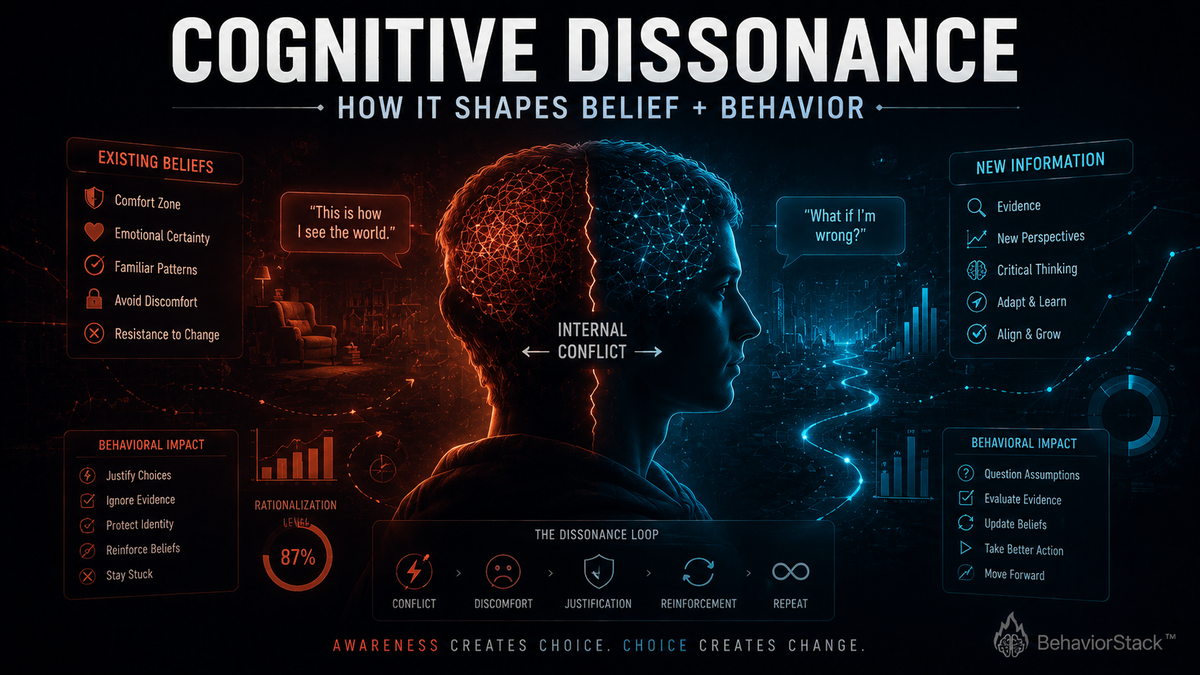
Cognitive dissonance is the mental discomfort we experience when two things conflict with each other.
Usually, the conflict exists between:
- beliefs
- actions
- values
- decisions
- identity
Your brain dislikes inconsistency.
When contradictions appear, it immediately tries to reduce the tension.
Unfortunately, humans often solve this discomfort in unhealthy ways.
The Three Options Your Brain Chooses From
When dissonance appears, people generally do one of three things.
Change The Behavior
You adjust your actions to align with your values.
Example:
"I need to stop checking my phone every five minutes."
This is usually the healthiest option.
Change The Belief
You alter your thinking to justify your behavior.
Example:
"Everyone is addicted to their phones anyway."
This is extremely common.
Ignore The Contradiction
You simply avoid thinking about it.
Example:
"I'll deal with it later."
This often creates repeating patterns.
Why This Shapes So Many Decisions
Cognitive dissonance quietly influences almost every area of life.
Relationships
People stay in unhealthy situations because leaving would conflict with previous investments.
Money
People continue losing strategies because admitting mistakes feels painful.
Work
People defend bad ideas simply because they helped create them.
Health
People delay behavior changes despite knowing what is best.
Technology
People cling to familiar systems because change creates uncertainty.
The issue is rarely information.
The issue is discomfort.
The Pattern Most People Never Notice
Many decisions follow this loop:
Decision
↓
Conflict
↓
Discomfort
↓
Justification
↓
Repeated Behavior
Over time, this loop reinforces itself.
The more we defend a decision, the more attached we become to it.
Even when evidence suggests we should change course.
Real-World Examples
Instead Of:
Thinking:
"I've already invested so much time into this relationship."
and staying for the wrong reasons.
You Can:
Ask:
"If I met this person today, would I make the same decision?"
Instead Of:
Defending a bad investment because of money already spent.
You Can:
Evaluate today's facts instead of yesterday's decisions.
Results
- Better self-awareness
- More objective thinking
- Improved communication
- Higher-quality decisions
The Question That Breaks The Bias
Whenever you feel defensive, ask yourself:
"Am I protecting a truth or protecting my ego?"
That single question can reveal cognitive dissonance almost immediately.
Defensiveness is often a signal.
And signals are valuable.
Because they tell us where awareness is needed.
Old Way vs Better Way
Old Way
Conflict → Defend → Repeat
Examples:
- Justify the behavior
- Ignore the evidence
- Double down emotionally
Better Way
Observe → Challenge → Decide
Examples:
- Recognize discomfort
- Examine assumptions
- Update your thinking
Where BehaviorStack™ Fits
This is where systems like BehaviorStack™ begin to matter.
Behavioral awareness helps identify:
- emotional reactions
- decision patterns
- timing distortions
- repeated justifications
before they become long-term habits.
Because awareness often interrupts unhealthy cycles.
Why This Gives You An Edge
Most people protect consistency.
High-level decision makers protect accuracy.
The goal is not to be right all the time.
The goal is to update your thinking when new information appears.
Over time, that flexibility becomes a competitive advantage.
Cognitive dissonance isn't a flaw.
It's a normal part of being human.
The problem occurs when we allow discomfort to drive decisions.
The people who recognize internal contradictions early become better communicators, better leaders, and better decision makers.
Because growth rarely happens when we defend old beliefs.
It happens when we are willing to challenge them.
CONTINUE EXPLORING
👉 Learn more about:
What Is BehaviorStack™? The Framework Behind Smarter Decisions
👉 Read next:
The Peak-End Rule: Why People Recall Things Wrong
👉 Explore:
Why Emotions Drive Most Decisions (Not Logic)
👉 Try:
HeartSpark™ — Better Conversations. Higher-Probability Responses.