
Anxious + Avoidant Texting Patterns: What’s Happening and What to Say Instead
Learn how anxious and avoidant texting patterns emerge, why generic AI struggles to solve them, and how behavioral decision intelligence improves communication.

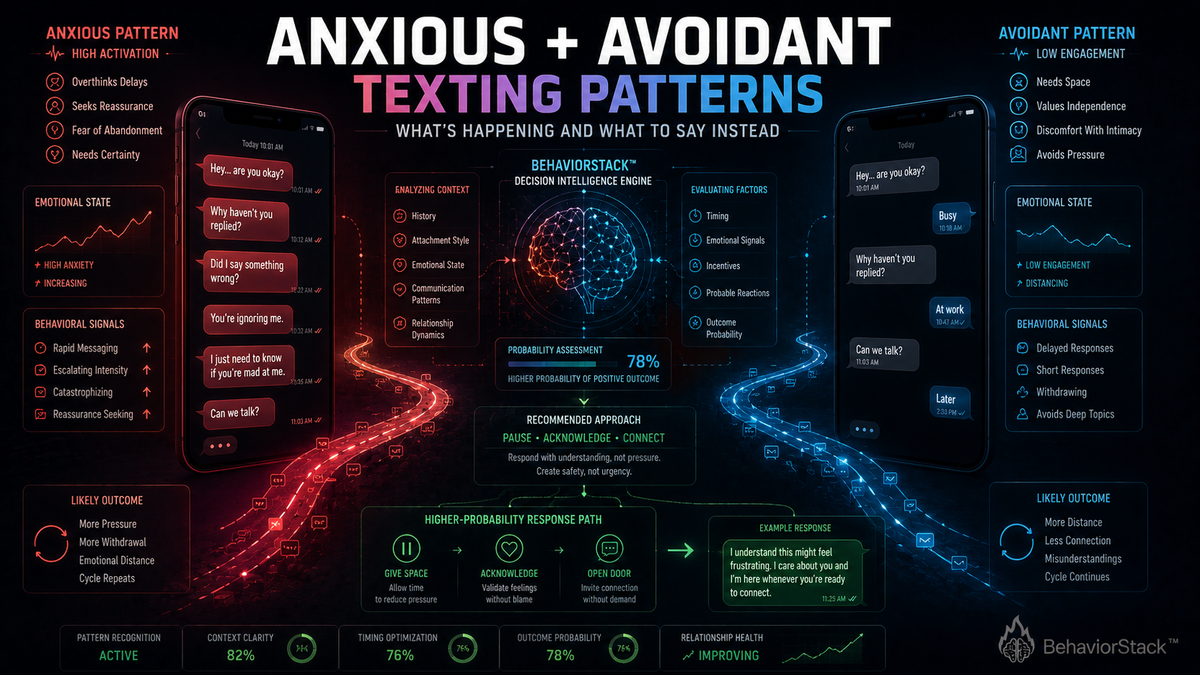
Two People. Two Completely Different Stories.
One person sends a text.
Hours pass.
No reply.
The anxious partner begins thinking:
- "Did I do something wrong?"
- "Are they losing interest?"
- "Why are they ignoring me?"
Meanwhile, the avoidant partner is thinking:
- "I just need some space."
- "I'll respond later."
- "Why does every conversation feel so intense?"
Neither person intends to create conflict.
Yet both leave the interaction feeling misunderstood.
The problem isn't simply communication.
It's that each person is interpreting the same situation through a completely different behavioral lens.
Why This Is More Than A Relationship Problem
Traditional AI can suggest a polite response.
It might rewrite a message.
It might even improve grammar or tone.
But it usually cannot answer the more important question:
Why is this conversation unfolding the way it is?
Decision Intelligence shifts the focus away from generating responses and toward understanding the behavioral system behind the conversation.
Instead of asking:
"What should I text?"
It asks:
- What emotional signals are present?
- What communication pattern is emerging?
- What behavior is likely to happen next?
- Which response has the highest probability of improving the outcome?
That difference changes everything.
The Pattern Hidden Inside The Conversation
Many anxious-avoidant interactions follow the same predictable cycle.
Connection
↓
Delay
↓
Anxiety Increases
↓
More Messages
↓
Pressure Increases
↓
Withdrawal
↓
More Anxiety
↓
Repeat
Neither person is trying to hurt the other.
Each person's behavior unintentionally reinforces the other's.
This creates a self-sustaining feedback loop.
The longer the cycle continues, the more difficult it becomes to interrupt.
If the cycle usually starts with you staring at an unanswered message, when to send the second message without sounding needy adds a motive check before the next text goes out.
Why Generic AI Falls Short
Most AI systems excel at producing text.
They are far less effective at understanding behavioral context.
For example, a chatbot might recommend:
"Tell them how you feel."
That advice isn't necessarily wrong.
It may simply be poorly timed.
Without considering factors like:
- emotional intensity
- communication history
- reciprocity
- attachment dynamics
- behavioral incentives
even a perfectly written message can produce a poor outcome.
Behavior matters just as much as wording.
The BehaviorStack™ Difference
BehaviorStack™ approaches conversations differently.
Instead of treating each message as an isolated event, it analyzes the broader decision environment.
Behavioral Signals
What emotions and motivations are driving both people?
Context
Is this a new conflict, or part of an established pattern?
Timing
Is this the right moment to communicate, or would waiting improve the outcome?
Probability
Which response is most likely to reduce tension rather than escalate it?
The goal isn't simply better writing.
The goal is better decisions.
What HeartSpark™ Adds
HeartSpark™ applies these principles to real conversations.
Rather than generating generic replies, it helps users understand:
- why someone may be responding the way they are
- which communication patterns are repeating
- when to engage and when to pause
- how different responses are likely to influence the conversation
Powered by BehaviorStack™, HeartSpark™ acts as a behavioral decision-support system—not just a messaging assistant.
A Side-by-Side Example
Traditional Approach
Partner:
"Why didn't you answer me?"
Response:
"I've just been busy."
Technically accurate.
Emotionally ineffective.
The anxious partner still feels ignored.
The avoidant partner still feels pressured.
Nothing changes.
Behavior-Aware Approach
Partner:
"Why didn't you answer me?"
Response:
"I understand why that felt frustrating. I needed some time to myself, but I also want you to know I wasn't trying to ignore you."
Same situation.
Different outcome.
The response acknowledges both the emotion and the underlying need.
Why This Represents The Future Of AI
The next generation of intelligent systems won't compete by generating more words.
They'll compete by improving better decisions.
Decision Intelligence combines:
- behavioral psychology
- contextual reasoning
- timing analysis
- probability modeling
to help people navigate complex situations with greater confidence.
Communication is just one application.
The same framework can improve leadership, negotiation, investing, marketing, and strategic decision-making.
The Long-Term Advantage
People who understand behavioral patterns gain an advantage that extends far beyond texting.
They become better at:
- recognizing emotional triggers
- anticipating reactions
- adapting communication
- making consistent decisions under uncertainty
That's why behavioral awareness compounds over time.
Better conversations build stronger relationships.
Better decisions create better outcomes.
Conclusion
Anxious and avoidant texting patterns are often treated as personality problems.
They're better understood as behavioral systems.
Once you recognize the signals, timing, and incentives driving both people, conversations become easier to navigate.
That's the promise of Decision Intelligence.
Not simply producing better responses.
Helping people make better communication decisions.
CONTINUE EXPLORING
👉 Learn more about:
What Is BehaviorStack™? The Framework Behind Smarter Decisions
👉 Read next:
What Is Behavioral AI? And Why It Changes How Decisions Are Made
👉 Explore:
Emotion vs Need: A Simple Decoder for Better Conversations
👉 Discover:
HeartSpark™ — Better Conversations. Higher-Probability Responses.