The Pre-Mortem Method: Find Failure Before It Happens
Pre mortem analysis helps identify hidden risks before decisions are made, improving outcomes and reducing avoidable mistakes.

Why Most Failures Feel Obvious In Hindsight
Have you ever looked back on a bad decision and thought:
"The warning signs were there all along."
Maybe it was:
- a business project that ran over budget
- an investment that carried more risk than expected
- a relationship problem that slowly escalated
- a strategy that seemed promising but never worked
After the fact, the mistakes often appear obvious.
Before the fact, they rarely do.
That's where the Pre-Mortem Method becomes valuable.
It helps you discover potential failures before they happen.
What Is A Pre-Mortem Analysis?
Most people are familiar with a post-mortem.
A post-mortem asks:
"Why did this fail?"
A pre-mortem asks a different question:
"Imagine this failed six months from now. What caused it?"
Instead of waiting for reality to reveal weaknesses, you intentionally search for them beforehand.
A pre-mortem analysis is a structured exercise designed to uncover:
- hidden risks
- flawed assumptions
- overlooked obstacles
- behavioral blind spots
before they become costly mistakes.
Why This Method Works So Well
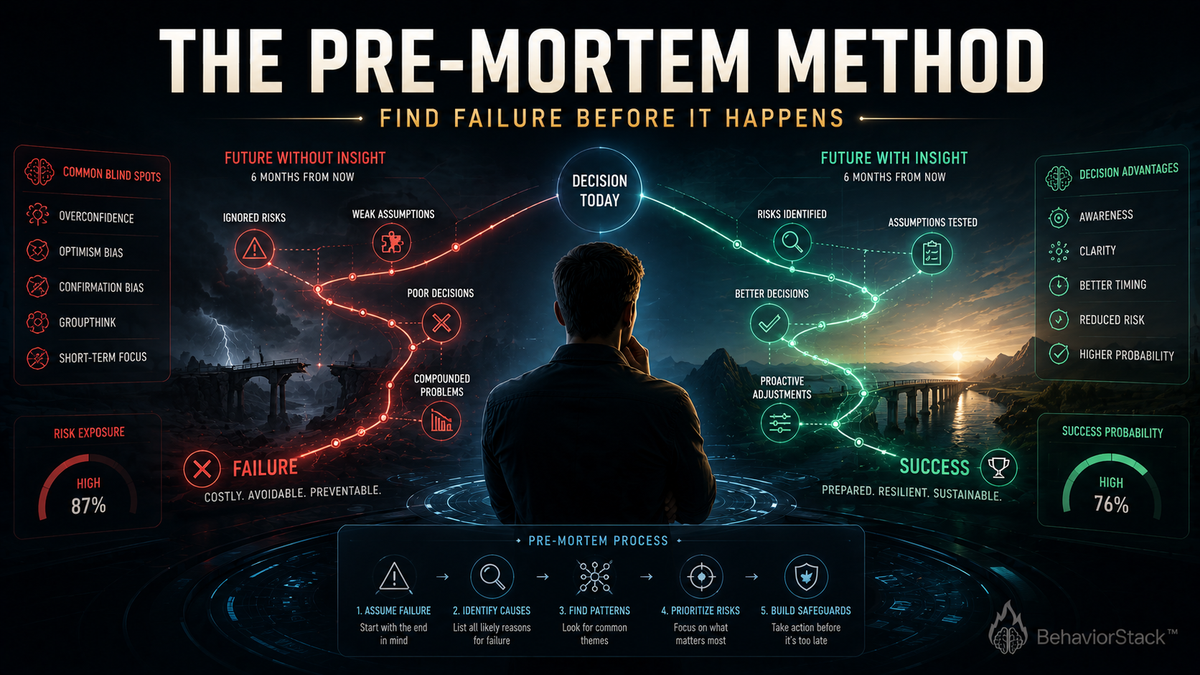
Human beings naturally focus on reasons a plan will succeed.
This tendency creates several biases:
- overconfidence
- optimism bias
- confirmation bias
The pre-mortem reverses that tendency.
Instead of proving success is likely, you actively search for reasons success might be difficult.
This creates a more balanced view of reality.
Not pessimism.
Preparation.
The Hidden Trap Most Decision Makers Fall Into
Many decisions follow this pattern:
Idea
↓
Excitement
↓
Commitment
↓
Execution
↓
Unexpected Problems
↓
Damage Control
↓
Regret
The problem isn't usually a lack of intelligence.
It's a lack of structured risk exploration.
People often spend more time imagining success than examining failure.
The Five-Minute Pre-Mortem Framework
Before making an important decision, pause and complete this exercise.
Step 1: Assume Failure
Imagine the project, investment, decision, or plan has failed.
Treat failure as a certainty.
Step 2: Write Down The Reasons
Ask:
"What most likely caused this outcome?"
List everything.
No filtering.
No judgment.
Step 3: Look For Patterns
Often several risks point toward the same issue:
- poor timing
- weak communication
- unrealistic expectations
- missing resources
Patterns matter more than individual concerns.
Step 4: Prioritize The Biggest Threats
Not every risk deserves equal attention.
Focus on the few issues most likely to create major consequences.
Step 5: Build Safeguards
Ask:
"What can I do today to reduce this risk?"
Now the exercise becomes actionable.
Old Way vs Better Way
Old Way
Plan → Commit → Hope
Examples:
- assuming everything will work
- ignoring uncertainty
- relying on optimism
Result:
More surprises and reactive decisions.
Better Way
Imagine Failure → Identify Risk → Improve Plan
Examples:
- challenge assumptions
- evaluate vulnerabilities
- create safeguards
Result:
Higher-quality decisions and fewer preventable mistakes.
Real-World Examples
Instead Of:
Launching a project assuming customers will immediately adopt it.
You Can:
Ask:
"What are the three most likely reasons adoption fails?"
Instead Of:
Making an investment based entirely on upside potential.
You Can:
Ask:
"What would need to happen for this investment to lose money?"
Results
- Better planning
- More realistic expectations
- Improved risk management
- Stronger decision quality
Why This Is Really About Decision Science
The Pre-Mortem Method isn't about predicting the future.
It's about improving how you think about the future.
The goal isn't perfect accuracy.
The goal is better preparation.
This is where systems like BehaviorStack™ begin to matter.
Behavioral awareness helps expose:
- hidden assumptions
- emotional blind spots
- overconfidence
- probability distortions
before they influence major decisions.
Why This Gives You An Edge
Most people ask:
"Why will this work?"
Better decision makers also ask:
"Why might this fail?"
That simple shift creates a significant advantage.
Because avoiding preventable mistakes often produces better outcomes than chasing perfect opportunities.
The best decision makers aren't necessarily smarter.
They're usually better prepared.
Conclusion
The Pre-Mortem Method is one of the simplest tools in decision science.
Yet it's also one of the most powerful.
By imagining failure before it occurs, you gain the opportunity to improve plans, reduce risk, and make more informed decisions.
The future will always contain uncertainty.
But uncertainty becomes far easier to navigate when you actively look for weaknesses before they become problems.
CONTINUE EXPLORING
👉 Learn more about:
What Is BehaviorStack™? The Framework Behind Smarter Decisions
👉 Read next:
Base Rate Neglect: The Most Common Reason Forecasts Fail
👉 Explore:
Time Pressure Bias: Why "Urgent" Decisions Are Often Wrong
👉 Try:
HeartSpark™ — Better Conversations. Higher-Probability Responses.