Why People Follow the Crowd (Herd Behavior Explained)
Herd behavior influences decisions through social pressure and emotional momentum; understanding it can improve awareness and decision-making.

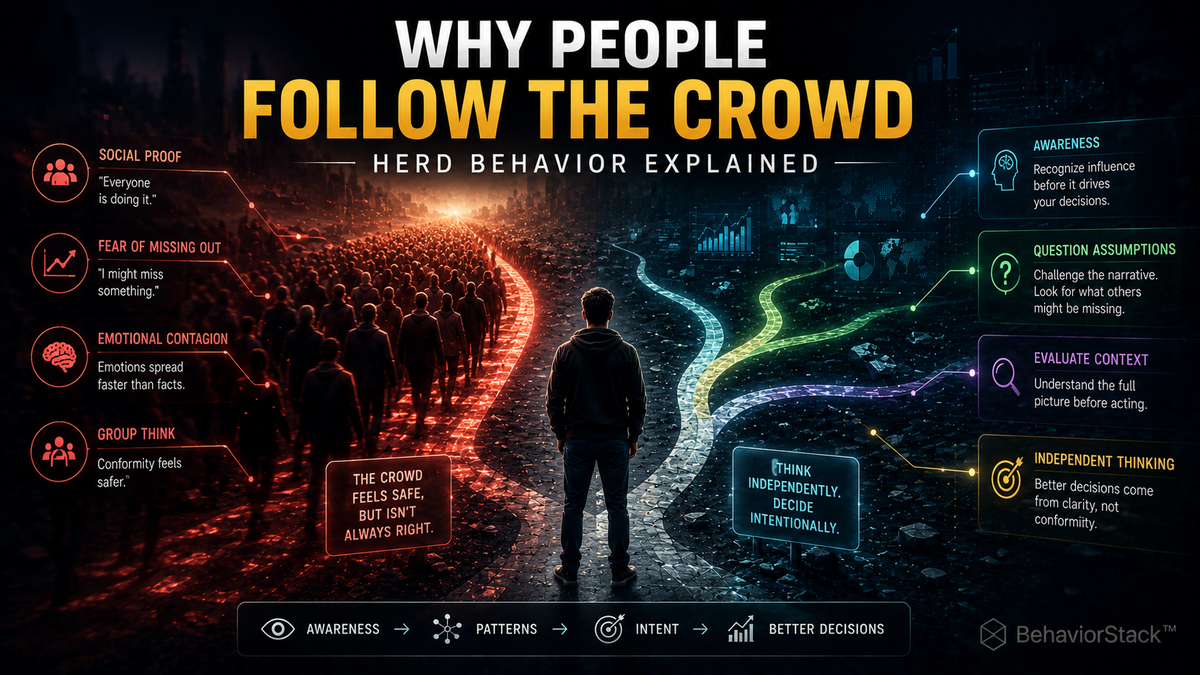
Everyone Thinks They’re Independent Thinkers
Most people believe their decisions are rational and self-directed.
But human behavior is heavily influenced by:
- social pressure
- emotional momentum
- group behavior
- perceived consensus
- fear of missing out
This happens everywhere:
- investing
- social media
- relationships
- politics
- trends
- leadership
People often follow the crowd without realizing it.
That behavioral pattern is known as:
herd behavior.
And it influences far more decisions than most people realize.
Herd Behavior Is A Survival Mechanism
Humans evolved in groups.
Historically, following the group often increased survival.
If everyone reacted to danger:
- you reacted too
- even without fully understanding the threat
That instinct still exists today.
The brain naturally assumes:
“If many people are doing something, it must be correct.”
But in modern environments, that instinct can create:
- emotional reactions
- poor timing
- irrational decisions
- mass overreactions
Especially in situations involving:
- uncertainty
- fear
- urgency
- social validation
How Herd Behavior Shows Up In Everyday Life
Herd behavior rarely feels obvious in the moment.
It often appears as:
- chasing trends
- reacting emotionally to group opinions
- copying decisions without independent analysis
- following momentum instead of evaluating context
Examples include:
- buying because others are buying
- agreeing because disagreement feels uncomfortable
- reacting emotionally to viral narratives
- entering situations late because “everyone else already is”
The crowd creates emotional momentum.
And emotional momentum changes decisions.
Why Herd Behavior Becomes Dangerous
Crowds can amplify:
- fear
- excitement
- panic
- confidence
- urgency
Once emotional momentum builds, people often stop evaluating:
- probability
- timing
- incentives
- long-term outcomes
This leads to:
- impulsive decisions
- emotional reactions
- reduced critical thinking
- avoidable mistakes
The danger is not simply following others.
The danger is:
stopping independent evaluation.
Most People Don’t Notice It Happening
That’s what makes herd behavior powerful.
It rarely feels irrational while it’s happening.
People usually justify group behavior with statements like:
- “Everyone is saying this.”
- “This must be right.”
- “I don’t want to miss out.”
- “So many people can’t be wrong.”
But large groups can absolutely be wrong.
And emotional momentum often spreads faster than objective reasoning.
A Smarter Way To Evaluate Decisions
Instead of:
Emotion → Crowd Reaction → Impulse
A better process becomes:
Observation → Context → Independent Analysis
That means:
- slowing down emotional reactions
- evaluating incentives
- recognizing behavioral momentum
- separating popularity from probability
This is where systems like BehaviorStack™ become increasingly valuable.
Behavioral awareness helps identify:
- emotional acceleration
- crowd psychology
- reaction patterns
- decision distortions
before they influence outcomes.
Real-World Example
Crowd-Driven Decision
A person sees:
- rapid excitement
- growing social validation
- emotional urgency
They react quickly without evaluating context.
Result:
- poor timing
- emotional decision-making
- increased risk
Behavior-Aware Decision
A person recognizes:
- crowd acceleration
- emotional momentum
- social pressure dynamics
They pause to evaluate:
- timing
- incentives
- probability
- long-term outcomes
Result:
- clearer thinking
- reduced emotional influence
- better decision quality
Why Understanding Herd Behavior Creates An Advantage
Most people react automatically to social momentum.
Few people stop to analyze:
- why momentum exists
- who benefits
- whether the behavior is rational
- how emotions are influencing decisions
That awareness creates a major long-term advantage.
Because better decisions often come from:
thinking independently while others react emotionally.
Conclusion
Herd behavior is one of the strongest psychological forces shaping human decisions.
It affects:
- markets
- communication
- leadership
- relationships
- public opinion
- strategic thinking
Understanding herd behavior does not mean ignoring others.
It means recognizing when:
emotion,
momentum,
and social pressure
begin replacing objective reasoning.
As decision environments become increasingly fast-moving and emotionally amplified, behavioral awareness becomes more valuable than ever.
Better decisions begin with understanding behavior.
CONTINUE EXPLORING
👉 Learn more about:
What Is BehaviorStack™? The Framework Behind Smarter Decisions
👉 Read next:
What Is FOMO in Decision Making?
👉 Explore:
Why Emotions Drive Most Decisions (Not Logic)
👉 Try:
HeartSpark™ or MarketSpark™