What Is Confirmation Bias? And Why It’s Dangerous
Confirmation bias causes people to favor information that supports existing beliefs—understanding it can improve awareness and decision-making.

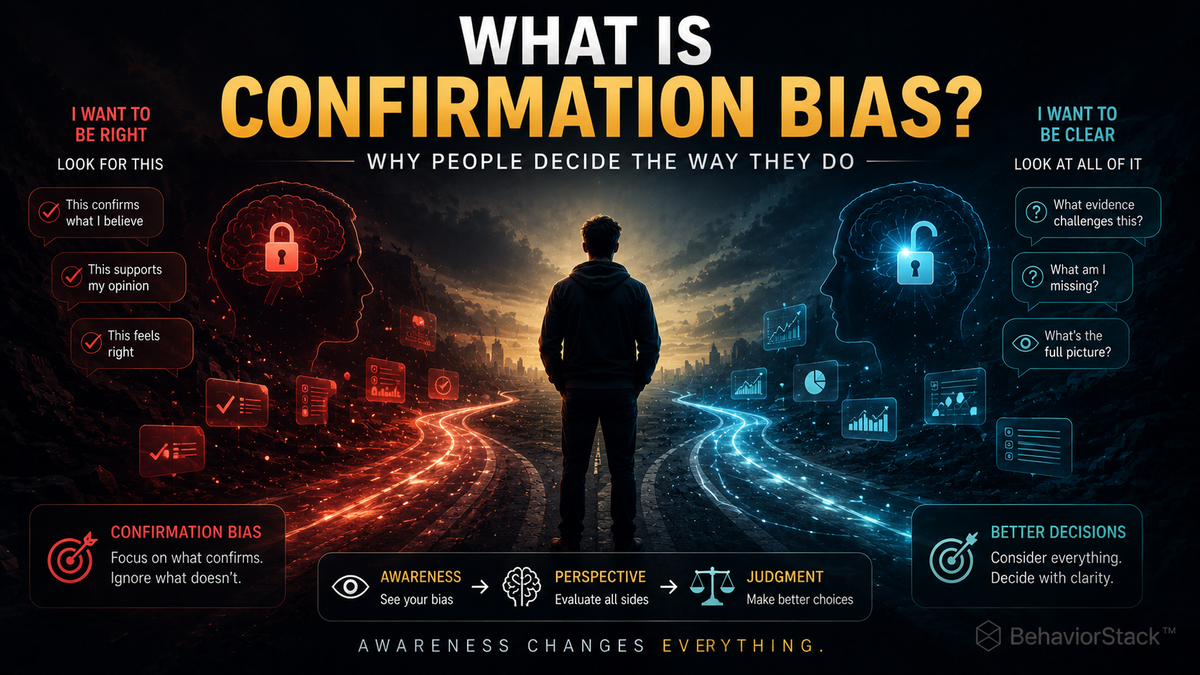
Most people believe they are thinking objectively.
But often…
they are only looking for information that confirms what they already believe.
This happens constantly in:
- conversations
- politics
- investing
- relationships
- leadership
- decision-making
Instead of evaluating information neutrally, people naturally gravitate toward:
- familiar opinions
- emotionally comfortable conclusions
- evidence that reinforces existing beliefs
This psychological pattern is known as:
confirmation bias.
And it can quietly distort decisions without people realizing it.
What Is Confirmation Bias?
Confirmation bias is the tendency to search for, interpret, and remember information in ways that support existing beliefs or assumptions.
In simple terms:
people tend to notice information they agree with…
while ignoring or minimizing information they dislike.
Supporting points:
- The brain naturally prefers certainty and familiarity.
- Emotional attachment to beliefs often overrides objective analysis.
This makes confirmation bias one of the most powerful cognitive biases influencing human behavior.
Why Confirmation Bias Matters
Confirmation bias affects:
- communication
- leadership
- investing
- relationships
- strategic planning
- everyday decision-making
This often leads to:
- poor judgment
- emotional decision-making
- blind spots
People stop evaluating situations objectively because they become emotionally attached to a particular outcome or belief.
Over time, this creates:
- distorted thinking
- overconfidence
- poor decision quality
Common Mistakes People Make
Most people:
- only consume information that supports their opinions
- dismiss opposing viewpoints too quickly
- confuse emotional certainty with factual accuracy
This creates a dangerous cycle.
The more emotionally invested someone becomes in a belief…
the harder it becomes to objectively evaluate new information.
Confirmation bias often causes people to:
- double down on poor decisions
- ignore warning signs
- resist necessary changes
How to Improve Confirmation Bias
Instead of reacting, focus on:
- Awareness
- Patterns
- Intent
Ask yourself:
- Am I evaluating this objectively?
or - Am I only looking for information that confirms what I already believe?
Better decision-making requires:
- curiosity
- self-awareness
- willingness to challenge assumptions
This is where systems like BehaviorStack™ begin to matter.
Behavioral awareness helps identify emotional blind spots and encourages more structured thinking.
Old Way vs Better Way
Old Way
React → Defend → Repeat
Better Way
Observe → Evaluate → Decide
Real-World Examples
Instead of:
- ignoring information that challenges your beliefs
- making emotionally defensive decisions
You can:
- evaluate multiple perspectives more objectively
- focus on probability instead of emotional certainty
Results:
- clearer thinking
- improved decision-making
- reduced emotional bias
Why This Gives You an Edge
Most people react emotionally.
Better outcomes come from:
Awareness + structure.
People who recognize confirmation bias gain the ability to:
- adapt faster
- evaluate situations more objectively
- make higher-quality decisions over time
Confirmation bias is dangerous because it often feels invisible.
People rarely notice when emotions are shaping what they choose to believe.
But awareness changes that.
The ability to question assumptions, evaluate context, and recognize behavioral patterns creates a major long-term advantage in:
- communication
- leadership
- strategy
- decision-making
Better decisions begin with understanding behavior.
CONTINUE EXPLORING
👉 Learn more about:
What Is BehaviorStack™? The Framework Behind Smarter Decisions
👉 Read next:
Why Overthinking Leads to Worse Decisions
👉 Explore:
What Is Loss Aversion? (And How It Affects Your Decisions)
👉 Try:
HeartSpark™
or
MarketSpark™